
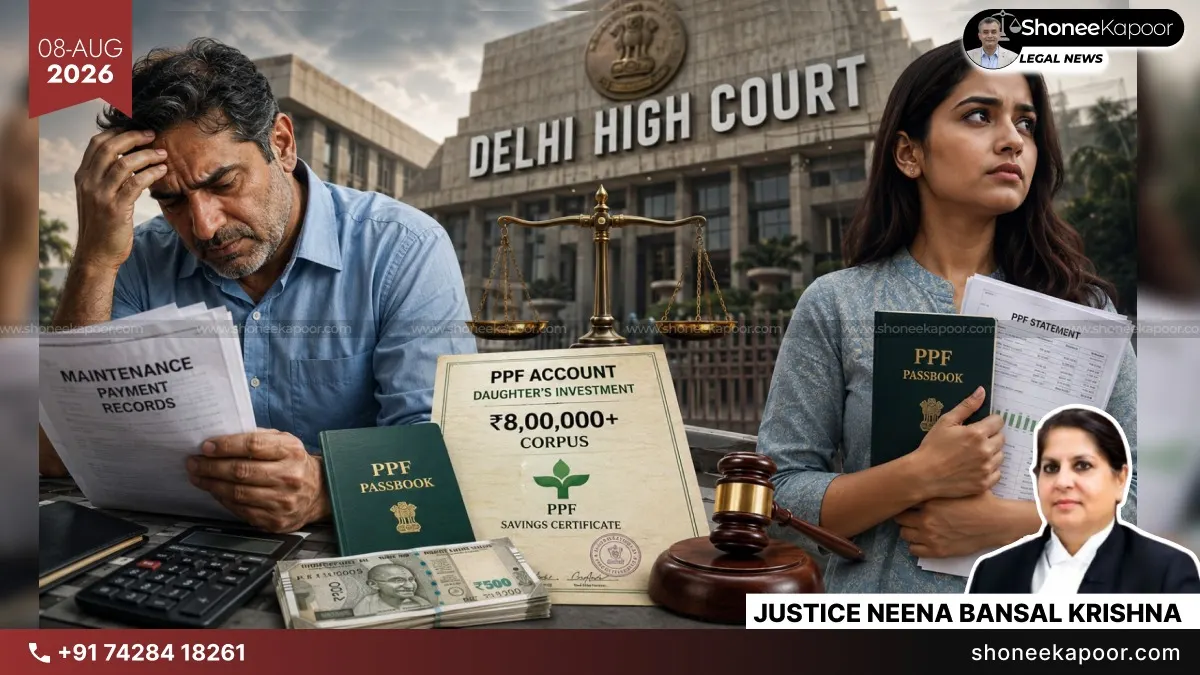
Father Paid Maintenance, Still Had To Return Daughter’s PPF: Delhi HC Calls Maintenance An “Independent Legal Responsibility”

Curated by NEWS DESK
Editorial DeskCan money a father invested for his daughter be adjusted against the maintenance he was ordered to pay her and his estranged wife? The Delhi High Court has drawn a clear line between a child’s investment and a parent’s maintenance obligation.
NEW DELHI: The Delhi High Court has held that a father cannot use money invested in his daughter’s Public Provident Fund (PPF) account to discharge his legal responsibility of paying maintenance to his daughter or estranged wife.
Justice Neena Bansal Krishna was hearing an appeal filed by Sudhir Kawatra against a District Court order directing him to return the PPF corpus to his daughter, Shamli Kawatra, along with 8% interest.
Sudhir had opened the PPF account for his daughter in 1999. According to Shamli, when the account matured in 2017, she approached the bank and discovered that her father had already withdrawn the entire corpus of more than ₹8 lakh in 2016 and closed the account. She claimed that the money was meant for her education and well-being.
The daughter thereafter filed a recovery suit. The District Court directed the father to return the entire amount with interest, following which he approached the Delhi High Court.
The father argued that he had already been paying maintenance for his daughter pursuant to a Family Court order and that around ₹6 lakh from the PPF corpus had effectively gone towards her well-being. He further submitted that he was also paying additional maintenance to his estranged wife pursuant to an order of the Uttarakhand High Court, which was also being used for the daughter.
The High Court, however, rejected the attempt to adjust these maintenance payments against the daughter’s PPF corpus. It held that money invested in the child’s name belongs to the child, while maintenance is a separate legal obligation of the parent.
The Court observed:
AUGUST“Being the investment in the name of the child, she was entitled to receive the amount. The father may have taken the money to which the Plaintiff was entitled, but it was only in the fiduciary capacity, as a Guardian, but cannot be utilised by the father to offset his responsibility of maintenance towards the child,”
The Court distinguished between long-term savings made for a child and the everyday expenditure involved in raising and maintaining the child. It observed:
“It would be significant to note that a parent during the childhood may make investment and create a corpus by putting savings annually, in some account, but essentially it is an investment to be utilised in future. However, the maintenance is the day-to-day expenditure in the upbringing of the child, which is the independent legal responsibility of a parent.
Merely because of a marital discord, the investments cannot be used by the father towards the maintenance, as it would simply amount to utilisation of the child’s money for the discharge of the legal responsibility of the father,”
The High Court further held that although the father had originally opened and operated the PPF account, the investment was for his daughter’s benefit. Once she became a major, she was entitled to receive it.
The Court said:
“The amount could not have been transferred by the defendant [father] to his own account and he was liable to give this money to the plaintiff [daughter].”
Accordingly, the Delhi High Court upheld the District Court order directing the father to return the entire PPF corpus to his daughter along with 8% interest.
EXPLANATORY TABLE OF LAWS AND LEGAL PRINCIPLES
| Law / Legal Principle | What It Means | Application In This Case |
| Maintenance of Child | A parent has an independent legal obligation to provide for the child’s day-to-day upbringing and needs. | The Court held that maintenance paid by the father could not be adjusted against the daughter’s PPF investment. |
| Maintenance of Wife | Maintenance payable to a spouse under a court order is a separate enforceable obligation. | The father relied on additional maintenance being paid to his estranged wife, but the Court did not permit the daughter’s PPF corpus to be used to discharge that liability. |
| Public Provident Fund (PPF) | A long-term savings and investment instrument. Where an investment is made for a minor child, the guardian operates it for the child’s benefit. | The father had opened the PPF account for his daughter in 1999. The Court treated the accumulated corpus as money to which the daughter was entitled. |
| Fiduciary Capacity of Guardian | A guardian dealing with a child’s property or investment holds and manages it for the child’s benefit rather than treating it as his own money. | The Court held that the father could deal with the amount only in his capacity as guardian and could not use it to offset his own maintenance liability. |
| 8% Interest on Recovery | Interest may be awarded with a money-recovery decree depending upon the order and circumstances. | The District Court ordered repayment of the PPF corpus with 8% interest, and the High Court upheld the decision. |
CASE DETAILS
| Case Particular | Details |
| Case Title | Sudhir Kawatra v. Shamli Kawatra |
| Court | High Court of Delhi at New Delhi |
| Case Number | RFA 285/2023 |
| Bench | Hon’ble Ms Justice Neena Bansal Krishna |
| Decision Date | August 3, 2026 |
| Nature of Case | Regular First Appeal arising from recovery proceedings |
COUNSELS APPEARED
| Party | Counsel |
| Appellant / Father – Sudhir Kawatra | Advocates Rajnish Kumar Jha and Dolli Rani |
| Respondent / Daughter – Shamli Kawatra | Advocate Shubham Gupta |
KEY TAKEAWAYS
- A father cannot adjust his daughter’s PPF money against maintenance.
- Money invested in the daughter’s name belongs to her.
- Maintenance paid to the daughter or estranged wife does not change this obligation.
- A father managing a minor child’s investment only holds it for the child’s benefit.
- Maintenance and repayment of a child’s separate assets may remain independently enforceable.
This Could Change Your Case-Get FREE Legal Advice-Click Here!
Disclaimer: The views and opinions expressed in this article are those of the Indian courts and do not necessarily reflect the official policy or position of “ShoneeKapoor.com” or its affiliates. This article is intended for informational and educational purposes only. The content provided is not legal advice, and viewers should not act upon this information without seeking professional counsel. Viewer discretion is advised.
Related Articles

What Legal Remedies Are Available For Men In India? 498A, Divorce, Maintenance, Custody & False Cases
Know the legal remedies available for men in India against false 498A, maintenance, domestic violence, custody battle...

Myth: Only Women Face Domestic Violence – Legal Reality, Court Judgments, and the Untold Truth in Indian Law
Indian law protects women under the Domestic Violence Act, but court judgments reveal a more complex truth about abus...
Share Your Thoughts
Comments are moderated before publication.