
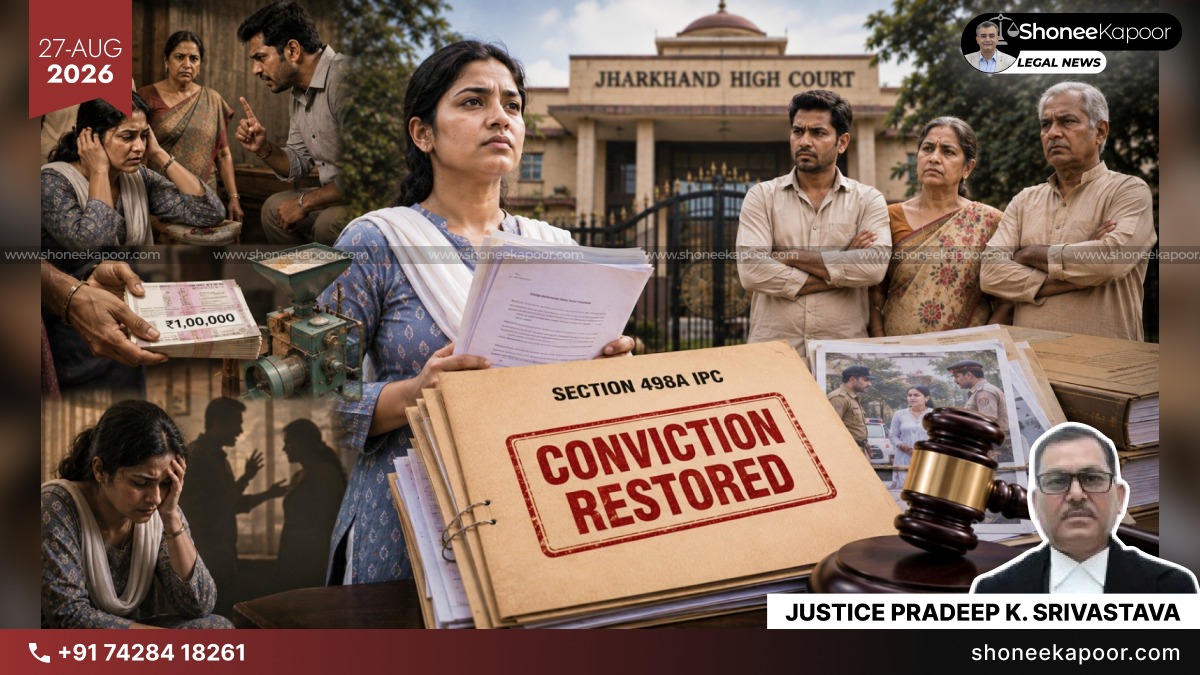
Can A Husband’s Business Money Demand Become A 498A Case Even If It Is Not Dowry? Jharkhand High Court Answers

Curated by NEWS DESK
Editorial DeskDoes Section 498A IPC apply when money demanded from a wife’s family is allegedly for the husband’s business and not specifically called dowry? The Jharkhand High Court has explained why the legal test is wider than a traditional dowry demand.
RANCHI: The Jharkhand High Court has held that a specific demand for “dowry” is not necessary to attract Section 498A of the Indian Penal Code. An unlawful demand for money, property or valuable security, when accompanied by the cruelty or harassment contemplated under the provision, can also fall within Section 498A.
Justice Pradeep Kumar Srivastava made the ruling while allowing a criminal revision filed by a wife and restoring the Trial Court’s conviction of her husband and his parents under Sections 498A and 323 IPC.
The parties were married on 25 June 2008. According to the complaint, the family gave ₹1 lakh in cash, ten tolas of gold ornaments, and household articles at the time of marriage. The wife alleged that after she became pregnant, her husband demanded another ₹1 lakh from her father to purchase a haulier machine for his rice business.
She claimed that her father was a retired UCIL employee and could not fulfil the demand because of his other liabilities. She alleged that she was thereafter subjected to physical and mental cruelty by her husband and in-laws.
The complaint further alleged that her basic necessities and medical facilities were stopped during pregnancy and that she was assaulted and pressured to bring the money. The defence denied the allegations and claimed false implication. No oral or documentary evidence was produced by the defence.
The Trial Court convicted the accused under Sections 498A and 323 IPC on 20 April 2016. However, the District and Additional Sessions Judge-I, Ghatshila, allowed their appeal on 2 February 2017 and acquitted them.
While examining the evidence, the High Court found that the husband and his family had demanded ₹1 lakh for his business. According to the Court, when the demand was not fulfilled, the complainant was subjected to cruelty and was driven out of her matrimonial home. The Court also noted that her version was supported by other witnesses, including an independent villager who corroborated the allegations of cruelty
The High Court then reproduced the reasoning adopted by the Appellate Court:
“After going through the evidence on record, I find that the allegation of demand of Rs.1,00,000/- was in connection with development of the business and not related to any dowry, so apparently Section 498A I.P.C. was not made out in this case. No independent witness took an oath in this case. It appears that it is a case of lack of adjustment and the reliance may be placed upon the case of Smt. Moutushi Sarkar versus Rajeev Sarkar & Ors. Reported in 2016 (1) Crimes 338.”
The Court explained that the language of Section 498A is not restricted only to demands technically described as dowry. It covers an unlawful demand for property or valuable security when the other ingredients of cruelty under the section are established.
The Court observed:
“It is quite clear from the explanation that the cruelty includes any willful conduct or harassment with a view to coercing her (the woman) to meet any unlawful demand of property or valuable security, resulting in likelihood of causing danger to life, limb or health. There is no whisper in the said definition about demand of any dowry, but rather demand of any property or valuable security, which should be unlawful.”
Applying this principle, the High Court noted that the defence did not plead that the ₹1 lakh was merely sought as a loan to be repaid later. The Court treated it as an alleged unlawful demand followed by coercive physical and mental harassment to compel the complainant to obtain money from her father.
The High Court therefore held that the case came within Section 498A IPC. It called the Appellate Court’s reasoning that the money was required only for business development and was therefore outside Section 498A a “very absurd” view.
The Court further held that Section 498A “does not speak about demand of dowry but rather any unlawful demand of money or property”.
Accordingly, it termed the findings of the Appellate Court acquitting the husband and his family members “absolutely unwarranted, illegal and perverse”.
The High Court ultimately set aside the acquittal and restored the Trial Court’s conviction and sentence. The husband and his parents were directed to surrender before the Trial Court within two months to receive the sentence awarded against them, failing which coercive steps were directed to be taken.
EXPLANATORY TABLE OF LAWS AND SECTIONS
| Law / Section | What It Provides | Relevance In This Case |
|---|---|---|
| Section 498A IPC | Punishes a husband or his relative for subjecting a woman to legally defined cruelty. It includes harassment connected with an unlawful demand for property or valuable security. | Main provision involved. The High Court held that the demand need not specifically qualify as “dowry” if it is an unlawful demand covered by Section 498A. |
| Explanation (a) to Section 498A IPC | Covers wilful conduct likely to drive a woman to suicide or cause grave injury or danger to her life, limb or mental or physical health. | Forms part of the statutory definition of “cruelty” reproduced and considered by the High Court. |
| Explanation (b) to Section 498A IPC | Covers harassment intended to coerce a woman or her relative to meet an unlawful demand for property or valuable security, or harassment because such demand was not met. | Central to the judgment. The Court relied on this language to hold that an unlawful demand for ₹1 lakh could fall within Section 498A even if it was allegedly sought for business rather than described as dowry. |
| Section 323 IPC | Punishment for voluntarily causing hurt. | The Trial Court convicted the accused under Sections 498A and 323 IPC. The High Court later restored the conviction and sentence after setting aside the appellate acquittal. |
| Criminal Revision Jurisdiction | Allows the revisional court to examine the legality, correctness and propriety of findings or orders of subordinate criminal courts, subject to the limits governing revisional interference. | The complainant-wife approached the High Court against the appellate judgment that had acquitted the accused. The High Court allowed the revision and restored the Trial Court judgment. |
CASE DETAILS
| Particulars | Details |
|---|---|
| Case Title | Smt. Anita Bhakat v. State of Jharkhand and Ors. |
| Court | High Court of Jharkhand at Ranchi |
| Case Number | Cr. Revision No. 337 of 2017 |
| Neutral Citation | 2026:JHHC:25218 |
| Bench | Hon’ble Mr Justice Pradeep Kumar Srivastava |
| Petitioner | Smt. Anita Bhakat |
| Opposite Parties | State of Jharkhand, Gouranga Bhakat, Sunil Kumar Bhakat and Smt. Balika Bhakat |
| For the Petitioner | Mr Pramod Kumar, Advocate; Mr Kishlay Kumar, Advocate |
| For the State | Ms Shweta Singh, A.P.P. |
| For O.P. No. 2 | Mr Manoj Kumar Dash, Advocate |
| Original Complaint Case | Complaint Case No. 23 of 2009 |
| Trial Court | Judicial Magistrate 1st Class, Ghatshila |
| Criminal Appeal | Criminal Appeal No. 78 of 2016 |
| Appellate Court | District & Additional Sessions Judge-I, Ghatshila |
KEY TAKEAWAYS
- 498A is not limited to dowry: Even an alleged unlawful demand for money or property can attract Section 498A.
- Business money can also trigger 498A: The ₹1 lakh was allegedly for the husband’s business, but that alone did not protect him from criminal liability.
- Men cannot rely on a “not dowry” defence alone: Courts will examine whether the demand was unlawful and linked with cruelty or coercion.
- Matrimonial money disputes can turn criminal: A family or business-related financial dispute can become a 498A prosecution if allegations satisfy the legal ingredients.
- Men must fight on evidence, not labels: The real defence is whether the prosecution actually proves unlawful demand, cruelty and their connection.
Share Your Thoughts
Comments are moderated before publication.