
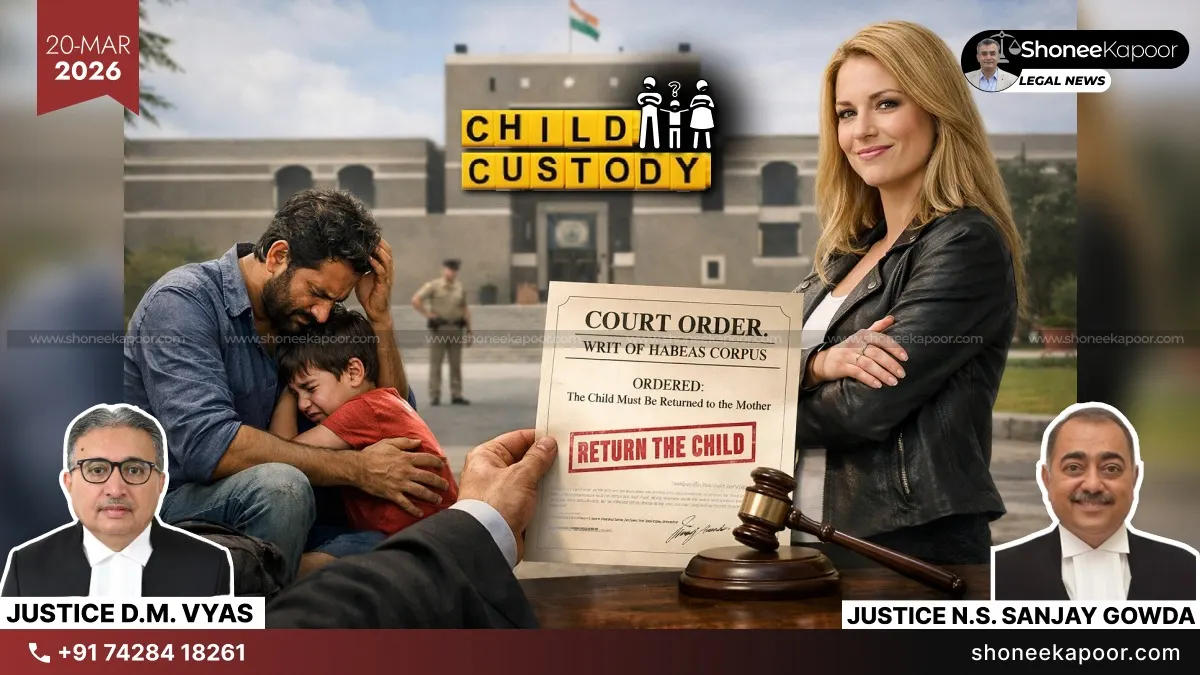
Gujarat High Court held a father’s act of bringing his child to India during foreign custody proceedings as unlawful and ordered return to the mother in Canada.
If such claims by fathers are often rejected, why are similar claims by mothers accepted?
AHMEDABAD: In an important cross-border child custody case, the Gujarat High Court, through Justice N.S. Sanjay Gowda and Justice D.M. Vyas, ruled against a father who had brought his minor son from Canada to India without the mother’s consent, holding that his custody was unlawful. The case also reflects the emotional and legal helplessness many men face when matrimonial breakdown turns into an international custody battle.
The father’s side was not simply about defiance. It came from a situation where the marriage had already broken down, the child was at the centre of conflict, and the father appears to have felt that bringing his son to India, into a familiar family environment, was in the child’s best interest.
The High Court did not accept that position. It found that the child had been lawfully in the mother’s custody and that the father could not remove him from Canada without permission. As the Court put it:
“It is therefore clear from the above set of facts, that the custody of the child was lawfully with the mother, and since it is not in dispute that the child was removed from Canada without the permission of the mother and brought to India, the father’s custody would have to be declared as unlawful.”
The Court reached this conclusion after noting that the father had earlier accepted the mother’s custody, that the child had remained with her for a substantial period, and that even the informal parenting arrangement in Canada did not amount to joint custody.
It also took note of the fact that the father had already participated in the Canadian proceedings and that the Ontario Court had passed an order directing the return of the child to Canada. The Gujarat High Court held that the father could not justify retaining custody in India by relying on his own unilateral act.
On the issue of welfare, the Court also held that the child should return to Canada and stay with the mother. It said:
“We, are therefore, of the view that the best interests of the child would also be for him to return to Canada and be with his mother.”
The final ruling went against the father, and he was directed to hand over the child. What stands out, however, is that in child custody disputes, fathers who approach the court through habeas corpus often do not get immediate relief and are usually pushed toward a longer custody battle before the appropriate forum.
In this case, the Court did entertain the matter in that form and examined the legality of custody as well as the welfare of the child, but the outcome still went against the father. For many men, that is the difficult reality: even when the Court hears the issue urgently, the final result may still leave the father to continue a long legal fight for meaningful access to his child.
Explanatory Table: Laws and Provisions Involved
| Law / Provision | Purpose | How Applied in This Case |
| Writ of Habeas Corpus | To examine whether a person is in unlawful custody and to secure immediate release | The mother filed this petition alleging the child was illegally taken to India and sought restoration of custody |
| Family Law Act (Ontario) | Governs financial support and family rights in Canada | The mother initiated proceedings under this law before the Ontario Court before the child was removed |
| Children’s Law Reform Act (CLRA), Ontario | Governs custody, parenting time, and decision-making for children | The Ontario Court relied on this law to grant the mother decision-making authority and order return of the child |
| Section 28, CLRA | Grants authority to assign decision-making responsibility for a child | The Ontario Court used this provision to give the mother sole decision-making rights |
| Hindu Minority and Guardianship Act, 1956 | Defines natural guardianship of Hindu minors | The father relied on this to claim lawful custody in India, but the Court rejected this argument in the facts of the case |
| Hindu Marriage Act | Governs marriage between Hindus in India | The Court noted the parties did not marry under this law, reinforcing that Canadian law would apply |
| Canadian Civil Law | Governs marriage and custody where parties marry under it | The Court held that since the marriage was under Canadian law, rights and obligations must be decided accordingly |
| OCI (Overseas Citizen of India) Status | Allows lifelong visa-free entry to India | Mentioned only to show the child could stay in India, not to determine custody rights |
Case Details
- Case Title: Tillana Shripal Shah vs State of Gujarat & Anr.
- Court: High Court of Gujarat at Ahmedabad
- Case Number: R/Special Criminal Application (Habeas Corpus) No. 17368 of 2025
- Neutral Citation: 2026:GUJHC:20467-DB
- Bench: Hon’ble Mr. Justice N.S. Sanjay Gowda & Hon’ble Mr. Justice D. M. Vyas
- Dates:
- Judgment Reserved On: 05/02/2026
- Judgment Pronounced On: 18/03/2026
- Counsels
- For Applicant/Petitioner: Mr. Harsh N. Parekh
- For Respondent No. 2: Mr Manan K. Paneri
- For State: Ms. Monali Bhatt, Addl. Public Prosecutor
Key Takeaways
- Even when a father acts out of concern for his child, courts strictly judge legality, not intent, and unilateral decisions can destroy his case.
- Informal access or shared parenting time does not translate into legal custody rights—fathers remain vulnerable despite involvement.
- Once a foreign court is involved, fathers are bound by that jurisdiction, and shifting countries does not improve their legal position.
- Habeas corpus may get urgent hearing, but it rarely results in relief for fathers, often pushing them into long custody battles.
- The system prioritises “status quo with mother” in young children, leaving fathers to fight prolonged legal battles just to maintain basic access.
This Could Change Your Case-Get FREE Legal Advice-Click Here!
Disclaimer: The views and opinions expressed in this article are those of the Indian courts and do not necessarily reflect the official policy or position of “ShoneeKapoor.com” or its affiliates. This article is intended for informational and educational purposes only. The content provided is not legal advice, and viewers should not act upon this information without seeking professional counsel. Viewer discretion is advised.
