
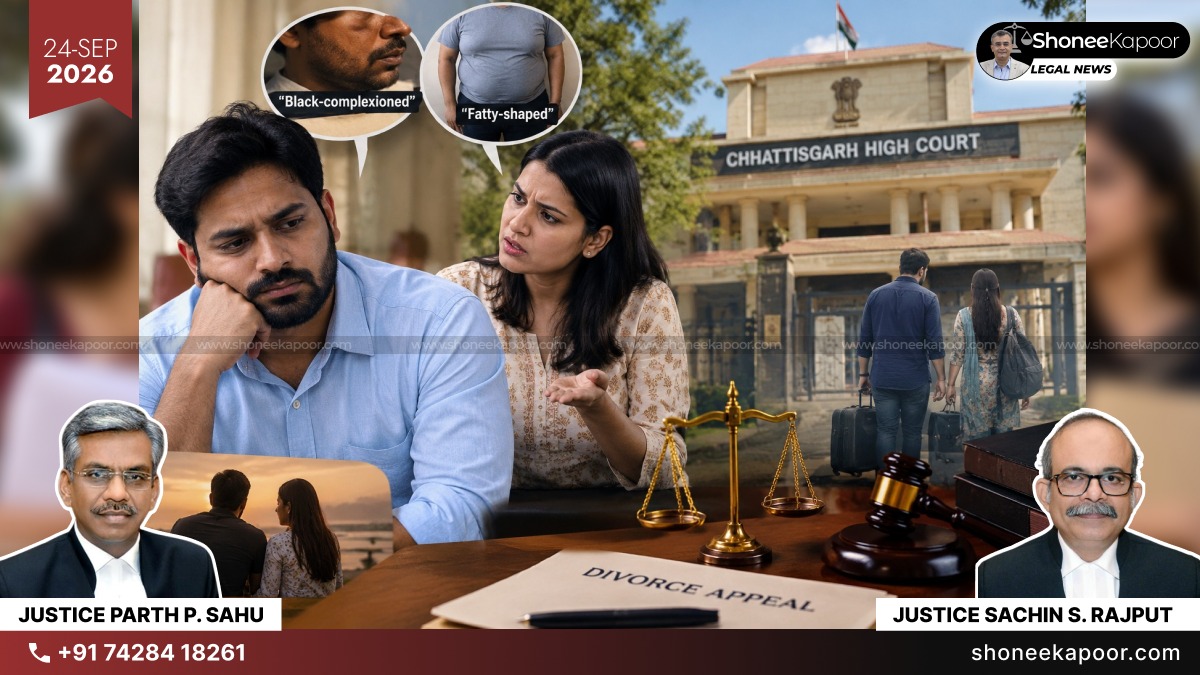
Wife Calling Husband 'Black-Complexioned' And 'Fat' Not Enough To Prove Cruelty? Chhattisgarh HC Denies Divorce

Curated by NEWS DESK
Editorial DeskCHATTISGARH: The Chhattisgarh High Court has dismissed a husband's appeal seeking divorce on the grounds of cruelty and desertion, holding that his allegations against his wife were not proved through cogent evidence. The Court also held that the wife's alleged act of calling him “black complexioned” or “fatty shaped” was not sufficient in the facts of this case to grant divorce.
A Division Bench of Justice Parth Prateem Sahu and Justice Sachin Singh Rajput was hearing an appeal filed by the husband under Section 19(1) of the Family Courts Act, 1984. He had challenged the Family Court's order rejecting his divorce petition under Section 13 of the Hindu Marriage Act, 1955.
The couple married on 7 March 2019 according to Hindu rites. According to the husband, the wife treated him with hostility, threatened to implicate him in false cases and frequently went to her parental home. He claimed that despite his efforts to bring her back, she refused to return. The wife later initiated proceedings under the Domestic Violence Act against the husband and his family members.
The wife denied his allegations. She instead alleged that the husband had an illicit relationship with another woman, consumed alcohol, abused her and failed to properly care for her during pregnancy. She claimed that the husband himself was unwilling to continue the marriage.
The husband argued before the High Court that his wife had been living separately since December 2019 without sufficient justification and had failed to resume cohabitation despite his willingness to continue the marriage. He also challenged the Family Court's direction requiring him to return her stridhan.
After examining the evidence, the High Court found that the husband had failed to establish the necessary ingredients of cruelty and desertion. The Court noted that several allegations had been made against the wife, but they were not supported by cogent evidence.
The Court specifically observed:
“Though the appellant/husband has made several allegations against the respondent/wife, yet none of them has been substantiated by leading any cogent evidence of the witnesses.”
On the husband's allegation about comments concerning his physical appearance, the Court said:
“Of course, he has alleged that the respondent/wife used to brand him as being a black complexioned or a fatty shaped but they cannot be taken to be sufficient ground for granting a decree of divorce to him.”
On desertion, the Court found that the husband could not prove that his wife was staying with her parents without reasonable excuse. The wife maintained that no effort had been made by him to take her back, while her mother stated that the husband's family had sent her away after her miscarriage.
The High Court also relied on the Supreme Court's decision in Samar Ghosh v. Jaya Ghosh, (2007) 4 SCC 511, which explains the principles governing mental cruelty in matrimonial cases. The Court noted that there is no uniform standard for mental cruelty and that the examples identified by the Supreme Court are illustrative rather than exhaustive.
Applying those principles, the High Court observed:
“If the facts and circumstances of the case in hand are analysed, there is nothing on record on the basis of which the act of the respondent/wife can be dragged within the sweep of cruelty as has been categorised in the case referred to above.”
The Court further found that merely making several allegations could not substitute for proof. It held that the husband had also failed to establish the necessary animus deserendi, or intention to permanently desert the matrimonial relationship, on the wife's part.
The High Court therefore found no reason to interfere with the Family Court's decision. The High Court dismissed the husband's appeal without costs, leaving the refusal of divorce intact.
EXPLANATORY TABLE OF LAWS AND SECTIONS
| Law / Section | What It Means | Relevance In This Case |
|---|---|---|
| Section 13, Hindu Marriage Act, 1955 | Provides statutory grounds on which a Hindu marriage may be dissolved by divorce, including cruelty and desertion. | The husband sought divorce under this provision on allegations of cruelty and desertion. |
| Section 27, Hindu Marriage Act, 1955 | Allows the matrimonial court to make appropriate orders concerning property presented at or about the time of marriage which may belong jointly to the spouses. | The Family Court allowed the wife's application and directed the husband to return the gifts/stridhan listed in Schedule A. |
| Section 19(1), Family Courts Act, 1984 | Provides for an appeal to the High Court from specified judgments or orders of a Family Court. | The husband invoked this provision to challenge the Family Court judgment before the Chhattisgarh High Court. |
| Domestic Violence Act | Provides civil and other statutory remedies to an aggrieved woman in a domestic relationship. | The judgment records that the wife had initiated domestic violence proceedings against the husband and his family members. |
| Samar Ghosh v. Jaya Ghosh, (2007) 4 SCC 511 | Supreme Court precedent laying down illustrative principles for determining mental cruelty in matrimonial disputes. | The High Court applied this precedent and found that the proved facts did not bring the wife's conduct within the required scope of cruelty. |
CASE DETAILS
| Particular | Details |
|---|---|
| Case Title | Akash Ghosh v. Smt. Pooja Seet |
| Court | High Court of Chhattisgarh at Bilaspur |
| Case Number | FA(MAT) No. 325 of 2024 |
| Neutral Citation | 2026:CGHC:40835-DB |
| CNR | CGHC010324722024 |
| Judgment Reserved | 25 June 2026 |
| Judgment Delivered | 18 September 2026 |
| Bench | Justice Parth Prateem Sahu and Justice Sachin Singh Rajput |
| Judgment By | Justice Sachin Singh Rajput |
| Counsel for Husband/Appellant | Shri Parasmani Shriwas, Advocate |
| Counsel for Wife/Respondent | Shri Punit Ruparel, Advocate |
| Family Court Case | Civil Suit No. 129A/22 |
| Family Court Order | 28 August 2024 |
| Result | Husband's appeal dismissed without costs; refusal of divorce upheld |
KEY TAKEAWAYS
- A husband alleged his wife repeatedly mocked his dark complexion and body shape, but the Court held these allegations were not enough to end the marriage.
- He also alleged hostility, threats of false cases and prolonged separation, yet the Court found that these claims lacked cogent evidence.
- For a husband, alleging mental cruelty is not enough. Even repeated matrimonial misconduct must be backed by specific and convincing proof.
- Even years of living separately do not automatically prove desertion. The husband must also establish that the wife intended to desert the marriage without reasonable cause.
- Despite the husband's allegations of insults, threats and separation, the Chhattisgarh High Court refused him divorce because the legal requirements of cruelty and desertion were not proved.
Share Your Thoughts
Comments are moderated before publication.