
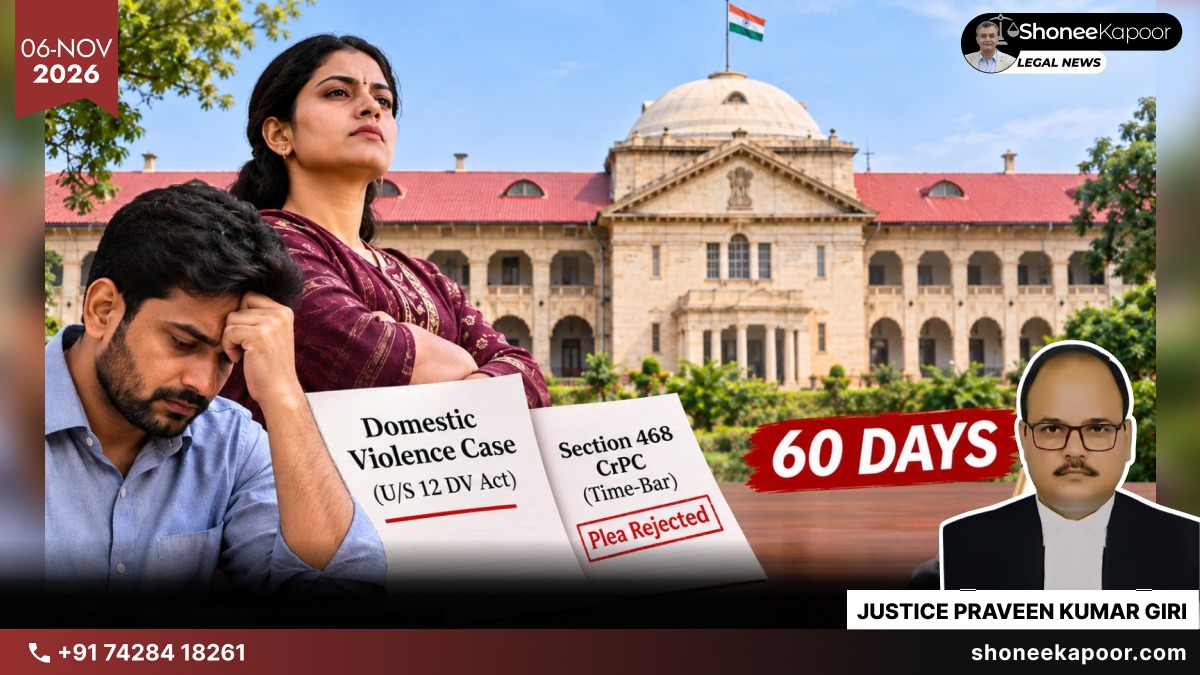
Domestic Violence Cases To Be Disposed Of Within 60 Days Under Section 12 Of DV Act: Allahabad High Court

Curated by NEWS DESK
Editorial DeskUTTAR PRADESH: The Allahabad High Court has directed courts to make efforts to dispose of domestic violence cases within 60 days, as provided under Section 12(5) of the Domestic Violence Act, 2005. The Court also stressed the need to dispose of pending DV cases and execution proceedings quickly.
Justice Praveen Kumar Giri passed the order while hearing a husband's criminal revision petition challenging the lower courts' orders in a domestic violence case filed by his wife.
The wife had approached the Magistrate under Section 12 of the DV Act, seeking protection, residence, monetary relief and compensation under Sections 18, 19, 20 and 22 of the Act.
The husband argued that the wife's DV complaint was barred by limitation under Section 468 CrPC. However, both the trial court and appellate court rejected his objection, following which he approached the Allahabad High Court.
Read Also:- Gujrat HC – Complaint under Domestic Violence Not Barred by Limitation
Opposing the revision, the State argued that Section 468 CrPC does not apply to applications filed under Section 12 DV Act, relying on the Supreme Court's judgment in Kamatchi v. Lakshmi Narayanan (2022).
The Supreme Court had clarified that filing a domestic violence application is not itself a criminal offence. Criminal liability under the DV Act may arise when a person violates a protection order or interim protection order.
The High Court observed that no protection order had been passed against the husband in the present case. Therefore, the limitation provision under Section 468 CrPC could not be applied as argued by him.
The Court further explained that reliefs under Sections 18 to 22 of the DV Act do not themselves prescribe criminal punishment attracting the limitation provisions relied upon by the husband.
Read Also;- How Does Domestic Violence Affect Male Victims
Finding that the husband's revision appeared aimed at delaying the domestic violence proceedings, rather than contesting the case on merits, the Allahabad High Court dismissed his revision petition.
Referring to Section 12(5) of the DV Act, the Court emphasised that Magistrates must endeavour to decide domestic violence applications within 60 days from the first hearing.
The High Court directed the concerned courts to follow this statutory timeline and warned that unjustified delays in DV cases could invite scrutiny of judicial officers' conduct.
The Court directed the Registrar (Compliance) to communicate the order to the concerned judicial officers, including those in Agra, and forward a copy to the Judicial Training and Research Institute, Lucknow.
Read Also:- Husband Must Pay Maintenance Despite Child Custody With Him: Delhi High Court
EXPLANATORY TABLE OF LAWS AND SECTIONS
| Law / Section | What It Means | Application In This Case |
|---|---|---|
| Section 12, DV Act | Allows an aggrieved person to seek relief from a Magistrate. | Wife filed the DV application. |
| Section 12(4), DV Act | First hearing should ordinarily be fixed within three days. | Part of the statutory procedure reproduced by the Court. |
| Section 12(5), DV Act | Magistrate must endeavour to dispose of the application within 60 days of its first hearing. | Basis of the High Court's direction. |
| Section 18, DV Act | Protection against domestic violence. | Relief sought by the wife. |
| Section 19, DV Act | Residence and shared household orders. | Relief sought by the wife. |
| Section 20, DV Act | Maintenance and other monetary reliefs. | Relief sought by the wife. |
| Section 21, DV Act | Temporary child custody orders. | Discussed while explaining available remedies. |
| Section 22, DV Act | Compensation for injuries, including mental torture. | Relief sought by the wife. |
| Sections 31–32, DV Act | Punishment and procedure relating to breach of protection orders. | No protection order had been breached. |
| Section 33, DV Act | Punishment for failure of a Protection Officer to discharge duties. | Discussed to distinguish offences from civil reliefs. |
| Section 468 CrPC | Limitation on taking cognizance of certain offences. | Husband's objection rejected. |
| Section 125 CrPC | Maintenance for eligible dependants. | Separate maintenance proceedings were mentioned. |
| Section 498A IPC | Criminal cruelty by husband or his relatives. | Cruelty and dowry allegations formed part of the matrimonial dispute; the judgment did not decide their merits. |
CASE DETAILS
| Particular | Details |
|---|---|
| Case Title | Chaudhary Manish Singh v. State of U.P. and Another |
| Court | Allahabad High Court |
| Neutral Citation | 2026:AHC:225827 |
| Bench | Justice Praveen Kumar Giri |
| Order Date | October 30, 2026 |
| Case Number | Criminal Revision No. 6433 of 2026 |
| Husband's Counsel | Advocates Anand Mohan Pandey and Krishan Mohan Pandey |
| State Counsel | Additional Government Advocate Pankaj Kumar |
| Marriage Date | November 27, 2014 |
| DV Case | Case No. 14837 of 2023, Pratigya v. Chaudhary Manish Singh and Others |
| Police Station | Shahganj, Agra |
| Trial Court Order | October 8, 2024 |
| Appellate Court Order | September 8, 2026 |
| Final Decision | Husband's revision dismissed; directions issued for speedy disposal of DV proceedings, including execution proceedings |
KEY TAKEAWAYS
- DV Cases Must Be Decided Speedily: Allahabad High Court stressed the 60-day disposal timeline under Section 12(5) DV Act.
- Husband’s Limitation Plea Rejected: Section 468 CrPC cannot automatically bar a DV application under Section 12.
- DV Complaint Is Not A Criminal Offence: Criminal liability may arise from breaching a protection order, not merely from filing a DV case.
- Endless DV Litigation Must Stop: Unnecessary delays prolong legal and financial pressure on husbands facing matrimonial disputes.
- Speedy Justice Is A Right Of Both Parties: Husbands also deserve timely hearings, fair proceedings and protection against prolonged litigation.
Share Your Thoughts
Comments are moderated before publication.