
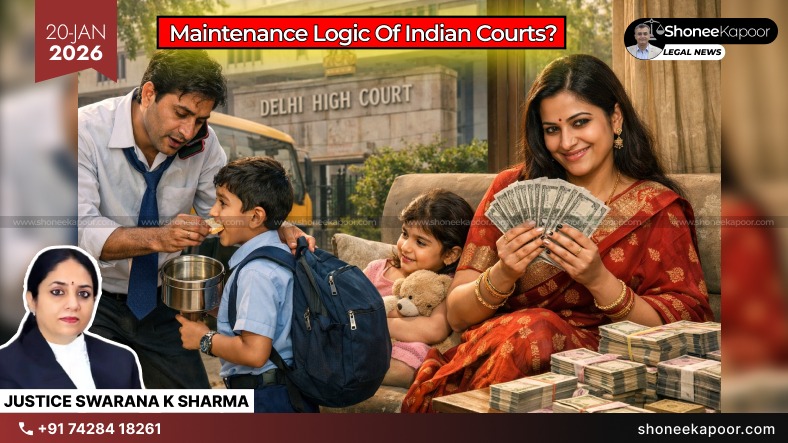
Husband Must Pay Maintenance Despite Child Custody With Him: Delhi High Court

Written and analysed by Vaibhav Ojha
Head Of Legal CommunicationsThe Delhi High Court ruled that keeping one child with the husband does not cancel his duty to maintain the wife and the other child. Maintenance depends on alleged need and presumed earning capacity, not shared custody realities.
New Delhi: The Delhi High Court said that a husband cannot escape his legal duty to maintain his wife and a minor child living with her merely because one child is staying in his custody. The Court emphasised that maintenance obligations under law do not get divided or reduced simply due to split custody of children between parents.
In this case, the marriage between the parties and the birth of two children were not disputed. The parties had been living separately since January 2021. The minor son was living with the husband, while the minor daughter was living with the wife. The wife claimed she had no independent income and sought maintenance for herself and the daughter. The husband claimed that he earned only around ₹13,500 per month from a contractual job with the Municipal Corporation of Delhi and argued that he was already bearing the full responsibility of the son living with him, with support from his parents.
The wife denied having any income and stated that she was living in a rented house and solely taking care of the minor daughter. She alleged that the husband was involved in property dealing and had higher income than disclosed.
The Family Court closely examined the income and expenditure affidavits and bank statements filed by the husband. It found serious inconsistencies between his claimed income and his actual spending. The Court noted unexplained withdrawals, frequent fuel payments despite denial of vehicle use, absence of regular rent or school fee payments, and material suggesting involvement in property dealing under the name “Neel Associates”. Based on this, the Family Court held that the husband had concealed his real income and estimated his income at ₹60,000 per month, directing him to pay ₹20,000 per month as interim maintenance.
The husband challenged this order before the Delhi High Court. He argued that the Family Court relied on assumptions, scrutinised his bank account too strictly, ignored the fact that he was maintaining one child fully with help from his parents, and failed to draw adverse inference against the wife for not filing her bank statements. He also argued that scrutiny of bank transactions at the interim stage was excessive.
After hearing both sides, the High Court explained the limited scope and purpose of interim maintenance proceedings and reiterated the object of Section 125 CrPC. The Court observed that
“The obligation of a husband to maintain his wife and minor children, where they are unable to maintain themselves, is firmly embedded in law.”
It further clarified that maintenance proceedings are meant to prevent destitution and provide immediate relief, not to conduct a full trial.
On the argument that the husband was already maintaining one child, the Court gave an important finding. It held that:
“The mere fact that one child is in the custody of the petitioner-husband cannot, by itself, be a ground to absolve him of his obligation to maintain respondent no.1-wife and the minor child residing with her.”
The Court added that:
“The responsibility of maintenance does not stand divided merely because each parent has custody of one child.”
However, it also noted that this factor is relevant while deciding the quantum of maintenance.
Regarding the wife’s alleged income, the Court noted that there was no material placed on record by the husband to prove that she was earning or running a beauty parlour. In the absence of proof, the Family Court was justified in not drawing adverse inference against her at the interim stage, though it was also noted that she had not filed her bank statements.
The High Court then examined the husband’s bank records in detail and upheld the Family Court’s approach. It found that the expenses claimed by the husband exceeded his stated income even before accounting for his own basic needs. The Court observed that the transaction pattern did not match the projected picture of survival on ₹13,500 per month. Frequent withdrawals, payments to fuel stations, restaurants, service centres, and commercial outlets were found to be inconsistent with his claims.
The Court also accepted the Family Court’s reasoning on concealed income in the unorganised sector and stated that
“Persons engaged in unorganised or semi-formal sectors, such as property dealing, often do not have neatly documented income streams.”
In such cases, the Court held that a “reasonable and pragmatic assessment, drawn from surrounding circumstances, expenditure patterns and lifestyle indicators” is permissible.
At the same time, the High Court took a balanced view. Considering that the husband was also maintaining the minor son and that there was no direct proof of fixed monthly income beyond the contractual job, the Court slightly reduced the assessed income. It held that the ends of justice would be met by assessing the husband’s income at ₹50,000 per month instead of ₹60,000. Accordingly, it modified the maintenance amount from ₹20,000 to ₹17,500 per month payable to the wife and the minor daughter from the date of application.
The Court clarified that all its observations were only for the purpose of deciding interim maintenance and would not affect the final outcome of the main case after evidence is led.
This judgment highlights a harsh reality for many husbands and fathers. Even when a man is fully taking care of one child, managing expenses with parental support, and earning a modest declared income, courts can still impose additional financial burden based on inferred earning capacity. Declaring low income on paper may not protect a man if transaction patterns suggest otherwise.
The financial pressure of maintaining two households, coupled with judicial assumptions about undisclosed income, increases economic and mental stress on men navigating matrimonial litigation. The ruling reinforces that courts will prioritise financial protection of dependents, even if it places heavy ongoing liability on a single earning father.
Explanatory Table
| Law / Section | Purpose | Use in This Case |
| Section 125 CrPC | Maintenance to wife and children to prevent destitution | Wife and daughter granted interim maintenance despite one child living with father |
| Revisional Jurisdiction (CrPC) | Review lower court orders for legality | Husband challenged Family Court’s maintenance order |
| Interim Maintenance Principle | Immediate relief without detailed trial | Court avoided income trial and relied on prima facie assessment |
| Social Objective of Maintenance Law | Prevent vagrancy and abandonment | Used to justify continued liability on husband |
| Income Assessment Principle | Reasonable estimation when proof absent | Husband’s income presumed due to informal work |
Case Details
- Case Title: Pankaj vs Archana & Anr.
- Case Number: CRL.REV.P. 409/2024 & CRL.M.A. 9309/2024
- Court: High Court of Delhi at New Delhi
- Bench: Hon’ble Dr. Justice Swarana Kanta Sharma
- Dates:
- Judgment Reserved On: 24.12.2025
- Judgment Pronounced On: 05.01.2026
- Judgment Uploaded On: 09.01.2026
Counsels
- For Petitioner:
- Mr. L. K. Singh, Advocate
- Mr. Raj Kumar, Advocate
- For Respondents:
- Mr. Rajiv Shrivastava, Advocate
- Mr. Aftab Ahmad, Advocate
Key Takeaways
- Even if a father is fully raising and financially supporting one child, courts can still force him to pay maintenance for the wife and the other child, increasing double financial burden on men.
- Salary slips and declared income alone do not protect men; courts can estimate income based on bank transactions, lifestyle spending, and assumptions of hidden earnings.
- Men working in unorganised or contractual sectors face higher risk of income being guessed upward without strict proof, exposing them to inflated maintenance liability.
- Interim maintenance orders create immediate financial pressure on husbands even before full trial, evidence, or cross-examination is completed.
- The system prioritises financial security of dependents, often overlooking the economic stress, parental responsibility, and vulnerability faced by single earning fathers during prolonged litigation.
This Could Change Your Case-Get FREE Legal Advice-Click Here!
Disclaimer: The views and opinions expressed in this article are those of the Indian courts and do not necessarily reflect the official policy or position of “ShoneeKapoor.com” or its affiliates. This article is intended for informational and educational purposes only. The content provided is not legal advice, and viewers should not act upon this information without seeking professional counsel. Viewer discretion is advised.
Related Articles
Unheard Voices: Understanding Men’s Rights and Legal Inequality in India
India speaks proudly of women’s empowerment but ignores the men who suffer in silence. With rising false accusations,...

Family Courts Refuse My RTI To Reveal Divorce Data: Is Transparency Selective When It Comes to Men?
Family Courts have refused to provide year-wise divorce and alimony statistics under the RTI Act, citing technical gr...

Can an Educated Wife Claim Maintenance from Her Husband? The Legal Reality No One Explains
Indian courts recognise education and earning capacity, yet husbands are still routinely ordered to pay maintenance.I...
Relevant Judgements
Can an NRI Husband Be Forced to Pay Maintenance in India? Supreme Court Rules Explained for Overseas Indian Men
Living abroad does not automatically protect an NRI husband from maintenance claims in India.But can Indian courts pa...
Share Your Thoughts
Comments are moderated before publication.