
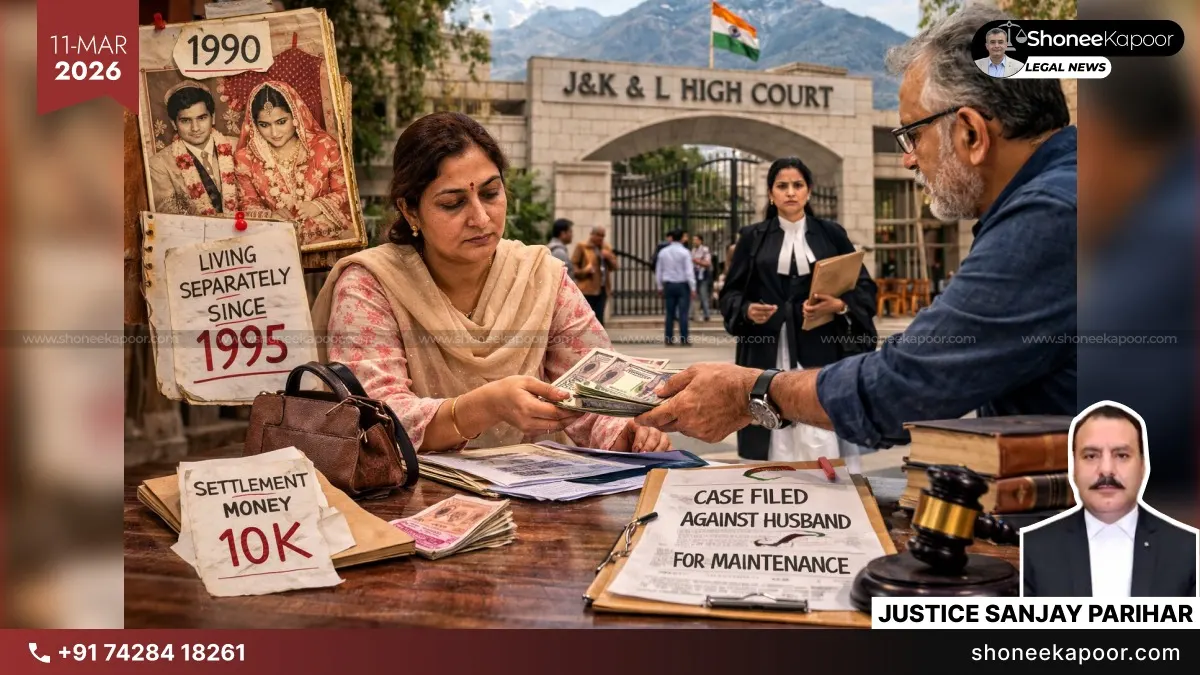
After accepting a settlement and living separately for decades, a fresh maintenance claim reached the courts. The High Court examined the old agreement and the conduct of the parties, raising a larger question about how long past settlements can be reopened.
JAMMU: The High Court of Jammu & Kashmir and Ladakh at Jammu, in a judgment delivered by Justice Sanjay Parihar, dealt with a long-running matrimonial dispute between a husband and wife who had been living separately for many years. The case arose from petitions challenging orders passed in maintenance proceedings under Section 488 Cr.P.C.
The couple married in 1990 and had a son. Later disputes arose, and the wife initiated criminal and maintenance proceedings against the husband. In 1995, both parties reached a compromise where the wife accepted ₹10,000 as full and final settlement and withdrew the earlier proceedings. After this settlement, the parties started living separately.
Years later, the wife again approached the court seeking maintenance. The trial court granted maintenance, but the revisional court set aside that order, holding that the parties had been living separately by mutual consent. The matter then reached the High Court.
Justice Sanjay Parihar examined the entire record and clarified the legal position regarding divorce and maintenance. The Court observed that:
“Under the J&K Hindu Marriage Act 1980, marriage between Hindus can only be dissolved by a decree of divorce in accordance with statutory provisions, unless a specific custom is pleaded and strictly proved.”
However, the Court explained that the issue of maintenance is different from the question of divorce. It stated:
“Section 488(5) Cr.P.C. independently disentitles a wife from maintenance if she is living separately by mutual consent.”
While examining the wife’s conduct, the Court noted that she had withdrawn earlier proceedings after accepting settlement money, described herself as divorced in later proceedings, and lived separately for many years without asserting marital rights.
Based on these facts, the Court concluded that the parties had been living separately by mutual consent and that the wife had failed to prove neglect or refusal by the husband. As a result, the High Court upheld the revisional court’s decision that she was not entitled to maintenance.
However, considering the wife’s financial circumstances and the long separation, the Court directed payment of a lump sum amount of ₹2.50 lakhs as a one-time settlement to avoid hardship. The Court ordered:
The Court directed:
“The said amount shall be paid by the respondent within a period of six months from the date of receipt of a certified copy of this order.”
With these observations, the High Court dismissed the petitions while directing payment of the one-time settlement amount to resolve the dispute.
Explanatory Table: Laws And Provisions Involved
| Law / Section | Meaning | Role in This Case |
| Section 488 Cr.P.C. (J&K) | Provision for maintenance to wife, children, and parents if the husband neglects or refuses to maintain them | Wife filed maintenance proceedings under this section |
| Section 488(5) Cr.P.C. | A wife is not entitled to maintenance if she is living separately by mutual consent | Court relied heavily on this provision to deny maintenance |
| Sections 494/109 RPC | Offence of bigamy and abetment under Ranbir Penal Code | Wife earlier filed criminal complaint alleging second marriage |
| Section 403 Cr.P.C. | Protection against double jeopardy in criminal law | Used when husband was discharged in earlier bigamy proceedings |
| Section 125(4) Cr.P.C. (parallel principle) | Maintenance cannot be claimed if wife lives separately by mutual consent | Court referred to similar legal principle in precedents |
| J&K Hindu Marriage Act, 1980 | Governs marriage and divorce for Hindus in J&K | Court clarified that marriage can be dissolved only by decree of divorce unless valid custom is proved |
| Section 31 J&K Hindu Marriage Act | Allows modification or enhancement of maintenance due to changed circumstances | Court discussed possibility of financial changes affecting settlements |
| Section 482 Cr.P.C. | Inherent powers of High Court to secure ends of justice | High Court exercised its inherent jurisdiction while deciding petitions |
Case Details
- Case Title: Sarita Devi vs Mohan Singh
- Court: High Court of Jammu & Kashmir and Ladakh at Jammu
- Case Numbers: CRM(M) No. 444/2020 c/w CRM(M) No. 279/2021
- Bench: Hon’ble Mr. Justice Sanjay Parihar
- Neutral Citation: 2026:JKLHC-JMU:734
- Dates:
- Judgment Reserved On: 13 February 2026
- Judgment Pronounced On: 6 March 2026
- Counsels:
- For Petitioner: Mr. Jasbir Singh Jasrotia, Advocate
- For Respondent: Mr. Vishal Kapur, Advocate
Key Takeaways
- When two adults mutually agree to live separately and follow that arrangement for years, reopening the dispute later defeats the very purpose of settlement.
- Statements made in court carry legal weight; a person who repeatedly claims to be divorced or separated cannot later change that stand to seek financial claims.
- Endless matrimonial litigation places a heavy emotional and financial burden on husbands who are forced to defend old disputes again and again.
- Even after acknowledging mutual separation, directing financial payments sends a mixed signal about finality and fairness in matrimonial settlements.
- Real gender justice means respecting voluntary agreements between spouses instead of allowing disputes to be revived decades later.
This Could Change Your Case-Get FREE Legal Advice-Click Here!
Disclaimer: The views and opinions expressed in this article are those of the Indian courts and do not necessarily reflect the official policy or position of “ShoneeKapoor.com” or its affiliates. This article is intended for informational and educational purposes only. The content provided is not legal advice, and viewers should not act upon this information without seeking professional counsel. Viewer discretion is advised.
