
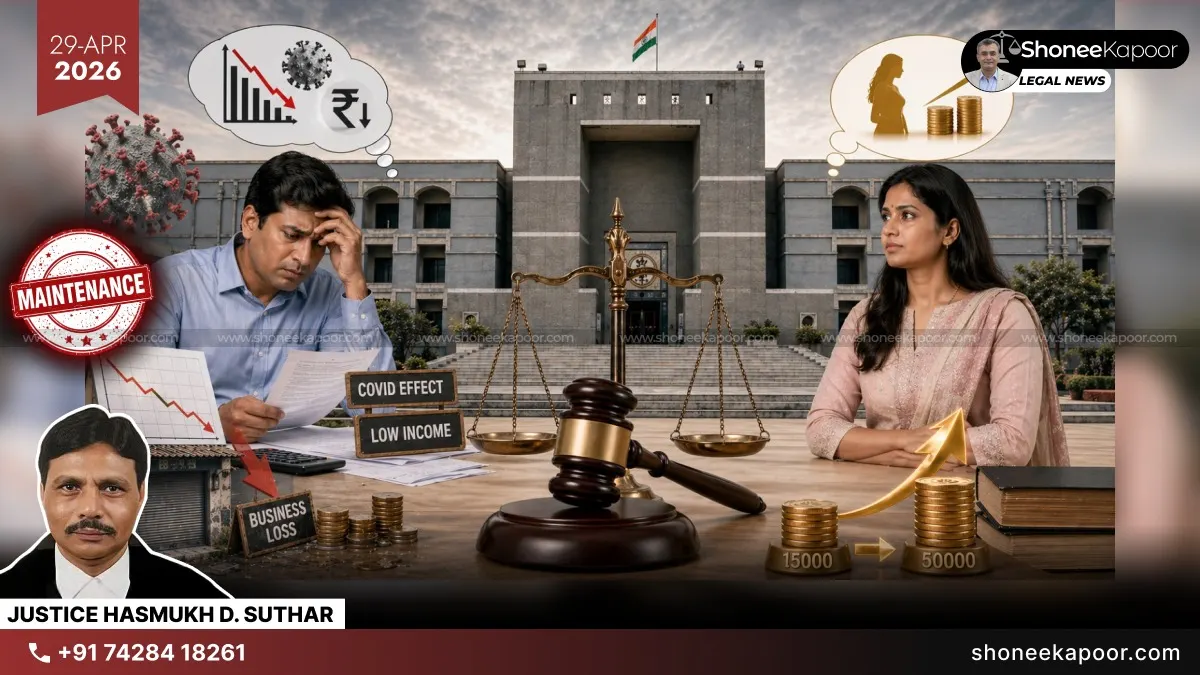
The Gujarat High Court upheld maintenance enhancement from ₹15,000 to ₹50,000, holding that unproven financial loss cannot excuse support for a wife undergoing cancer treatment.
Are financially distressed husbands becoming invisible in maintenance litigation?
AHMEDABAD: The Gujarat High Court at Ahmedabad, in a judgment dated 24/04/2026 by Honourable Mr. Justice Hasmukh D. Suthar, dismissed a husband’s revision plea and upheld a Family Court order directing him to pay ₹50,000 per month as maintenance to his wife.
The case started when the wife filed a maintenance application under Section 125 CrPC, claiming that her husband was not providing proper financial support. The Family Court had initially granted interim maintenance of ₹15,000 per month, but later increased it to ₹50,000 per month from the date of application.
The husband challenged this increase before the High Court, arguing that the order was unfair and not based on proper evidence. He clearly stated that his business had suffered, especially after COVID-19, and his income had reduced significantly. He also pointed out that at the time of filing the case, the wife was still living with him and her expenses were already being taken care of.
It was further argued that the Family Court ignored key financial documents like Income Tax returns, audit reports, and testimony of an Income Tax Officer. The husband claimed that the sudden jump from ₹15,000 to ₹50,000 per month was completely arbitrary and not supported by real proof of his earning capacity.
On the other side, the wife argued that the husband was hiding his real income and living a luxurious life, including foreign travel and business activities. It was also claimed that he had multiple financial investments and continued business operations, showing that he had the capacity to pay.
The High Court accepted the wife’s arguments and observed that the husband had not properly disclosed his actual income. The Court also took into account that the wife was suffering from cancer and required financial support for treatment and living expenses.
The Court relied heavily on the principle that a husband has a legal duty to maintain his wife and cannot escape liability by claiming reduced income without strong proof. It further stated that even if the wife is educated or capable of earning, that alone is not sufficient to deny maintenance.
The Court referred to important Supreme Court judgments including Shailja and Another vs. Khobbanna (2018), Sunita Kachwaha vs. Anil Kachwaha (2014), and Chaturbhuj vs. Sita Bai (2008), and observed:
“Where the wife was surviving by begging, it would not amount to her ability to maintain herself. It can also be not said that the wife has been capable of earning but she was not making an e ort to earn. Whether the deserted wife was unable to maintain herself, has to be decided on the basis of the material placed on record.
Read Also: Scared of Marriage After Seeing Divorce? 25 Things Every Man Must Check Before Saying YesWhere the personal income of the wife is insu!cient she can claim maintenance under Section 125 Cr.P.C. The test is whether the wife is in a position to maintain herself in the way she was used to in the place of her husband. The wife should be in a position to maintain standard of living which is neither luxurious nor penurious but what is consistent with status of a family. The expression “unable to maintain herself” does not mean that the wife must be absolutely destitute before she can apply for maintenance under Section 125 CrPC.”
Finally, the High Court refused to interfere with the Family Court’s decision and dismissed the revision application.
EXPLANATORY TABLE: LAWS AND SECTIONS INVOLVED
| Law / Section | Purpose | How Applied in This Case |
| Section 125 CrPC | Gives maintenance to wife, children, parents if neglected | Wife filed claim for monthly maintenance |
| Section 125(3) CrPC | Enforces unpaid maintenance through legal process | Wife initiated recovery steps for non-payment |
| Section 397 CrPC | Revisional power to examine lower court order | Husband filed revision before High Court |
| Section 401 CrPC | High Court power to confirm or interfere in revision | Used along with Section 397 |
| Family Court Jurisdiction | Decides matrimonial and maintenance disputes | Family Court Anand passed original order |
| Evidence Principles | Court assesses truthfulness and financial disclosure | Court doubted husband’s full income disclosure |
CASE DETAILS
- Case Title: Vasantbhai Premjibhai Vekariya vs State of Gujarat & Anr
- Court: Gujarat High Court at Ahmedabad
- Case Number: R/CR.RA/175/2022
- Connected Matters: CR.MA No.1/2022, CR.MA No.1/2023, CR.MA No.1/2024
- Bench: Hon’ble Mr. Justice Hasmukh D. Suthar
- Date of Judgment: 24/04/2026
- Counsels:
- For Applicant: Mr. Ashish M. Dagli
- For Respondent: Mr. Darshit R. Brahmbhatt
- For State: Mr. Rohan Raval, APP
KEY TAKEAWAYS
- Courts are increasingly relying on “earning capacity” instead of actual proven income, which can unfairly burden husbands facing real financial distress.
- Even when income tax records and business losses are shown, many courts still presume concealment rather than objectively verifying finances.
- Maintenance amounts are often fixed on lifestyle assumptions, creating risk of unrealistic liabilities beyond a man’s present means.
- A wife’s education, employability, or earning potential is frequently given little weight, leading to one-sided responsibility on husbands.
- Maintenance law should protect genuine dependents, but it must also ensure fairness, evidence-based assessment, and prevent misuse against men.
This Could Change Your Case-Get FREE Legal Advice-Click Here!
Disclaimer: The views and opinions expressed in this article are those of the Indian courts and do not necessarily reflect the official policy or position of “ShoneeKapoor.com” or its affiliates. This article is intended for informational and educational purposes only. The content provided is not legal advice, and viewers should not act upon this information without seeking professional counsel. Viewer discretion is advised.
