
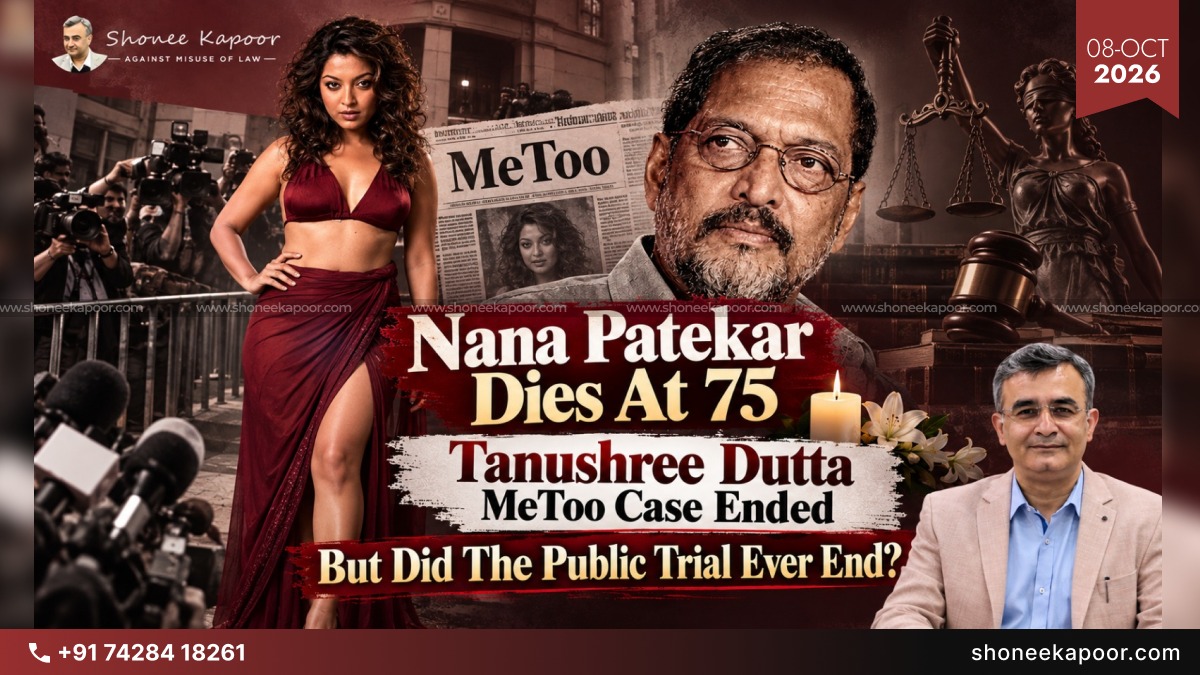
Nana Patekar Dies At 75: Tanushree Dutta MeToo Case Ended, But Did The Public Trial Ever End?

Written and analysed by Shonee Kapoor
Legal Consultant, Author & Men's Rights ActivistNEW DELHI: Veteran actor Nana Patekar passed away on 8 October 2026, aged 75, following a cardiac arrest in Goa.
India has lost one of its most powerful performers, a Padma Shri recipient and three-time National Film Award winner.
But as the country remembers his legacy, another chapter deserves scrutiny: the Tanushree Dutta MeToo case, the Mumbai Police investigation and the court's final decision in March 2025.
An allegation made headlines. The legal outcome deserves equal attention.
TANUSHREE DUTTA VS NANA PATEKAR: WHAT ACTUALLY HAPPENED?
In 2018, actress Tanushree Dutta publicly accused Nana Patekar of inappropriate conduct during the shooting of Horn Ok Pleasss in March 2008.
Patekar consistently denied the allegations.
An FIR was registered under Sections 354 and 509 of the Indian Penal Code, relating to outraging a woman's modesty.
The controversy became a major part of India's #MeToo movement.
But public accusation and legally established guilt are two very different things.
2019: MUMBAI POLICE FILED A B-SUMMARY REPORT
After investigating the allegations, Mumbai Police filed a B-summary report in 2019, stating that the investigation had not found incriminating material and treating the complaint as false.
Tanushree Dutta challenged the report through a protest petition, seeking further investigation.
Importantly, the police's assessment was not itself a judicial finding that Dutta had deliberately fabricated the complaint.
MARCH 2025: WHAT DID THE MUMBAI COURT ACTUALLY DECIDE?
On 7 March 2025, Judicial Magistrate First Class N. V. Bansal of the Andheri Court, Mumbai, declined to take cognisance of the alleged 2008 offences.
The Court found that:
- The alleged incident dated back to 23 March 2008.
- The relevant offences carried a three-year limitation period under the applicable Code of Criminal Procedure.
- No application explaining and seeking condonation of the substantial delay had been filed.
- Consequently, the Court could not proceed on the allegations.
The magistrate expressly stated that the alleged incident could not be declared either true or false because its merits had not been examined.
The B-summary report was therefore not adjudicated on its merits. A connected proceeding concerning another accused was also disposed of for insufficient grounds to proceed.
The legally accurate result: The proceedings ended without any criminal conviction of Nana Patekar, but the Court did not pronounce a merits-based acquittal declaring the complaint fabricated.
That distinction matters. A men's rights argument must stand on actual court findings, not exaggerated ones.
WHAT DOES INDIAN SUPREME COURT CASE LAW SAY?
Three established Supreme Court judgments explain why an accused man's legal rights and reputation cannot be dismissed.
1. State of Punjab v. Sarwan Singh, (1981) 3 SCC 34
The Supreme Court explained that criminal limitation provisions help prevent stale prosecutions, loss of evidence and abuse of legal process. This principle is directly relevant to the limitation issue examined in Patekar's case.
2. Kali Ram v. State of Himachal Pradesh, (1973) 2 SCC 808
The Supreme Court reaffirmed the presumption of innocence and the prosecution's burden to establish criminal guilt. An allegation is not a conviction.
3. Subramanian Swamy v. Union of India, (2016) 7 SCC 221
The Supreme Court recognised reputation as a component of the dignity protected under Article 21 of the Constitution.
The message is clear: A man's reputation is not disposable merely because he has been accused.
TANUSHREE DUTTA'S REACTION AFTER NANA PATEKAR'S DEATH
Following news of Patekar's passing, Tanushree Dutta posted a video discussing her scheduled work commitments and media attention.
According to published reporting, she used the expression "evil dead" while discussing anticipated media interest in the death. She did not name Patekar in that video and also offered condolences to his family.
I find that choice of expression deeply insensitive in the context of a man's death.
Dutta has every right to maintain her account of past events. But disagreement over allegations does not require abandoning basic human dignity.
As for Patekar's estranged wife, Neelakanti, reports establish that they lived separately and that she supported him financially early in his career. Their private marital circumstances provide no basis for accusing her of wrongdoing.
MY VIEW: A MAN'S REPUTATION MATTERS EVEN AFTER DEATH
Nana Patekar faced serious public allegations, denied them consistently, and died without a conviction arising from this case.
I do not need to falsely claim that a court declared Tanushree Dutta a liar to defend his rights.
A woman has the right to complain. A man has the right to defend himself. Neither the media nor public opinion has the right to pronounce him guilty without proof.
The allegations received enormous attention. How many people gave the procedural outcome the same attention?
A man can spend years answering accusations. Even when proceedings end, the internet rarely gives him his reputation back.
Nana Patekar deserves to be remembered for his work, his contribution to Indian cinema and the dignity owed to every human being.
Rest in peace, Nana Patekar.
FAQ’S
1. Why did the Mumbai court close Nana Patekar's MeToo case?
The court declined cognisance in March 2025 because the alleged 2008 offences were time-barred and the delay had not been explained through an appropriate application.
2. Did the court declare Tanushree Dutta's complaint false?
No. Police filed a B-summary, but the magistrate did not decide whether the underlying allegations were true or false.
3. Was Nana Patekar convicted in the MeToo case?
No. The criminal proceedings ended without a conviction against him.
4. Which IPC sections were involved?
Sections 354 and 509 IPC, concerning outraging a woman's modesty.
5. What does Indian law say about an accused man's reputation?
Article 21 protects dignity and reputation. Criminal guilt must be established through lawful proceedings and the applicable standard of proof.
Legal note: This article distinguishes allegations, police findings and judicial determinations. The cited Supreme Court judgments explain general principles; they were not decisions in Nana Patekar's individual case.
Sources: Reuters (8 October 2026); The Indian Express and PTI/Business Standard (7 March 2025); Hindustan Times (8 October 2026); reported Supreme Court decisions cited above.



Share Your Thoughts
Comments are moderated before publication.