
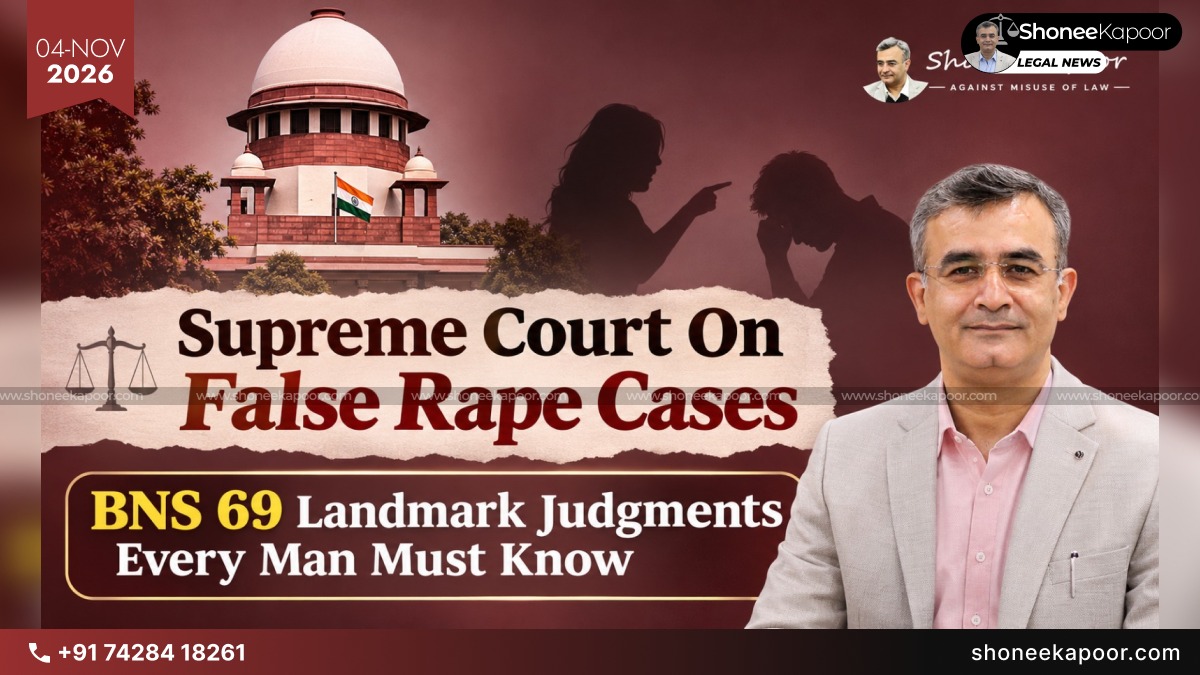
Supreme Court On False Rape Cases: BNS 69 Landmark Judgments Every Man Must Know

Written and analysed by Vaibhav Ojha
Head Of Legal CommunicationsNEW DELHI: A relationship ends. Marriage does not happen. Months or even years later, the man finds himself facing criminal prosecution.
Can a breakup become a rape case?
Can a failed promise to marry attract 10 years of imprisonment under Section 69 BNS?
The Supreme Court of India has repeatedly drawn a distinction between genuine sexual offences, deliberately deceptive promises and consensual relationships that eventually fail.
In its landmark 30 October 2026 judgment, the Supreme Court warned against criminalising failed consensual relationships. In another significant decision dated 7 September 2026, it quashed an FIR specifically registered under Section 69 of the Bharatiya Nyaya Sanhita.
These decisions matter to every man facing allegations arising from a failed relationship. But they must be understood correctly: not every rape allegation is false, and not every broken marriage promise is a criminal offence.
Here are six important Supreme Court rulings that explain the distinction.
1. SANTHOSH KUMAR N.P. V. STATE: A FAILED RELATIONSHIP CANNOT AUTOMATICALLY BECOME RAPE
Supreme Court | 30 October 2026 | 2026 INSC 1179
A relationship that ended in 2003 became the subject of criminal proceedings in 2011. The man finally obtained discharge from the Supreme Court in October 2026.
In Santhosh Kumar N.P. v. State–Station House Officer & Anr., a Bench comprising Justice B.V. Nagarathna and Justice R. Mahadevan examined allegations of rape, cheating and concealment of an earlier marriage.
The woman alleged that the man had represented himself as unmarried and participated in a temple marriage ceremony with her in Mysuru in 1996.
Read Also:- How To Seek Discharge In A Section 69 BNS Promise-To-Marry Case?
The couple lived together until 2003. However, the record indicated that she had learned of his existing marriage and children within months of their relationship beginning and nevertheless continued living with him.
What happened in court?
Senior Advocate R. Basant, appearing for the accused, argued that the relationship was consensual and that the complainant knew about the earlier marriage.
The complainant's counsel disputed this position, relying on alleged reassurances, IVF-related documents, a rental agreement and a joint savings account.
The Supreme Court examined the material and concluded that the essential ingredients of the alleged criminal offences were not made out.
The Bench expressed concern that retrospectively criminalising past consensual intimacy effectively:
denudes the man of any agency entirely
The Court discharged the accused from offences under Sections 376, 420, 493, 494 and 495 IPC.
What men must understand: A man has the right to withdraw from an otherwise consensual relationship. But the judgment does not protect conduct involving genuine coercion, fraudulent inducement or absence of legally valid consent.
Important: This case was decided under the IPC, not Section 69 BNS.
Read the detailed judgment analysis on ShoneeKapoor.com
Read the Supreme Court judgment PDF
2. KUNAL RAMESHBHAI KALYANI V. STATE OF GUJARAT: SUPREME COURT QUASHES SECTION 69 BNS FIR
Supreme Court | 7 September 2026 | 2026 INSC 987
This is one of the most important recent Supreme Court decisions directly interpreting Section 69 BNS and false promises of marriage.
Read Also:- Section 69 BNS: Legal Protection or Weapon Against Men?
A Bench comprising Justice J.B. Pardiwala and Justice K. Vinod Chandran examined a criminal complaint filed against Kunal Rameshbhai Kalyani.
The complainant alleged that the man established physical relations after expressing his intention to marry her, but later refused marriage because his mother opposed the match.
The Gujarat High Court had refused to quash the FIR.
The Supreme Court disagreed.
The Bench examined the complaint and observed that the parties had developed a friendship through a digital platform, which subsequently became a romantic relationship.
Crucially, the complaint did not establish that the woman's decision to have sexual intercourse on the first occasion depended on a marriage promise.
The Court found no sufficient basis for concluding that the accused had employed deceitful means from the beginning.
What did the Supreme Court decide?
It held that expressing a genuine desire to marry does not automatically amount to criminal deception merely because marriage ultimately fails.
Read Also:- Sexual intercourse by employing deceitful means
The Court quashed FIR No. 11196030250292, registered at Sayajiganh Police Station, Vadodara, under Section 69 BNS.
What men must understand: The prosecution must establish the statutory ingredients of deception. An unfulfilled promise alone cannot substitute for the required dishonest intention.
There is another important chronological detail: the order mentions alleged physical encounters in February and April 2024, before Section 69 BNS came into force on 1 July 2024. The Supreme Court decided this appeal on the absence of deceit; it did not separately decide a question of retrospective application.
Read the complete Section 69 BNS case analysis
Read the official Supreme Court judgment PDF
3. SUPREME COURT GRANTS ANTICIPATORY BAIL IN ALLEGED FALSE PROMISE OF MARRIAGE CASE
Supreme Court | 7 October 2026 | SLP (Crl.) No. 14603/2026
Can a man receive protection from arrest even when serious sexual-offence allegations have been made against him?
In a case arising from FIR No. 97/2026, Bhalswa Dairy Police Station, Delhi, the accused faced allegations under IPC provisions read with Section 69 BNS.
The Delhi High Court rejected his anticipatory bail application.
The accused challenged that decision before the Supreme Court.
A Bench of Justice Ujjal Bhuyan and Justice Atul S. Chandurkar considered developments in the investigation.
During the proceedings, the State informed the Court that the investigation had been completed, the chargesheet had been filed and the accused had cooperated with the investigating authorities.
The Supreme Court set aside the Delhi High Court's order dated 10 July 2026 and made its earlier interim protection absolute.
Read Also:- Police Pressuring Men To Marry In Section 69 BNS Cases — Ground Reality
What men must understand: Bail proceedings concern personal liberty and the need for custody. An accusation does not establish guilt, and the seriousness of an allegation does not eliminate judicial consideration of bail.
However, grant of anticipatory bail is not an acquittal or quashing of the FIR. The prosecution may continue.
Read the complete Supreme Court anticipatory bail case
4. ANKIT TOMAR V. STATE OF HARYANA: SUPREME COURT QUASHES RAPE PROCEEDINGS
Supreme Court | 26 February 2026 | 2026 INSC 262
In Ankit Tomar v. State of Haryana, the Supreme Court examined allegations under Sections 376(2)(n) and 506 IPC.
The complainant alleged that the accused established physical relations on a promise of marriage and subsequently married another woman.
The prosecution also referred to a pregnancy arising during the relationship.
However, the Supreme Court considered material showing that the complainant was already married and had two children. There was no allegation that she was divorced or separated when the relationship occurred.
A Bench comprising Justice Sanjay Kumar and Justice K. Vinod Chandran found that the facts disclosed a consensual relationship, without the alleged deceptive inducement necessary to sustain the rape prosecution.
The Court quashed the criminal proceedings arising from FIR No. 127 dated 28 March 2024, registered at Kheripul Police Station, Faridabad.
What men must understand: The legal test concerns the actual circumstances of consent and alleged deception. A later marriage to another person does not, by itself, establish that earlier sexual relations amounted to rape.
This was an IPC prosecution, but the Court's reasoning is relevant when analysing allegations of false marriage promises.
Read the official Supreme Court judgment PDF
5. PRAMOD KUMAR NAVRATNA V. STATE OF CHHATTISGARH: MARRIED WOMAN'S RAPE COMPLAINT QUASHED
Supreme Court | 5 February 2026 | 2026 INSC 124
Can an alleged promise to marry support a rape prosecution when the complainant remains legally married to another person?
The Supreme Court examined this question in Pramod Kumar Navratna v. State of Chhattisgarh & Ors.
The complainant, an advocate, alleged that another advocate established sexual relations with her on a promise of marriage.
Her earlier marriage was still legally subsisting, although divorce proceedings were pending.
The accused challenged the prosecution, arguing that the relationship was consensual and that the complainant knew the legal position concerning her existing marriage.
What happened before the Bench?
The State relied on allegations and WhatsApp conversations to argue that the accused had deliberately induced the complainant into a physical relationship.
The accused contested the allegation of fraudulent inducement.
The Bench of Justice B.V. Nagarathna and Justice Ujjal Bhuyan examined the facts, the parties' knowledge of the subsisting marriage and the alleged promise.
The Court concluded that the material did not disclose the offence of rape on the alleged false promise of marriage.
It quashed the FIR, chargesheet and consequential criminal proceedings.
What men must understand: Courts examine whether a marriage promise was legally and factually capable of inducing consent. An existing marriage was a decisive consideration in this particular case, not a universal exemption from liability for sexual offences.
Read related Supreme Court judgment coverage on ShoneeKapoor.com
Read the official Supreme Court judgment PDF
6. AMOL BHAGWAN NEHUL V. STATE OF MAHARASHTRA: SUPREME COURT QUASHES FIR AGAINST YOUNG MAN
Supreme Court | 26 May 2025 | 2025 INSC 782
In Amol Bhagwan Nehul v. State of Maharashtra & Anr., a young man faced criminal proceedings arising from allegations of sexual intercourse on a false assurance of marriage.
The FIR invoked Sections 376, 376(2)(n), 377, 504 and 506 IPC.
The Bombay High Court had declined to quash the proceedings.
The Supreme Court examined the complaint and surrounding circumstances, including the history of the relationship and the allegation of fraudulent inducement.
A Bench comprising Justice B.V. Nagarathna and Justice Satish Chandra Sharma found that the necessary ingredients of the alleged offences were not established on the record before it.
The Court referred to principles governing quashing of proceedings to prevent abuse of criminal process.
It set aside the High Court's decision, quashed the FIR and consequential proceedings, and discharged the accused.
The judgment specifically considered the accused's young age and the consequences of subjecting him to an unwarranted criminal trial.
What men must understand: Criminal proceedings should not continue when the allegations and material, assessed under the applicable legal standard, fail to disclose the essential ingredients of an offence.
Read the official Supreme Court judgment PDF
WHAT IS SECTION 69 BNS? CAN A FAILED MARRIAGE PROMISE LEAD TO 10 YEARS IN JAIL?
Section 69 of the Bharatiya Nyaya Sanhita, 2023, in force from 1 July 2024, creates a specific offence involving sexual intercourse obtained through deceitful means or a promise to marry made without any intention of fulfilling it, where the act does not amount to rape.
The law provides for:
- Punishment: Imprisonment extending up to 10 years and fine.
- Classification: Cognizable and non-bailable.
- Trial: Court of Session.
- Deceitful means: The statutory explanation includes false promises of employment or promotion and marriage by suppressing identity.
Section 69 BNS is not the provision defining rape. Rape is defined under Section 63 BNS, with punishment under the applicable provisions including Section 64.
The distinction matters because the elements of the two offences are not identical.
| Legal issue | Position |
|---|---|
| Relationship ends without marriage | Not automatically an offence |
| Genuine marriage promise later broken | Does not, by itself, establish Section 69 |
| Promise knowingly false from inception | May attract Section 69 when the remaining elements exist |
| Sexual intercourse without legally valid consent amounting to rape | Consider the relevant rape provisions |
| FIR lacks the essential ingredients | Quashing may be available on the facts |
The Supreme Court's earlier decision in Pramod Suryabhan Pawar v. State of Maharashtra, (2019) 9 SCC 608, remains an important authority on the distinction between a false promise made in bad faith and a subsequently unfulfilled promise in the context of rape allegations under the IPC.
The September 2026 Kunal Kalyani decision is especially significant because it applies the requirement of dishonest intention directly to Section 69 BNS.
Read the complete analysis: Section 69 BNS — Legal Protection or Weapon Against Men?
Read the official Bharatiya Nyaya Sanhita, 2023
FACING A SECTION 69 BNS CASE? FIVE LEGAL STEPS EVERY ACCUSED MAN SHOULD KNOW
1. Examine the exact allegation of deceit.
Identify when the marriage promise was allegedly made, what was communicated and whether the complaint alleges that it was dishonest from the beginning. Other forms of deceit under Section 69 must be considered separately.
2. Preserve the original electronic evidence.
Safeguard complete WhatsApp conversations, emails, call records, photographs and other lawfully obtained material. Preserve original devices and metadata. Electronic evidence may require compliance with Section 63 of the Bharatiya Sakshya Adhiniyam, 2023.
3. Seek anticipatory bail where justified.
An accused apprehending arrest may approach the appropriate court under Section 482 BNSS, subject to the statutory requirements and case facts. Non-bailable does not mean that bail is legally impossible.
4. Consider FIR quashing or discharge.
Where the allegations fail to disclose an offence, a High Court may exercise its inherent jurisdiction under Section 528 BNSS, subject to the applicable law.
For a Sessions case governed by the BNSS, Section 250 provides a discharge mechanism, including the statutory 60-day period for applying from the date of commitment. The procedural regime and any transitional provisions must be checked.
5. Do not compromise your defence through impulsive action.
Do not threaten or contact the complainant to influence testimony, delete communications, publish protected personal information or manufacture evidence.
Under Section 72 BNS, the identity of a person alleging an offence under Section 69 is protected, subject to statutory exceptions.
A defence based on records and law is stronger than one built on anger, assumptions or social media accusations.
Read the complete Section 69 BNS discharge guide for men
FIVE KEY TAKEAWAYS FROM THE SUPREME COURT
- A breakup is not proof of rape. The ingredients of the alleged criminal offence must be established.
- Intention from the beginning matters. A genuine marriage promise that later fails is different from a deliberately deceptive promise.
- Section 69 BNS is not rape. It creates a separate offence carrying imprisonment of up to 10 years and fine.
- Men have procedural rights. Bail, discharge and quashing can be sought when legally justified.
- Evidence decides cases, not outrage. Courts must protect genuine victims while also preventing unsupported prosecutions.
MY VIEW: A MAN HAS THE RIGHT TO WALK AWAY
A woman has every right to reject a relationship, withdraw consent or refuse marriage. A man has the same right to end a relationship.
A man cannot be forced to marry merely because the alternative is the threat of criminal prosecution.
Sexual assault deserves serious punishment. Deliberate fraud deserves legal consequences. But a failed relationship, without the elements of an offence, must not become a criminal case simply because one person refuses to continue it.
When criminal law is used to settle personal scores, the consequences are not confined to the courtroom. Arrest, public stigma, financial ruin and years of litigation can follow even before any conviction.
As the Supreme Court observed in Santhosh Kumar N.P., criminal law cannot be used as a means of personal revenge or coercion.
My demand is simple: Punish the guilty. Protect genuine victims. But stop treating every accused man as guilty merely because a woman has made an allegation.
Justice must depend on evidence, not gender.
FAQ’S
1. Can a woman file a rape case after a breakup?
Yes, if the facts disclose rape. But a breakup alone does not make previous consensual intercourse rape.
2. Is Section 69 BNS a bailable offence?
No. It is cognizable and non-bailable, but the accused may seek bail from the competent court.
3. Is breaking a promise to marry a crime in India?
Not automatically. Section 69 requires its statutory elements, including the relevant deceitful intention.
4. Can a Section 69 BNS FIR be quashed?
Yes. Courts may quash proceedings in appropriate cases where the essential ingredients of an offence are absent.
5. Can a man seek anticipatory bail under Section 69 BNS?
Yes. Anticipatory bail may be sought under Section 482 BNSS, subject to the facts and legal requirements.
LEGAL DISCLAIMER: The rulings discussed above include cases under the IPC as well as proceedings under Section 69 BNS. They are relevant to the legal principles governing consent and deception, but should not be treated as interchangeable statutory precedents. Quashing, bail and discharge do not automatically establish that a complainant knowingly filed a false case.
This article is for legal awareness. Individual remedies depend on the applicable law, evidence and procedural stage of the case.





Share Your Thoughts
Comments are moderated before publication.