
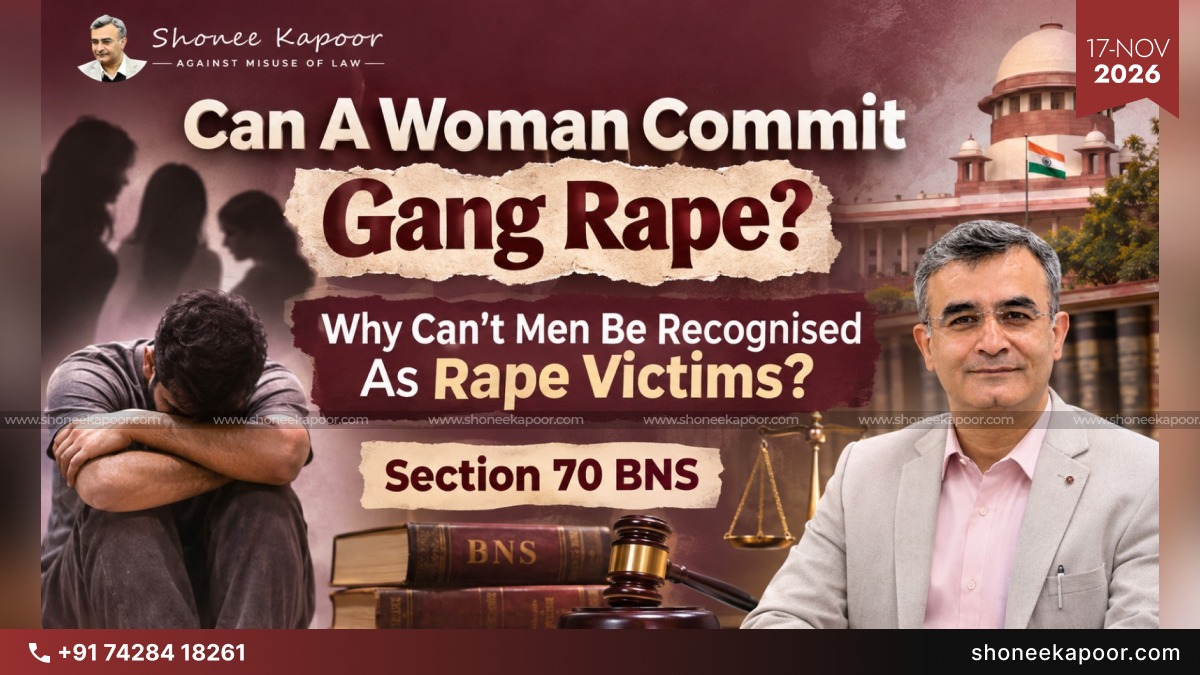
Can a Woman Commit Gang Rape? Section 70 BNS Explained

Written and analysed by Vaibhav Ojha
Head Of Legal CommunicationsWomen can face gang rape charges without physically committing rape, the Delhi High Court has ruled. But if India can recognise women as offenders, why does its rape law still not expressly recognise men as victims?
NEW DELHI: For decades, the discussion surrounding rape in India has largely revolved around two predetermined identities: a male offender and a female victim.
But criminal intention has no gender.
On 15 October 2026, the Delhi High Court delivered a significant judgment holding that a woman can also be charged with gang rape under Section 376D IPC and Section 70 of the Bharatiya Nyaya Sanhita (BNS), 2023, even if she has not personally committed the physical act of rape.
The judgment raises a much larger question about India's criminal justice system.
If gender cannot protect a woman from criminal liability, why should gender deprive a man of legal protection?
What is Section 70 BNS?
Section 70 of the Bharatiya Nyaya Sanhita, 2023, deals with the offence of gang rape. It substantially carries forward the gang rape provisions introduced into the IPC through the Criminal Law (Amendment) Act, 2013, with changes to the punishment framework for minor victims.
The provision uses three legally significant expressions:
- “persons”
- “common intention”
- “deemed to have committed the offence of rape”
These expressions are important because liability for gang rape is not necessarily restricted to individuals who physically commit rape.
A person who intentionally participates in the commission of the offence through common intention may also incur criminal liability.
Read the Bharatiya Nyaya Sanhita, 2023 – Official Government Text
What is the punishment under Section 70 BNS?
| Provision | Offence | Punishment |
|---|---|---|
| Section 70(1) BNS | Gang rape of an adult woman | Minimum 20 years of rigorous imprisonment, extending to imprisonment for the remainder of natural life, and fine |
| Section 70(2) BNS | Gang rape of a girl below 18 years | Imprisonment for the remainder of natural life and fine, or death |
Both provisions are cognizable, non-bailable and triable by a Court of Session.
Once the ingredients of the offence are established, a female participant can also face the applicable statutory punishment under the interpretation adopted by the Delhi High Court.
Section 63 vs Section 70 BNS: Why does the difference matter?
Although both provisions deal with sexual offences, their statutory language is fundamentally different.
Section 63 BNS defines rape by expressly referring to a man as the perpetrator.
Section 70 BNS, however, uses the gender-neutral expression persons while determining criminal responsibility for gang rape.
| Legal aspect | Section 63 BNS | Section 70 BNS |
|---|---|---|
| Offence | Rape | Gang rape |
| Corresponding IPC provision | Section 375 | Sections 376D, 376DA and 376DB |
| Statutory language concerning offender | Man | Persons |
| Female offender | Not expressly recognised as a principal offender | Can face charges through group participation or common intention |
| Adult male victim | Not expressly recognised | Not expressly recognised |
| Individual physical commission | Concerns acts constituting rape | Not necessary for every participant |
Section 70 introduces gender-neutrality in determining the liability of participants. It does not make the entire rape law gender-neutral.
Delhi High Court: A woman can be charged with gang rape
Ansxxx & Anr. v. State of NCT of Delhi & Anr. (2026)
On 15 October 2026, Justice Anup Jairam Bhambhani of the Delhi High Court examined whether a woman could legally face gang rape charges.
The case arose from allegations that a mother had threatened and forced her minor daughter to have sexual relations with another accused and had remained present during the alleged offences.
The woman challenged the trial court's decision to frame charges, primarily arguing that rape is statutorily defined as an offence committed by a man.
The High Court began its judgment with a German proverb:
“He who holds the ladder is as guilty as the thief.”
What was argued before the High Court?
The petitioners' argument: Since Section 63 BNS identifies a man as the offender, the expression persons under Section 70 BNS should also be restricted to men.
The petitioners relied upon earlier Supreme Court judgments in Priya Patel v. State of M.P. and State of Rajasthan v. Hemraj.
The Amicus Curiae's argument: The 2013 criminal law amendment created gang rape as a distinct substantive offence. Consequently, the older Supreme Court judgments needed to be examined in the context of the statutory provisions then in force.
The State adopted the submissions of the Amicus Curiae.
What did the Delhi High Court decide?
The Court interpreted gang rape as a separate offence involving collective criminal responsibility. It rejected the proposition that all participants must necessarily be male.
At the same time, it did not decide whether a woman could independently commit rape under Section 63 BNS.
The criminal revision petition was dismissed, and the order framing charges was upheld.
| Case details | Particulars |
|---|---|
| Case title | Ansxxx & Anr. v. State of NCT of Delhi & Anr. |
| Neutral citation | 2026:DHC:9197 |
| Case number | CRL.REV.P. 37/2025 |
| Bench | Justice Anup Jairam Bhambhani |
| Judgment date | 15 October 2026 |
| Result | Order framing charges upheld |
The High Court permitted the prosecution to proceed. It did not convict the accused.
Read Detailed Coverage on ShoneeKapoor.com
Download the Original 45-Page High Court Judgment
Landmark Indian judgments on women as sexual offenders
The Delhi High Court judgment cannot be properly understood without examining how Indian rape laws have evolved over the past two decades.
1. Priya Patel v. State of Madhya Pradesh (2006)
Supreme Court of India | (2006) 6 SCC 263 | 12 July 2006
The case involved allegations that a woman facilitated a rape committed by her husband.
The Supreme Court held that a woman could not be prosecuted for gang rape under the then-existing Section 376(2)(g) IPC.
However, the Court left open the possibility of prosecution for abetment, if legally permissible and supported by the facts.
This judgment was delivered before the 2013 criminal law amendment, when gang rape was dealt with under the aggravated punishment provisions of Section 376 IPC.
Read the Full Supreme Court Judgment – Priya Patel
2. State of Rajasthan v. Hemraj & Anr. (2009)
Supreme Court of India | (2009) 12 SCC 403 | 27 April 2009
The Supreme Court reiterated the legal position adopted in Priya Patel while examining criminal liability under the old IPC framework.
The State's appeal was dismissed.
Both judgments must be understood in light of the statutory language and legal framework that existed before the 2013 amendment.
Download the Original Supreme Court Judgment
3. Suneeta Pandey v. State of U.P. & Anr. (2023)
Allahabad High Court | Application U/S 482 No. 39234/2022 | 13 February 2023
Justice Shekhar Kumar Yadav examined whether a woman could be summoned to face trial for gang rape under the amended Section 376D IPC.
The High Court held that a woman who facilitates gang rape may also be prosecuted because the expression person under Section 376D is not restricted to men.
The application challenging the summoning order was dismissed.
This judgment demonstrated the importance of distinguishing the post-2013 gang rape provision from its predecessor.
Read the Full Allahabad High Court Judgment
Download the Official Indian Law Reports – Allahabad High Court, Page 780
4. Sundari Gautam v. State of NCT of Delhi (2024)
Delhi High Court | 2024:DHC:5944 | 9 August 2024
The Delhi High Court examined whether a woman could face charges of aggravated penetrative sexual assault under the POCSO Act.
The Court held that Sections 3 and 5 of the POCSO Act apply irrespective of the offender's gender.
The pronoun used in the statutory provision could not be interpreted in a manner that defeated the legislative objective of protecting children from sexual abuse.
The woman's challenge to the framing of charges was rejected.
Read the Full Delhi High Court Judgment
5. Raju @ Umakant v. State of Madhya Pradesh (2025)
Supreme Court of India | 2025 INSC 615 | 1 May 2025
The Supreme Court reiterated the principle of collective criminal liability in gang rape cases.
Where the prosecution establishes that the accused acted together with the requisite common intention, separate proof of the completed physical act of rape by every participant is unnecessary.
Although this judgment concerned the older IPC provision and did not specifically decide female liability, it explains the principle of common intention underlying gang rape offences.
Download the Original Supreme Court Judgment
How Indian gang rape laws evolved from 2006 to 2026
| Year | Legal development |
|---|---|
| 2006 | Supreme Court excludes women from gang rape liability under the then-existing provision in Priya Patel |
| 2009 | Supreme Court reiterates its earlier interpretation in Hemraj |
| 2012 | POCSO Act introduces gender-neutral protection for children |
| 2013 | Section 376D IPC creates a standalone gang rape provision |
| 2023 | Allahabad HC recognises potential female liability under Section 376D IPC |
| 2024 | Section 70 BNS comes into force |
| 2024 | Delhi HC recognises female liability for penetrative sexual assault under POCSO |
| 2025 | Supreme Court reiterates the principle of collective liability in gang rape |
| 2026 | Delhi HC holds that women can face gang rape charges under Section 70 BNS |
The Delhi High Court has not overruled the earlier Supreme Court judgments. Rather, it has distinguished them on the basis of changes in the statutory framework.
When can a woman be charged with gang rape?
Depending on the facts and evidence, a woman may face prosecution if she:
- Intentionally restrains a victim to facilitate rape.
- Threatens or coerces a victim into submitting to sexual assault by another person.
- Knowingly assists in carrying out a common criminal plan involving rape.
- Deliberately prevents a victim from escaping as part of the commission of the offence.
- Otherwise participates in furtherance of the common intention to commit the offence.
However, mere presence at the crime scene, acquaintance with the accused or a family relationship does not, by itself, establish criminal liability.
The prosecution must establish the necessary ingredients of the offence.
Gender should neither be evidence of guilt nor a defence against proven criminal conduct.
Can a woman be charged with rape if she acts alone?
Section 63 BNS continues to define the principal offence of rape in male-specific terms.
The Delhi High Court, in its October 2026 judgment, expressly clarified that it was not deciding whether a woman could independently commit rape within the meaning of Section 63 BNS.
Other provisions concerning abetment, criminal intimidation, hurt, wrongful confinement or sexual offences against children may apply depending on the circumstances.
Therefore, claiming that India has completely gender-neutral rape laws after this judgment would be legally incorrect.
Does the POCSO Act recognise women as sexual offenders?
Yes.
Unlike the general rape provisions under the BNS, the Protection of Children from Sexual Offences Act, 2012, provides protection to children irrespective of gender.
A child below 18 years of age may be a victim, whether male or female. Women can also be prosecuted as offenders.
| Provision | Legal meaning |
|---|---|
| Section 2(1)(d) POCSO | Defines a child as a person below 18 years |
| Section 3 POCSO | Penetrative sexual assault |
| Section 5(g) POCSO | Gang penetrative sexual assault |
| Section 6 POCSO | Punishment for aggravated penetrative sexual assault |
| Section 7 POCSO | Sexual assault |
| Sections 16–17 POCSO | Abetment and its punishment |
The Delhi High Court's decision in Sundari Gautam reinforces this position.
India already has a statutory model that recognises female sexual offenders and male victims.
Why should the principle of gender-neutral protection disappear when a boy turns 18?
Read the POCSO Act – Official India Code Website
Can a man be a rape victim under Indian law?
This remains one of the most significant gaps in India's criminal justice system.
An adult male victim of sexual assault is not expressly recognised as a rape victim under Sections 63 and 70 BNS.
The problem became more serious when the Bharatiya Nyaya Sanhita replaced the Indian Penal Code on 1 July 2024 without retaining an equivalent of Section 377 IPC.
What happened to Section 377 IPC?
In Navtej Singh Johar & Ors. v. Union of India, (2018) 10 SCC 1, the Supreme Court decriminalised consensual private sexual acts between adults covered by Section 377 IPC.
However, the judgment did not decriminalise non-consensual acts covered by that provision.
The BNS subsequently omitted Section 377 IPC without introducing an equivalent provision specifically addressing such non-consensual acts against adult male victims.
Other criminal remedies may still be available, depending on the facts, but they are not equivalent to express recognition under the rape provisions.
Download the Original Supreme Court Judgment – Navtej Singh Johar
Read the Detailed Judgment Analysis
Parliament was warned about the legal gap
The Parliamentary Standing Committee on Home Affairs, in its 246th Report on the Bharatiya Nyaya Sanhita, 2023, specifically highlighted the consequences of omitting Section 377 IPC.
In paragraphs 1.16 and 1.17, the Committee identified the absence of equivalent protection against certain non-consensual sexual acts and recommended retaining Section 377 in the proposed criminal law.
Despite this recommendation, the enacted BNS did not include an equivalent provision.
The legal gap was identified even before the new criminal laws came into force.
Male victims were not an unforeseeable consequence of criminal law reform. Their inadequate protection was a concern that had already been formally raised.
Read the Official Parliamentary Standing Committee Recommendations – 246th Report
Delhi High Court and the demand for gender-neutral rape laws
In August 2026, the Delhi High Court examined arguments in a public interest litigation challenging the gender-specific nature of several sexual offence provisions under the BNS.
The Division Bench comprising Chief Justice Devendra Kumar Upadhyaya and Justice Tejas Karia discussed the limits of judicial interpretation.
During the hearing, the Bench reportedly asked:
“Can we by judicial fiat create an offence?”
The Court indicated that creating a new criminal offence falls within the legislative domain.
These were reported courtroom observations, not a final declaration making rape laws gender-neutral.
The larger responsibility for addressing the statutory gap therefore rests with Parliament.
Read the Detailed Courtroom Coverage on ShoneeKapoor.com
What should real gender-neutral rape laws look like?
Article 14 of the Constitution guarantees equality before the law and equal protection of the laws. Article 21 protects life and personal liberty, including human dignity.
Article 15(3) permits special provisions for women and children. However, protecting women does not require Parliament to ignore sexual violence against adult men.
India must consider criminal law reforms that ensure:
- Gender-neutral recognition of sexual offenders.
- Gender-neutral recognition of victims of sexual violence.
- Punishment proportionate to the offence, irrespective of gender.
- Equal access to victim rehabilitation and legal remedies.
- Fair investigation, due process and protection against malicious prosecution.
The demand for men's rights is not a demand to dilute women's safety.
It is a demand to extend justice to those who remain inadequately protected.
Crime has no gender. Why should justice?
I welcome judicial interpretations that hold offenders accountable irrespective of their gender.
But recognising women as potential offenders in gang rape cases is only one part of the solution.
The other, equally important part is recognising men as potential victims.
A woman who commits a crime must face the law. A man who suffers a crime must receive its protection.
Neither should depend on gender.
India does not need fewer protections for women. It needs equal protection for every victim. That is real gender neutrality.
FAQs
1. Can a woman be charged with gang rape in India?
Yes. The Delhi High Court held in October 2026 that women can face gang rape charges under Section 70 BNS through group participation or common intention.
2. What is the punishment under Section 70 BNS?
A minimum of 20 years' rigorous imprisonment for gang rape of an adult woman. For a victim below 18, natural-life imprisonment with fine or death.
3. Is Section 70 BNS gender-neutral?
It is gender-neutral regarding participants in gang rape, as interpreted by the Delhi High Court, but not regarding all victims.
4. Can a woman be punished under the POCSO Act?
Yes. The POCSO Act recognises sexual offenders and child victims irrespective of gender.
5. Can an adult man file a rape case under Section 63 BNS?
Section 63 BNS does not expressly recognise adult male rape victims. Other criminal remedies may apply depending on the facts.
Read also
- Why Indian Laws Treat Men As Guilty Until Proven Innocent
- The Law That Forgot Its Sons: How India's Gender Laws Turn Protection Into Persecution
- Understanding Men's Rights and Legal Inequality in India
- Why India Needs Gender-Neutral Domestic Violence Laws
Disclaimer: This article is intended for legal awareness and educational purposes. Criminal liability and the applicability of statutory provisions depend upon the facts, evidence and date of the alleged offence.





Share Your Thoughts
Comments are moderated before publication.