
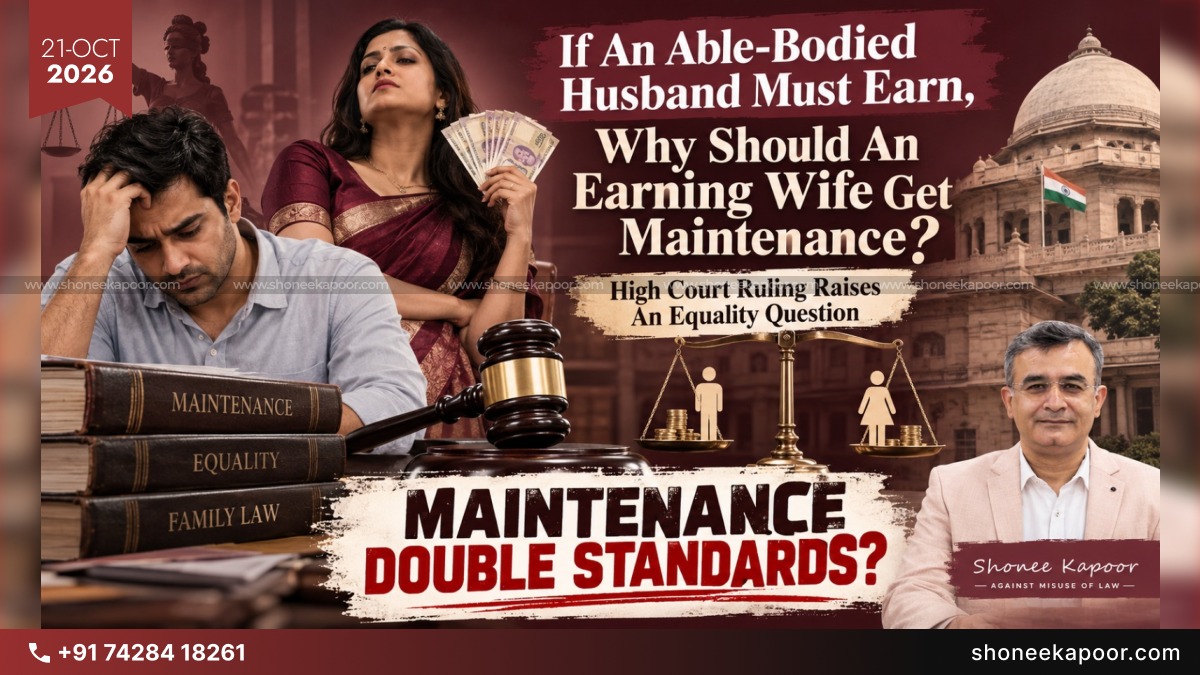
If An Able-Bodied Husband Must Earn, Why Should An Earning Wife Get Maintenance? High Court Ruling Raises An Equality Question

Written and analysed by Vaibhav Ojha
Head Of Legal CommunicationsNEW DELHI: India's maintenance laws are meant to protect genuine financial dependence, not create an automatic entitlement to a spouse's earnings.
Yet the question remains:
Why should a working husband be expected to support himself while an educated or earning wife seeks financial support without establishing genuine need?
The law does not automatically deny maintenance to an educated wife. But recent judgments show that independent income, deliberate unemployment and financial disclosure can make or break a maintenance claim.
1. Madras High Court Rejects Husband's Maintenance: Prove You Cannot Earn
Case: Radha v. Selvakumar
Madras High Court | Justice M. Dhandapani | 8 July 2025
A husband sought maintenance under Section 24 of the Hindu Marriage Act from his wife, who was employed in the Tamil Nadu Police Department.
His counsel argued that an accident had left him disabled and unable to work. The wife's counsel opposed the order, explaining that she was supporting herself and their son.
The Court observed:
"If he is capable of earning but chooses not to, his claim will likely be rejected."
The husband failed to establish a physical or mental disability preventing him from earning. The High Court therefore set aside the maintenance order.
The question is unavoidable: If a husband must establish genuine inability to earn, why shouldn't equivalent financial scrutiny apply to a wife?
The judgment did not declare all husbands ineligible for maintenance. It decided the case on the evidence presented.
2. Delhi High Court: Educated Wife Cannot Remain Idle Just to Claim Maintenance
Case: Megha Khetrapal v. Rajat Kapoor
Delhi High Court | Justice Chandra Dhari Singh | 19 March 2025
The wife possessed an international business qualification and had previous professional experience, including employment in Dubai.
The husband relied on her employment history and a disputed WhatsApp conversation suggesting that taking up employment could affect her alimony claim. The Court considered this material prima facie; the conversation's authenticity remained a matter for trial.
The High Court observed that a well-educated wife with suitable professional experience ought not to remain unemployed solely to obtain maintenance.
Result: The Court upheld the rejection of her interim maintenance application under Section 125 CrPC, considering the case's particular facts.
How to Draft a Reply to an Interim Maintenance Application: Husband’s Complete Defence Guide
This was not a declaration that every educated woman loses maintenance. The decision turned on evidence suggesting deliberate avoidance of employment.
3. Bombay High Court Rejects ₹1 Lakh Maintenance Claim by Earning Wife
Case: RPS v. PS, Interim Application 3958/2025
Bombay High Court | Justices Bharati Dangre and Manjusha Deshpande | 17 July 2026
A US-based woman earning USD 8,700 gross per month sought ₹1 lakh in monthly interim maintenance from her former husband during a pending divorce appeal.
She cited high living expenses and financial responsibilities.
The Court found that she had sufficient independent income and rejected her application under Section 24 of the Hindu Marriage Act.
The Court did not accept high living costs abroad, on these facts, as sufficient grounds to shift her expenses onto her former husband.
Her appeal concerning permanent alimony remained pending. The High Court's rejection concerned the interim application.
4. Delhi High Court Reduces Maintenance: Husband's Salary Is Not the Only Factor
Case: Ashutosh Rai Asthana v. Yamita Rai Asthana
Delhi High Court | Justice Saurabh Banerjee | 11 August 2026
The husband had an annual income exceeding ₹63 lakh in the relevant tax return.
However, the Court also examined the wife's MBA qualification, ₹10,450 monthly rental income, ₹4,400 monthly fixed-deposit interest, her accommodation and the husband's responsibility for their children's expenses.
Result: Interim maintenance reduced from ₹30,000 to ₹25,000 per month.
The Court did not eliminate maintenance, but held that the husband's earnings could not be considered in isolation.
5. Delhi Court Rejects Working Wife's ₹60,000 Maintenance Claim
Tis Hazari Courts | Mahila Court-01 | 7 September 2026
In a reported domestic violence proceeding, the wife earned ₹63,863 monthly as a Systems Engineer, while the husband disclosed approximately ₹1.63 lakh monthly income.
Despite the income disparity, the court dismissed her application for ₹60,000 monthly interim maintenance under Section 23 of the Domestic Violence Act.
The court found her financially capable of maintaining herself. A higher-earning husband did not automatically create an interim maintenance entitlement.
Importantly, the decision did not dispose of the underlying domestic violence allegations.
WHAT DOES INDIAN MAINTENANCE LAW ACTUALLY SAY IN 2026?
| Provision | Legal position |
|---|---|
| Section 24, Hindu Marriage Act | Either spouse may seek interim maintenance and litigation expenses if their independent income is insufficient. |
| Section 25, Hindu Marriage Act | Either spouse may seek permanent alimony; income, property and other statutory circumstances are relevant. |
| Section 144, BNSS | Provides maintenance for a wife unable to maintain herself, along with specified children and parents. It succeeds Section 125 CrPC, which remains relevant in older proceedings. |
| Sections 20 and 23, DV Act | Permit monetary relief and interim orders subject to statutory requirements and judicial assessment. |
There is an important Supreme Court limitation.
In Shailja v. Khobbanna, (2018) 12 SCC 199, the Supreme Court distinguished a wife's ability to earn from her actual earnings. Educational qualifications alone cannot automatically justify reducing maintenance.
Similarly, the Delhi High Court in Rakesh Ray v. Priti Ray, decided on 16 February 2026, recognised that unpaid domestic labour and childcare cannot simply be dismissed as idleness.
The legally defensible distinction is between proven financial need and deliberate financial dependence—not merely between employed and unemployed spouses.
EQUALITY MUST WORK BOTH WAYS
I am not arguing that genuinely dependent wives should be denied maintenance. Nor should children's financial rights be compromised.
I am questioning why a capable adult's financial responsibility should be judged differently merely because of gender.
If a husband must establish his inability to earn, a wife's actual earnings, assets, employment history and evidence of voluntary unemployment must also receive serious examination.
If a wife is genuinely financially independent, her husband's larger salary should not automatically become her entitlement.
Maintenance should protect financial vulnerability, not reward deliberate dependency.
Equality cannot mean financial independence for one spouse and permanent financial responsibility for the other.
A husband is a spouse, not an unlimited financial guarantee.
FAQ’S
1. Can an earning wife claim maintenance in India?
Yes. But her actual income, financial needs and the applicable law determine entitlement. Employment alone is not an automatic disqualification.
2. Can an educated wife be denied alimony?
Yes, on appropriate evidence. However, education or earning capacity alone does not automatically defeat maintenance.
3. Can a husband claim maintenance from his earning wife?
Yes. Sections 24 and 25 of the Hindu Marriage Act are gender-neutral, subject to their statutory requirements.
4. Can a husband challenge maintenance if his wife hides her income?
Yes. He can produce relevant financial evidence and seek appropriate relief. Rajnesh v. Neha requires financial disclosure in maintenance proceedings.
5. Is maintenance compulsory when the husband earns more?
No. A salary difference alone does not automatically establish entitlement. Courts consider income, needs, liabilities and the applicable legal test.





Share Your Thoughts
Comments are moderated before publication.