
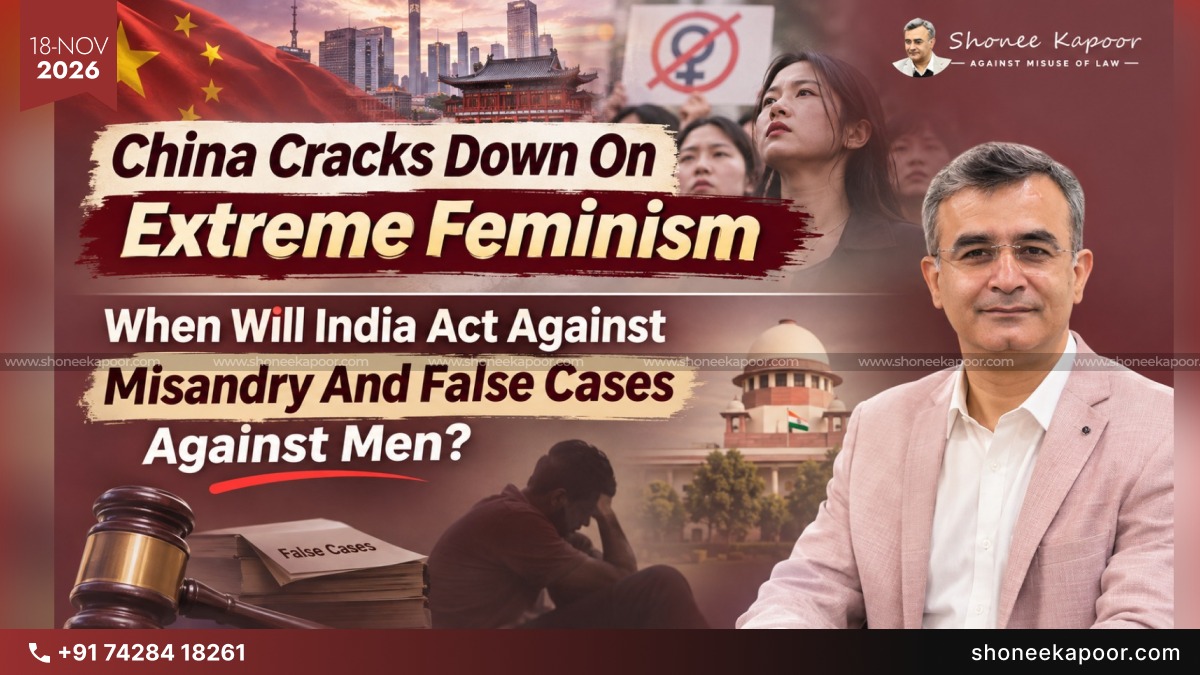
China Cracks Down On Extreme Feminism: When Will India Act Against Misandry And False Cases Against Men?

Written and analysed by Shonee Kapoor
Legal Consultant, Author & Men's Rights ActivistNEW DELHI: China has officially targeted extreme feminism and deliberate online gender antagonism. Meanwhile, Indian men fighting malicious criminal proceedings can face arrest, financial losses, humiliation and years of litigation. Who restores the years lost by an innocent accused?
What exactly has China done against extreme feminism?
On 19 January 2025, the Cyberspace Administration of China launched a month-long campaign targeting harmful online content, including extreme feminism, deliberate gender antagonism, anti-marriage and anti-childbirth narratives, and violent content. This was not a blanket ban on feminism.
Official Chinese government directive — 19 January 2025
A subsequent enforcement report dated 10 March 2026 reported action against more than 39,000 accounts and removal of over 708,000 posts across a broader campaign, not exclusively feminist accounts.
Figure 1. Reported minimum counts; broader campaign, not exclusively feminist content.
Chinese regulator enforcement report
Women’s empowerment or men’s persecution?
There is nothing wrong with demanding women’s rights. There is everything wrong with using legal protections to deny others their rights. When a man is falsely implicated, his parents and relatives may face proceedings too. An allegation can damage a reputation long before evidence is tested. Empowerment must never become a licence for malicious prosecution.
Are 99% of dowry cases false in India?
A reported Delhi RTI-based dataset for 2021–2024 recorded 23 convictions among 9,950 cases examined, alongside 4,655 quashings and 736 acquittals. The original RTI response has not been independently retrieved. Non-conviction is not proof of fabrication, and the dataset is not a nationwide false-case rate.
Figure 2. 2021–2024; 0.23% recorded convictions in the dataset, not a completed-trial conviction rate.
Detailed analysis on ShoneeKapoor.com
An acquittal can end a prosecution. It cannot return the years spent fighting it.
NCRB 2024: India’s matrimonial litigation crisis
Published analyses of Crime in India 2024 report the following figures for cruelty by a husband or his relatives. The complete original disposal tables were not independently retrieved; treat these as secondary-source figures pending verification.
|
Measure |
Reported figure |
|
New cases registered |
1,20,227 |
|
Cases classified false by police |
4,593 |
|
Cases charge-sheeted |
1,08,574 |
|
Cases pending trial |
8,54,798 |
|
Trial pendency rate |
92.2% |
Figure 3. Reported NCRB 2024 conviction rate; non-conviction does not establish a false complaint.
Genuine victims deserve speedy justice. Innocent accused persons deserve speedy justice too.
More than 86,000 married men died by suicide in 2024
NCRB’s Accidental Deaths & Suicides in India 2024 records 86,564 married men and 28,612 married women who died by suicide. These are counts across all recorded causes, not deaths attributable solely to matrimonial disputes or false cases.
Figure 4. NCRB ADSI 2024, Figure 2.9. Counts, not population-adjusted rates.
Men’s suffering should not have to end in a death certificate before society acknowledges it.
Six Supreme Court judgments on misuse of matrimonial laws
Sushil Kumar Sharma v. Union of India (2005) | (2005) 6 SCC 281
The Court upheld Section 498A IPC while warning that misuse could unleash a new form of legal terrorism.
Arnesh Kumar v. State of Bihar (2014) | (2014) 8 SCC 273
The Court directed police to assess the necessity of arrest rather than arresting automatically. Section 35 BNSS now contains corresponding statutory safeguards.
Kahkashan Kausar v. State of Bihar (2022) | (2022) 6 SCC 599
The Court quashed proceedings against relatives facing general allegations without specific roles. The husband’s allegations were not examined in that appeal.
Shivangi Bansal v. Sahib Bansal (2025)
The husband spent 109 days in jail and his father 103 days. The Court directed a public apology as part of the resolution, without treating it as an admission of legal liability.
State of Uttar Pradesh v. Ajmal Beg (2025)
The Court recognised both genuine dowry harassment and misuse of protective legislation. It restored convictions in the particular case before it.
Arti Mehta v. State of Madhya Pradesh (2026) | 2026 INSC 533
The Court quashed proceedings against four relatives and cautioned against using criminal proceedings to settle personal grievances. The husband’s prosecution was not terminated.
Figure 5. Days in custody as reported in the Supreme Court judgment of 22 July 2025.
India changed IPC to BNS. Did it change gender inequality?
|
Provision |
Legal position |
|
85–86 BNS |
Cruelty against a woman by husband or relatives; definition of cruelty. |
|
69 BNS |
Sexual intercourse with a woman through specified deceit, including a promise to marry without intention to fulfil it, not amounting to rape. |
|
63 BNS |
Rape defined with male perpetrator and female victim. |
|
DV Act, Section 2(a) |
Aggrieved person defined as a woman. |
Men retain general civil and criminal remedies but lack equivalent protection under these particular provisions.
Can women be punished for filing false cases?
|
Provision |
Purpose |
|
217 BNS |
False information intended to cause a public servant to misuse lawful power. |
|
229 BNS |
Punishment for false evidence. |
|
246 BNS |
Dishonestly making a false claim in court. |
|
248 BNS |
False criminal charge with intent to injure. |
|
273 BNSS |
Compensation in qualifying Magistrate-triable cases for accusations without reasonable cause. |
|
528 BNSS |
High Court’s inherent powers. |
Section 248(a) BNS provides up to five years’ imprisonment, a fine up to two lakh rupees, or both. Section 248(b) provides up to ten years and a fine for specified serious false charges. Acquittal alone does not establish liability. Statutory ingredients and procedural requirements, including Section 215 BNSS where applicable, must be satisfied.
Bharatiya Nagarik Suraksha Sanhita, 2023
What India must learn from China
India need not copy censorship. It needs constitutional, gender-neutral reforms:
· Consistent action against unlawful threats, targeted harassment and defamation.
· Gender-neutral domestic violence and sexual offence protections.
· Accountability for proven deliberately false accusations.
· Compensation for proven malicious prosecution and wrongful imprisonment.
· Time-bound investigations and matrimonial criminal trials.
· A National Commission for Men.
· Transparent data distinguishing false complaints, settlements, quashings and acquittals.
The Constitution belongs to men too
Articles 14 and 21 guarantee equality before the law and protection of life and personal liberty. Article 15(3) permits special provisions for women and children. Article 19 protects expression subject to constitutional restrictions. Special protection cannot justify arbitrary arrest or malicious prosecution.
My position as a men’s rights activist
I do not oppose women’s rights. I oppose the misuse of women’s rights to violate men’s rights. I do not demand immunity for men who commit crimes. I demand accountability for anyone who deliberately fabricates allegations. India does not need a war against women. India needs a fight against gender discrimination, false prosecution and selective justice. Punish the crime, not the gender.
FAQ’S
Has China banned feminism?
No. It has targeted extreme feminism and gender antagonism as part of wider online regulation.
Are 99% of 498A cases false?
No official nationwide data establishes that claim.
Can a woman be jailed for filing a false case?
Yes, if the ingredients of an applicable offence such as Section 248 BNS are proved.
Is Section 498A IPC still applicable?
It may apply to older offences; Sections 85–86 BNS are the corresponding new provisions.
Does India need gender-neutral laws?
Equivalent protection for male victims and safeguards against misuse are important reforms.




Share Your Thoughts
Comments are moderated before publication.