



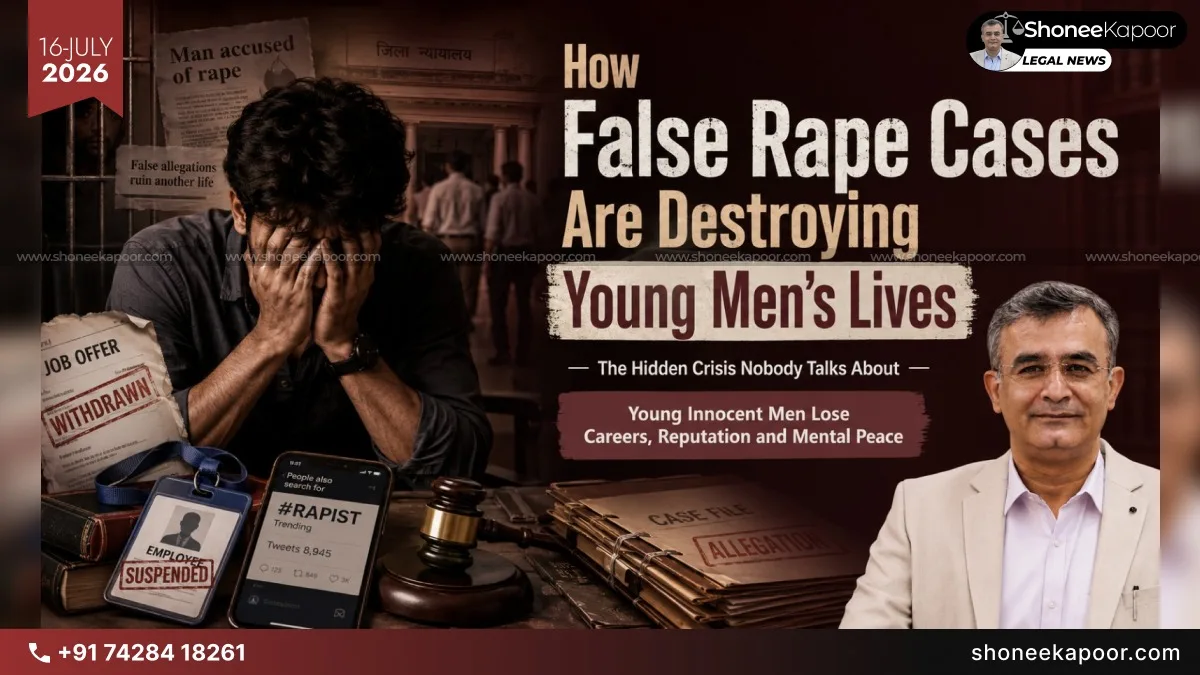
A young man may eventually prove his innocence, but who returns his lost career, reputation, relationships and years spent inside courtrooms? Recent Supreme Court and Delhi High Court judgments expose the permanent damage caused when consensual relationships or personal disputes are converted into rape prosecutions.
False Rape Cases in India: One False Allegation Can Destroy a Career, Reputation and Future Before Innocence Is Proven.
One allegation.
One FIR.
One night of police questioning.
And before any court examines the evidence, a young man can lose his liberty, education, employment, relationship, reputation and standing within his own family.
His name begins circulating on WhatsApp. His employer starts asking questions. His marriage prospects collapse. Friends distance themselves. His parents begin visiting police stations and courtrooms instead of planning his future.
Years later, the case may be quashed. He may be discharged. He may even be honourably acquitted.
But who returns those years?
Who repairs the reputation?
Who erases his name from internet searches?
Who explains to society that an accused man was never a convicted man?
That is the hidden crisis behind deliberately false rape allegations: the criminal case may eventually end, but the punishment imposed by the allegation can continue for life.
In December 2025, the Delhi High Court expressly recognised that a falsely implicated accused may suffer loss of reputation, incarceration, social stigma and psychological trauma, leaving scars that remain “unhealed for a lifetime.” The Court also warned that false sexual-offence complaints damage the credibility of genuine survivors.
THIS IS NOT AN ARGUMENT AGAINST GENUINE RAPE SURVIVORS
Rape is a grave offence. A woman subjected to sexual violence deserves protection, dignity, investigation, legal assistance and a fair trial.
No serious person disputes that.
But supporting genuine victims does not require the destruction of innocent men.
A legal system cannot maintain credibility by treating every complainant as dishonest. It also cannot maintain credibility by treating every accused man as guilty from the moment an allegation is made.
JUSTICE REQUIRES INVESTIGATION—NOT GENDER-BASED ASSUMPTIONS.
False complaints harm two sets of people:
- The innocent man who is arrested, humiliated or prosecuted.
- The genuine survivor whose truthful complaint is later viewed with greater suspicion because another person misused the same law.
The Delhi High Court has made the same point: false sexual-offence allegations weaken public confidence and can cause genuine complaints to be doubted.
FIRST, UNDERSTAND WHAT A “FALSE RAPE CASE” LEGALLY MEANS
Every acquittal is not proof that the complaint was deliberately fabricated.
Different legal outcomes must not be mixed together:
1. Deliberately false implication
The complainant knowingly invents an incident or falsely names a person to cause injury, obtain money, force marriage, settle a dispute or secure some other advantage.
2. Allegations that do not constitute rape
The facts stated in the FIR may be accepted at face value, but they still do not fulfil the legal ingredients of rape. This frequently arises where a long consensual relationship is retrospectively described as rape after a breakup.
3. Acquittal because guilt was not proved
The prosecution may fail because evidence is insufficient, inconsistent or does not prove guilt beyond reasonable doubt. That does not automatically establish that the complainant intentionally lied.
4. Retraction, settlement or withdrawal
A complainant may change her statement, exonerate the accused or seek settlement. The court must examine why the change occurred. Retraction alone does not automatically prove fabrication, but an unexplained reversal can require serious scrutiny.
A Kolkata Sessions Court reiterated in 2025 that an acquittal caused by insufficient supporting evidence cannot, by itself, establish that the original complaint was entirely false.
This distinction matters. Men’s rights advocacy must be based on evidence, not inflated statistics.
WHAT THE LATEST NCRB DATA ACTUALLY SHOWS
According to the latest Crime in India 2024 data, India registered 29,536 rape cases during 2024. A further 1,325 cases were registered under the new BNS offence concerning sexual intercourse through deceitful means.
The rape conviction rate for cases disposed of by courts was reported at approximately 24.4%, while more than 2.06 lakh rape cases were awaiting trial.
But these numbers do not prove that the remaining cases were false.
NCRB figures reflect cases entering and moving through the criminal justice system. They are affected by reporting, registration, investigation, evidentiary problems, witness conduct, court delays and the principal-offence method used for classification.
India still lacks one clean, nationally standardised figure identifying how many rape complaints were:
- deliberately fabricated;
- closed as mistakes of fact;
- quashed because no offence was disclosed;
- withdrawn after settlement;
- or rejected after a judicial finding of intentional falsehood.
That missing distinction allows both sides of the debate to misuse statistics.
The real issue is not merely the percentage of false cases. The issue is that even one knowingly fabricated rape case can permanently dismantle an innocent man’s life.
The Law Changed On 1 July 2024
The Bharatiya Nyaya Sanhita, Bharatiya Nagarik Suraksha Sanhita and Bharatiya Sakshya Adhiniyam came into force on 1 July 2024. Older offences and proceedings may continue under the IPC and CrPC because of the applicable saving provisions.
IMPORTANT CURRENT LEGAL PROVISIONS
| LAW AND SECTION | WHAT IT COVERS | WHY IT MATTERS |
| BNS Sections 63 and 64 | Definition and punishment for rape | Genuine absence of consent remains a serious criminal offence |
| BNS Section 69 | Sexual intercourse through deceitful means or a marriage promise made without intention to fulfil it, where the act does not amount to rape | Creates a separate offence punishable with imprisonment extending to ten years and fine |
| BNS Section 217 | Knowingly giving false information to a public servant so official power is used to injure or annoy another person | Can apply where deliberately false information is supplied to activate police action |
| BNS Section 248 | Instituting a criminal proceeding or falsely charging a person while knowing there is no lawful ground | Punishment can extend to five years; the aggravated form can extend to ten years |
| BNSS Section 482 | Anticipatory bail for a person apprehending arrest in a non-bailable offence | Provides pre-arrest protection, subject to statutory exclusions and the facts of the case |
| BNSS Section 528 | Inherent power of the High Court | Allows orders necessary to prevent abuse of court process or secure the ends of justice |
| BSA Section 120 | Presumption regarding absence of consent in specified aggravated rape prosecutions under BNS Section 64(2) | The presumption is limited; it is not a universal rule covering every rape prosecution |
BNS Section 69 expressly applies where intercourse was obtained by deceitful means or a promise to marry made without any intention of fulfilling it, but the conduct does not amount to rape. The provision also includes false promises of employment or promotion and marriage by suppressing identity within its explanation.
BNS Section 248 requires more than an acquittal. It requires proof that a person instituted proceedings or made a charge knowing that no just or lawful ground existed, and did so with intent to cause injury.
Similarly, BNS Section 217 applies when a person knowingly gives false information intending, or knowing it is likely, that a public servant will use lawful authority to injure or annoy another person.
These provisions exist. Their application, however, is neither automatic nor guaranteed merely because an accused has been acquitted.
A BREAKUP IS NOT AUTOMATICALLY RAPE
One of the most frequently litigated categories involves sexual relationships followed by an allegation that consent was obtained through a false promise of marriage.
The legal question is not simply:
“Did the marriage eventually happen?”
The actual questions are:
- Was the promise false from the beginning?
- Did the man never intend to marry when the promise was made?
- Was that deception directly responsible for the woman’s consent?
- Or was this a voluntary relationship that later failed because of family opposition, incompatibility, changed circumstances or a breakup?
The Supreme Court has repeatedly distinguished a false promise existing from inception from a genuine promise that could not subsequently be fulfilled.
A failed relationship is painful.
It is not automatically rape.
LANDMARK INDIAN JUDGMENTS EVERY YOUNG MAN SHOULD KNOW
1. Amol Bhagwan Nehul v. State of Maharashtra, 2025 INSC 782
This case directly concerned a 23-year-old B.Sc. Agriculture student accused under serious sexual-offence provisions after a relationship and an alleged promise of marriage.
The record also contained an earlier complaint from the young man’s father claiming that the woman had threatened to implicate him in a rape case if he refused to marry her.
The Supreme Court ultimately found that the essential ingredients of the alleged offences were not established and quashed the proceedings as an abuse of process. It warned that such litigation not only burdens courts but also “blots the identity” of a person accused of a heinous crime.
This is the reality young men face.
A twenty-three-year-old student may eventually receive justice from the Supreme Court. But reaching the Supreme Court itself requires years, money, legal representation and emotional endurance.
The quashing order closes the case.
It does not automatically restore the life that existed before the FIR.
2. Biswajyoti Chatterjee v. State of West Bengal, 2025 INSC 458
The Supreme Court examined allegations arising from an adult relationship in which both parties were mature and aware of the relevant personal circumstances.
The Court found the relationship consensual, noticed serious inconsistencies and terminated the proceedings at the stage of charge.
Its recorded observation was categorical:
“Every consensual relationship… cannot be given a colour of a false pretext to marry.”
The Court also noted a growing tendency to initiate criminal proceedings after relationships turn sour and held that such litigation can amount to abuse of process.
A criminal court is not a breakup-resolution forum.
Penal law cannot be used to convert every failed emotional expectation into a sexual offence.
3. Mahesh Damu Khare v. State of Maharashtra, 2024 INSC 897
The Supreme Court reiterated that criminal liability requires a direct connection between the allegedly false marriage promise and the sexual relationship.
Where a relationship continues knowingly for a prolonged period, the court must examine whether the relationship existed solely because of the promise or whether other personal considerations were involved.
The Court stressed that it would be a folly to treat every breach of a marriage promise as a false promise attracting a rape prosecution.
4. Naim Ahamed v. State (NCT of Delhi), 2023 SCC OnLine SC 89
The Supreme Court distinguished rape from consensual sex and distinguished a deliberately false promise from a genuine promise later broken by unforeseen circumstances.
The Court held that evidence must show that the accused had no intention of honouring the promise at the initial stage itself. A subsequent inability or failure to marry is not sufficient by itself.
5. State of GNCT of Delhi v. Toshib alias Paritosh & Others, 2025:DHC:11337
In this case, the Delhi High Court upheld the discharge of three men after the complainant, in her statement before the Magistrate, said that no offence had occurred and that her relationship with one accused was consensual.
The High Court found that the subsequent voluntary reversal of detailed rape allegations required firm scrutiny. It observed that falsely implicated accused persons may suffer incarceration, stigma, psychological trauma and permanent reputational harm.
The Court also directed mechanisms through which the Delhi State Legal Services Authority can examine recovery of victim compensation where allegations are judicially found false or where no offence occurred, subject to notice and an opportunity of hearing.
This judgment recognised something the public debate routinely ignores:
False allegations do not only misuse criminal law. They may also misuse financial and institutional systems created for genuine survivors.
HOW THE ALLEGATION BECOMES THE PUNISHMENT
The Arrest And Bail Battle
A rape allegation can lead to immediate fear of arrest. The accused must urgently arrange representation, collect documents and seek appropriate protection.
BNSS Section 482 permits an anticipatory-bail application before the High Court or Court of Session where a person apprehends arrest for a non-bailable offence, subject to specific statutory exclusions.
Even when bail is eventually granted, the accused has already spent days or weeks under fear that his liberty may disappear at any moment.
The Career Damage
A young man may miss examinations, interviews or training because he is attending the police station or court.
An employee may be suspended or asked to explain the case.
A professional may face background-verification problems.
The criminal court may later find him innocent, but an employer rarely waits several years for a final judgment before making a commercial decision.
The Digital Conviction
The complainant’s identity is legally protected.
The accused man’s name, photograph and workplace may still circulate publicly before guilt is proved.
The FIR becomes a headline.
The acquittal becomes a small update—if it is reported at all.
The allegation travels faster than the judgment.
The Destruction Of Family Life
Parents spend their savings on litigation. Siblings face questions. Engagements break. Land and jewellery may be sold to pay legal fees.
The criminal proceeding may technically be against one man, but practically it places his entire family on trial.
The Psychological Damage
An accused man is repeatedly told to remain silent because any emotional reaction may be used against him.
He cannot publicly defend himself without risking further complications. He is expected to continue working, supporting his family and attending court while society has already delivered its verdict.
The Delhi High Court’s recognition of lifelong scars is therefore not rhetoric. It reflects the consequences that cannot be erased merely by a discharge order.
WHAT A FALSELY ACCUSED MAN MUST DO IMMEDIATELY
Preserve every piece of digital evidence
Secure chats, emails, call records, photographs, payment records, travel bookings, location data and prior complaints. Do not delete or edit material merely because it appears embarrassing.
A complete record is more valuable than a selectively cleaned record.
Prepare a date-wise chronology
Record when the parties met, the nature of the relationship, travel undertaken together, financial transactions, discussions concerning marriage and any threats made before the FIR.
A criminal defence is built on dates and documents—not emotional speeches.
Do not threaten or pressure the complainant
Direct calls, angry messages, public posts or attempts to force withdrawal may produce additional allegations and damage an otherwise strong defence.
Seek legal protection without delay
Depending on the allegations and procedural stage, remedies may include anticipatory bail under BNSS Section 482, regular bail, discharge or a petition invoking the High Court’s inherent jurisdiction under BNSS Section 528.
Section 528 permits the High Court to intervene where necessary to prevent abuse of court process or secure the ends of justice. It is an exceptional remedy, not an automatic shortcut around investigation or trial.
Do not file a mechanical counter-case
A counter-prosecution under BNS Sections 217 or 248 requires proof of knowledge, intention and absence of lawful grounds.
The strongest counter-action ordinarily follows clear documentary evidence, a cancellation report accepted by a court, a finding of false implication, discharge on appropriate grounds or a judgment demonstrating deliberate fabrication.
Anger is not evidence.
A judicial record is.
WHAT INDIA MUST CHANGE
1. Stop treating acquittal and falsehood as the same statistic
NCRB reporting should separately identify:
- mistakes of fact;
- intentionally false complaints;
- civil or relationship disputes given criminal form;
- cases quashed because legal ingredients were absent;
- withdrawals and settlements;
- and acquittals based purely on reasonable doubt.
Without separate categories, public debate will remain dishonest.
2. Record the consequences suffered by acquitted accused persons
The system records the complaint, arrest, charge sheet and trial.
It does not adequately record the job lost, education interrupted, family debt incurred or years consumed by a prosecution that should never have continued.
3. Apply false-charge provisions where intentional fabrication is proved
A false complainant should not be punished merely because the accused was acquitted.
But where a court records deliberate fabrication, intentional false implication or misuse designed to injure another person, BNS Sections 217 and 248 should not remain decorative provisions.
4. Protect identity before guilt is judicially established
The complainant’s privacy must remain protected.
At the same time, lawmakers must seriously consider restricting publication of an accused person’s identity at least until charges are framed, subject to narrowly defined public-interest exceptions.
The present imbalance permits irreversible public punishment before judicial scrutiny.
5. Create compensation for demonstrably malicious prosecution
Where deliberate false implication is established through a clear judicial finding, the wrongfully prosecuted person should have access to an effective compensation mechanism.
An acquittal certificate is not compensation.
Words of sympathy do not repay legal fees or rebuild a career.
6. Make investigation evidence-driven from the first day
Police must preserve chats, CCTV recordings, call records, payment trails, location evidence and previous complaints promptly.
Evidence should decide whether a case proceeds.
Not pressure from social media.
Not the gender of the complainant.
Not the fear of criticism.
MY POSITION AS A MEN’S RIGHTS ACTIVIST
Protect every genuine rape survivor.
Investigate every serious complaint.
Punish every man whose guilt is proved through a fair trial.
But stop pretending that false rape allegations are harmless mistakes.
A deliberately fabricated rape allegation is not a minor lie. It is an attempt to use the State, police, prison system and social stigma as weapons against another human being.
The criminal justice system cannot demand evidence when a man claims innocence but suspend scrutiny when a woman makes an accusation.
That is not equality.
That is legal privilege.
A young man should not have to reach the Supreme Court merely to prove that a consensual relationship was consensual.
He should not lose his twenties defending an offence that never occurred.
He should not be declared socially guilty while remaining legally innocent.
Justice cannot be reduced to protecting one gender and presuming guilt against another.
Protect genuine victims. Punish genuine offenders. And when deliberate false implication is proved, hold the false accuser accountable with the same seriousness.
Because a rape allegation may take one minute to make.
But an innocent man can spend the rest of his life trying to escape it.
FAQ’S
No. An acquittal may result from insufficient evidence or failure to prove guilt beyond reasonable doubt. Intentional falsehood requires separate proof or a clear judicial finding.
No. Courts examine whether the promise was dishonest from the beginning and whether it directly caused the woman’s consent.
It punishes sexual intercourse obtained through specified deceitful means or a marriage promise made without intention to fulfil it, where the conduct does not amount to rape.
Yes, where deliberate falsehood and the required intention are proved. BNS Sections 217 and 248 may apply depending on the facts and procedure.
Yes, in appropriate cases. Under BNSS Section 528, the High Court may intervene to prevent abuse of process or secure the ends of justice, but every case depends on its own record.

Leave A Comment