



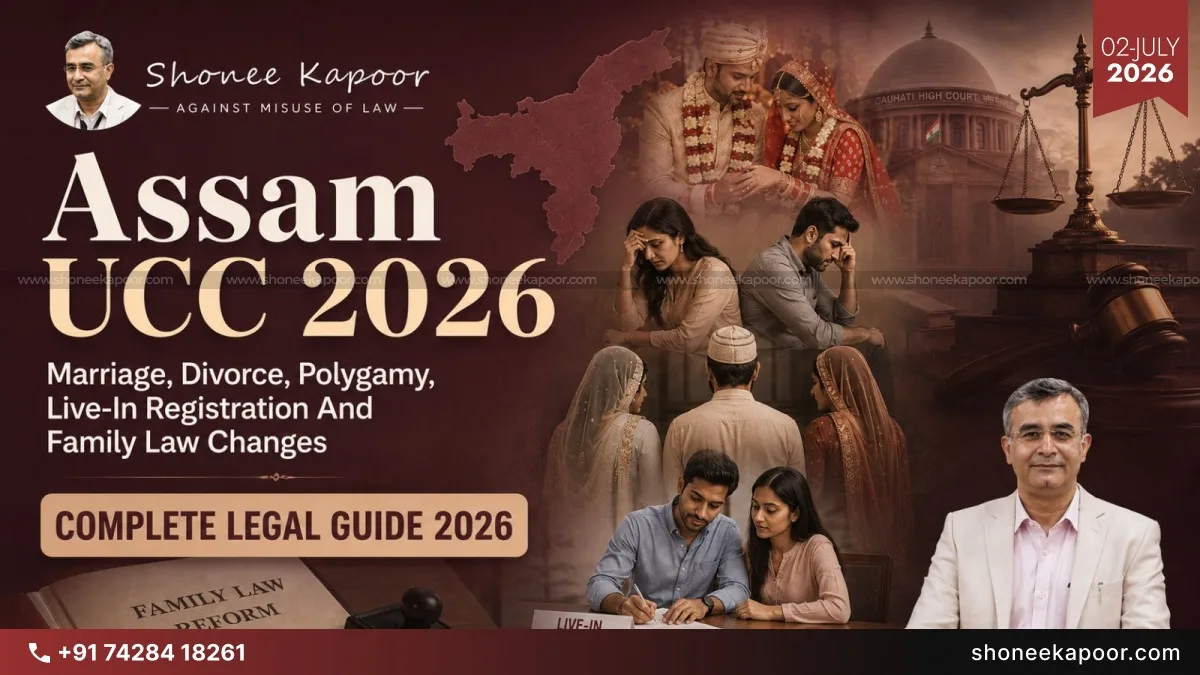
Assam’s new Uniform Civil Code changes far more than marriage—it rewrites the legal rules governing divorce, inheritance, live-in relationships and family disputes. Here’s what the law actually says, what has changed, and why every family should understand its impact before it reaches the courtroom.
NEW DELHI: Assam’s Uniform Civil Code, Assam, 2026 is not just another political headline. It is a direct intervention into marriage, divorce, succession, polygamy, live-in relationships, maintenance and family litigation.
For decades, Indian family law has suffered from one dangerous problem: the same relationship can have different legal consequences depending on religion, custom, personal law, registration status and social pressure. Assam’s UCC attempts to bring one civil framework for residents of Assam, while expressly excluding Scheduled Tribes from its operation.
The official Assam Legislative Assembly page lists the Bill titled “THE UNIFORM CIVIL CODE, ASSAM, 2026” and provides the Bill PDF for download. The Bill was later reported as passed by the Assam Legislative Assembly, making Assam the third state after Uttarakhand and Gujarat to adopt such a UCC framework. However, the practical enforcement still depends on statutory commencement and notification because the Bill itself provides that it will come into force on a date appointed by the State Government.
WHAT ASSAM UCC 2026 COVERS
The Assam UCC 2026 covers four major family law areas:
- Marriage and divorce
- Succession and inheritance
- Live-in relationships
- Incidental family law issues like maintenance, custody, registration and penalties
The government’s stated framework is to replace religion-based personal laws with a uniform system for marriage, divorce, succession and live-in relationships, while keeping Scheduled Tribes outside its ambit to protect customary and constitutional safeguards.
This is where the debate starts. Supporters call it equality before law. Critics call it excessive state control over private relationships. As a men’s rights activist, my view is simple: uniformity is good only when it is also fair, evidence-based and gender-neutral in actual courtroom practice.
1. SCHEDULED TRIBES ARE EXCLUDED
The Assam UCC does not apply to members of Scheduled Tribes. This is not a small exception. In Assam, tribal customary laws have deep roots in marriage, inheritance, land and family structure. The Bill keeps ST communities outside the UCC framework, and this has been defended as protection of tribal autonomy and customary rights.
This means Assam UCC is not a “one law for every person in Assam” in the absolute sense. It is a uniform code for those covered by it.
2. MARRIAGE AGE: 21 FOR MEN, 18 FOR WOMEN
The Assam UCC fixes the minimum marriage age at 21 years for men and 18 years for women. This continues the existing broad Indian legal position but places it inside the state’s uniform family law framework.
A marriage can continue to be solemnised through religious or customary ceremonies such as Saptapadi, Ashirvad, Nikah, Holy Union, Vedic Bibah, Ahom Chaklong, Anand Karaj and other recognised practices. So the UCC does not erase ceremonies. It regulates the civil consequences of those ceremonies.
3. MARRIAGE REGISTRATION BECOMES COMPULSORY
One of the biggest changes is compulsory registration of marriages.
The Bill requires marriages to be registered before the Sub-Registrar. Reports on the Bill state that marriages must generally be registered within 60 days of solemnisation, and failure to comply can attract penalties.
This is important for husbands also. In matrimonial litigation, unregistered marriages often become a weapon. One party denies the marriage. Another party disputes the date. False claims, exaggerated timelines and fabricated allegations become easier when documentation is weak.
The Supreme Court had already pushed India toward compulsory marriage registration in Seema v. Ashwani Kumar, where it directed states and union territories to frame rules for compulsory registration of marriages.
For men facing false matrimonial litigation, registration is not paperwork. It is evidence.
4. NON-REGISTRATION DOES NOT AUTOMATICALLY VOID MARRIAGE
A practical point: non-registration does not by itself make the marriage invalid. This is important because family law must not destroy genuine marriages merely because of paperwork delay.
But non-registration can create penalties and evidentiary problems. In litigation, the registered certificate will carry weight. If a husband is fighting maintenance, divorce, custody, bigamy or fraud allegations, documentary clarity becomes critical.
5. POLYGAMY AND BIGAMY ARE PROHIBITED
The Assam UCC prohibits polygamy and bigamy for those covered by the Code. The Bill links bigamy/polygamy punishment to the Bharatiya Nyaya Sanhita, 2023. Section 82 of BNS punishes marrying again during the lifetime of a husband or wife, where such marriage is void because the first spouse is living, with imprisonment up to seven years and fine.
This is one of the strongest parts of the UCC. A marriage cannot be treated as a revolving door. A spouse cannot keep one marriage alive and create another marriage through religious conversion, custom or loophole.
The Supreme Court dealt with this abuse in Sarla Mudgal v. Union of India, where the Court examined cases where Hindu husbands converted to Islam to perform a second marriage without dissolving the first marriage. The Court strongly discussed Article 44 and the need for a uniform civil code to prevent exploitation of conflicting personal laws.
6. DIVORCE ONLY THROUGH LEGAL PROCEDURE
The Assam UCC prohibits dissolution of marriage outside the procedure provided under the Code. This directly attacks informal, unilateral or extra-judicial divorce practices.
This matters because marriage creates civil consequences: maintenance, custody, inheritance, legitimacy, property and remarriage. If marriage can be ended by unilateral declaration, the weaker party is exposed. If marriage can be ended only through legal process, both parties get a record, a remedy and a courtroom forum.
The Supreme Court’s triple talaq judgment in Shayara Bano v. Union of India is part of the same broader legal journey. The challenge was against instant triple talaq, and the majority set aside the practice.
Assam UCC carries that logic further at the state level: divorce must be legal, recorded and justiciable.
7. GROUNDS FOR DIVORCE ARE STANDARDISED
The Bill creates uniform grounds for divorce such as cruelty, desertion and mutual consent. It also recognises other grounds such as adultery, conversion, mental disorder, communicable venereal disease, renunciation, seven-year absence, bigamous marriage and non-compliance with a maintenance order.
For men, this is a mixed bag.
The positive part is that uniform grounds reduce religious-law confusion. The dangerous part is courtroom misuse. Words like “cruelty” are often stretched in matrimonial litigation. A husband may face divorce, maintenance, domestic violence, 498A/BNS cruelty allegations and custody battle simultaneously from the same set of allegations.
Uniform law must not become uniform harassment.
8. MUTUAL CONSENT DIVORCE: COOLING PERIOD WITH WAIVER
The Bill provides for divorce by mutual consent where parties have lived separately for one year or more and mutually agree that the marriage should be dissolved. It also provides a second-motion structure, with scope for waiver in cases of exceptional hardship or exceptional depravity.
This is practical. A dead marriage should not be kept alive only for procedural punishment. But courts must ensure that settlements are voluntary, informed and not extracted under criminal-case pressure.
9. MAINTENANCE IS AVAILABLE TO WIFE OR HUSBAND
A key provision is that maintenance pendente lite and litigation expenses can be claimed by either wife or husband if the applicant has no independent income sufficient for support and expenses.
Permanent alimony and maintenance can also be ordered for either party, depending on income, estate, conduct, settlement and circumstances.
This is the language family law needs: party-neutral, fact-based, income-based.
But Indian courtroom reality is different. Men are usually treated as automatic payers, even when the wife is educated, earning, capable, suppressing income or using litigation as leverage. A gender-neutral text is only useful if courts apply it neutrally.
10. MAHR, DOWER AND STREEDHAN ARE PROTECTED SEPARATELY
The Bill provides that mahr, dower, streedhan or property presented to the wife will be in addition to her maintenance claim.
This needs careful judicial handling. Genuine streedhan must be returned. But double recovery must not be permitted. Maintenance is for support, not enrichment. Family courts must examine actual payments, settlement terms, income, assets and conduct.
11. CUSTODY: WELFARE PARAMOUNT, BUT CHILD BELOW FIVE ORDINARILY WITH MOTHER
The Bill states that child welfare is paramount. It also provides that custody of a minor child who has not completed five years shall ordinarily be with the mother.
This is the most important men’s rights concern in the Bill.
The word “ordinarily” must not become “automatically.” Fathers are not ATM machines with visitation rights. A father is a parent. If the mother is abusive, alienating, unstable, negligent or using the child as litigation leverage, the court must look beyond gender.
The Supreme Court has repeatedly held that in custody cases, the welfare of the child is the paramount consideration, not the statutory right of either parent.
So Assam UCC must be read like this: below five, mother may ordinarily get custody, but welfare overrides gender preference.
12. SUCCESSION: GENDER-EQUAL INHERITANCE FRAMEWORK
The Assam UCC creates a uniform succession framework. In intestate succession, Class-1 heirs include spouse, children and parents. Reports describe the Bill as creating a gender-equal order of preference among Class-1 heirs and giving equal rights to sons and daughters.
This is a major shift from religion-based succession differences. The idea is clear: inheritance should not depend on whether the deceased belonged to one religious community or another.
For families, this means succession planning becomes more important. Wills, nominations, property records and family settlements must be done carefully. Otherwise, after death, litigation begins.
13. LIVE-IN RELATIONSHIPS MUST BE REGISTERED
The most controversial part of the Assam UCC is live-in registration.
The Bill requires live-in relationships to be registered within one month. Children born from live-in relationships are to be treated as legitimate. Deserted women in live-in relationships can claim maintenance. Failure to register can attract punishment, including imprisonment up to three months or fine.
This provision has two sides.
One side says it protects women and children from abandonment. The other side says it brings private adult relationships under state surveillance.
The concern is not imaginary. Reports state that the Sub-Registrar can forward live-in relationship statements to the local police station for record, and in certain cases involving partners below 21, parents or guardians may be informed.
For men, this creates a serious litigation risk. A live-in relationship may now generate maintenance claims, criminal consequences for non-registration, police records, family pressure and future allegations.
The Supreme Court in Indra Sarma v. V.K.V. Sarma recognised that live-in relationships are not the same as legal marriage, but certain relationships “in the nature of marriage” can attract legal consequences under the Domestic Violence Act.
Assam UCC goes further by creating a statutory registration regime.
14. LIVE-IN WITH MARRIED PERSON CANNOT BE REGISTERED
The Bill does not permit registration of a live-in relationship where at least one person is already married or already in another live-in relationship.
This is sensible. A married person cannot use live-in terminology to bypass matrimonial obligations. But again, courts must examine evidence carefully. False claims of “live-in” after casual relationships may become a new litigation industry.
15. FALSE STATEMENTS IN REGISTRATION CAN BE PUNISHED
The Bill provides penalties for false statements, forged documents and suppression of material facts in marriage or live-in registration.
This is necessary. In family law, falsehood is not a small procedural defect. It can destroy liberty, reputation, property and parent-child relationships.
The problem in India is not absence of law. The problem is weak consequences for false claims. If Assam UCC is implemented honestly, false statements must be punished, not ignored.
16. THE ASSAM MUSLIM MARRIAGE REGISTRATION LAW IS REPEALED
The Bill proposes repeal of the Assam Compulsory Registration of Muslim Marriages and Divorces Act, 2024, while saving prior actions taken under it.
This is the core UCC move: one registration framework instead of community-specific registration law.
WHAT THE SUPREME COURT HAS SAID ON UCC AND FAMILY LAW
This is legislation, not a court judgment. So there is no “courtroom exchange” inside Assam UCC itself. But the legal background comes from real Supreme Court judgments.
| CASE | WHAT THE COURT DEALT WITH | WHY IT MATTERS FOR ASSAM UCC |
| Shah Bano, 1985 | Muslim divorced woman’s maintenance | Court said Article 44 had remained a “dead letter”; UCC was linked to national integration. |
| Sarla Mudgal, 1995 | Conversion and second marriage without dissolving first marriage | Court discussed misuse of personal law conflicts and stressed Article 44. |
| Seema v. Ashwani Kumar, 2006 | Compulsory marriage registration | Court directed states/UTs to frame rules for marriage registration. |
| Shayara Bano, 2017 | Instant triple talaq | Court set aside instant triple talaq; Assam UCC similarly insists on legal divorce procedure. |
| Indra Sarma, 2013 | Live-in relationship under DV Act | Court clarified when a live-in relationship may have legal consequences. |
| Gaurav Nagpal, 2009 | Child custody | Welfare of child is paramount, not automatic parental entitlement. |
MEN’S RIGHTS VIEW: GOOD REFORM, BUT WATCH THE MISUSE
Assam UCC 2026 has some good features:
It bans polygamy.
It forces marriage documentation.
It makes divorce a legal process.
It recognises party-neutral maintenance language.
It creates inheritance clarity.
It gives legitimacy to children from live-in relationships.
But the danger is also real.
If live-in registration becomes police surveillance, it will create harassment.
If maintenance remains one-sided in practice, men will still suffer.
If custody below five becomes automatic mother custody, fathers will again be reduced to visitors.
If cruelty allegations remain loosely tested, false cases will continue under a new legal wrapper.
If false statements are not punished, UCC will become another tool in matrimonial extortion.
Uniform Civil Code must mean uniform responsibility, uniform evidence standards and uniform consequences for falsehood. Not just uniform liability on men.
FINAL WORD
Assam UCC 2026 is a major family law development. It changes how marriage, divorce, polygamy, succession and live-in relationships are treated in Assam.
But no law becomes fair merely because it uses the word “uniform.”
The real test is courtroom implementation.
- Will husbands get equal consideration in maintenance?
- Will fathers get real custody justice?
- Will false allegations be punished?
- Will live-in registration protect genuine partners without becoming moral policing?
- Will family courts apply evidence, not gender sympathy?
That is where Assam UCC will either become real reform or another law that looks equal on paper and becomes biased in practice.
FAQs
Yes. It was reported as passed by the Assam Legislative Assembly in May 2026, but practical enforcement depends on official commencement notification.
Yes. Polygamy and bigamy are prohibited for persons covered by the Code, with punishment linked to BNS Section 82.
Yes. Marriage registration is compulsory, generally within 60 days, with penalties for non-compliance.
Yes. Live-in relationships must be registered within one month, and failure can attract punishment.
The Bill says child welfare is paramount, but children below five shall ordinarily remain with the mother. Fathers must rely on welfare evidence to contest custody.

Leave A Comment