
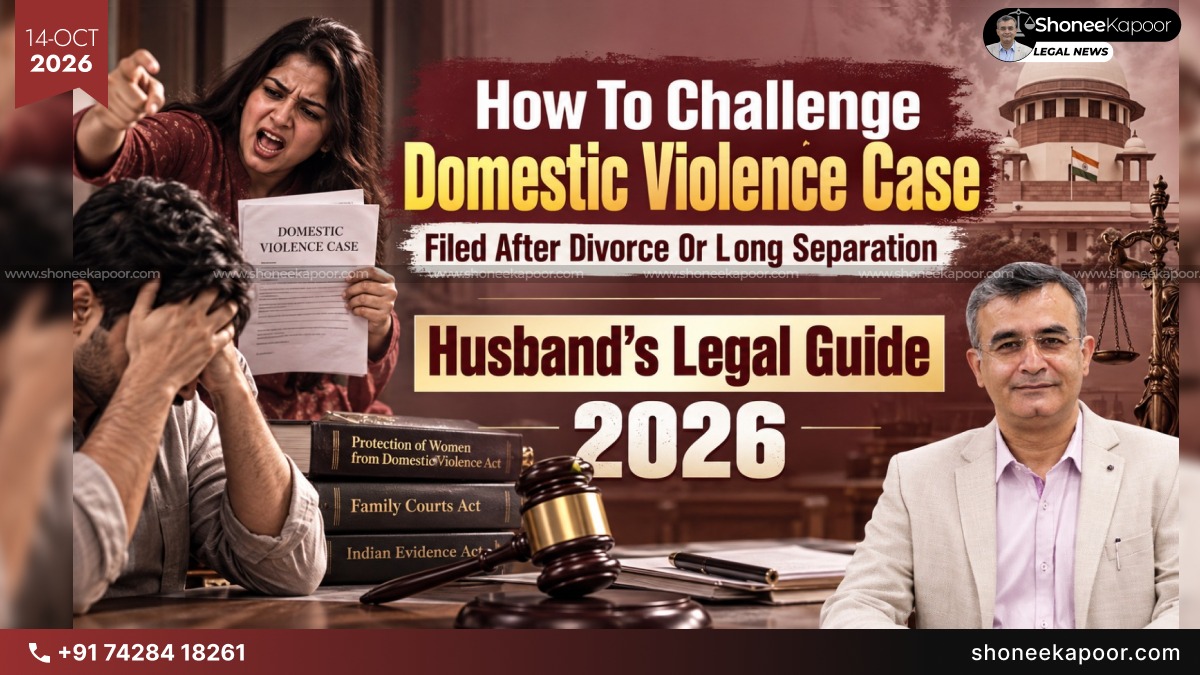
How To Challenge A Domestic Violence Case Filed After Divorce Or Long Separation: Husband's Legal Guide 2026

Written and analysed by Vaibhav Ojha
Head Of Legal Communications
NEW DELHI: A husband obtains a divorce, settles maintenance, returns the agreed belongings and moves on. Years later, another Domestic Violence (DV) case lands in court. Can a wife revive allegations after divorce? Can years of separation help a husband get the case dismissed?
The answer depends on the allegations, evidence and previous court orders.
Under the Protection of Women from Domestic Violence Act, 2005 (PWDVA), divorce or long separation does not automatically prevent proceedings. However, the Supreme Court's 2026 judgments provide important safeguards against reopening settled claims and pursuing proceedings that constitute an abuse of process.
1. Supreme Court 2026: Wife Cannot Simply Reopen Settled DV Claims After Divorce
Reji Baby v. Subi Mary & Ors. — 24 August 2026
Citation: 2026 INSC 918 | Criminal Appeal No. 1346/2021
In this case, the spouses signed a settlement agreement on 23 July 2016. The wife expressly relinquished her monetary and maintenance claims, and the parties subsequently obtained a mutual-consent divorce on 30 January 2017.
Despite the settlement, fresh proceedings under the DV Act were initiated.
The Supreme Court quashed the proceedings, noting that the wife had voluntarily waived her monetary claims and had not legally challenged the settlement or divorce decree.
The Court held that the proceedings under the DV Act "constitute an abuse of process."
Importantly, the Court preserved the independent monetary claims of the adult daughter, who was not a party to the settlement.
Husband's Legal Takeaway: A voluntary, documented and unchallenged full-and-final settlement can be a strong defence against subsequent proceedings seeking to revive the same relinquished claims.
Read the Supreme Court Judgment
2. Supreme Court 2026: Vague Domestic Violence Allegations Cannot Sustain Proceedings
Dhananjay Rathi v. Ruchika Rathi — 13 April 2026
Citation: 2026 INSC 360 | Criminal Appeal No. 1924/2026
The parties had entered into a mediated matrimonial settlement. Subsequently, the wife withdrew consent for mutual divorce and filed a DV complaint in October 2025 against her husband and mother-in-law.
The Supreme Court examined the allegations, settlement documents and chronology of litigation.
The Court found that the DV complaint contained no specific incidents establishing domestic violence by the husband or his mother.
While discussing complaints lacking specific allegations, the Supreme Court stated that such proceedings "shall be nipped in the bud."
The Court quashed the DV proceedings and, exercising its exceptional powers under Article 142, dissolved the marriage subject to specified settlement obligations.
Husband's Legal Takeaway: Mere naming of a husband or his relatives is not enough. Specific allegations, surrounding circumstances and documentary evidence matter.
Read the Official Supreme Court Judgment
3. Can A Wife File A Domestic Violence Case After Divorce?
Yes, in legally maintainable circumstances. Divorce alone is not a universal defence.
Three Supreme Court judgments explain why:
Inderjit Singh Grewal v. State of Punjab, (2011) 12 SCC 588: The Supreme Court quashed DV proceedings where the parties had obtained a mutual-consent divorce and the complaint sought relief inconsistent with the subsisting decree, while alleging that the divorce was a sham. The ruling was based on the particular facts and abuse of judicial process.
Juveria Abdul Majid Patni v. Atif Iqbal Mansoori, (2014) 10 SCC 736: The Supreme Court clarified that a subsequent divorce does not automatically extinguish remedies arising from domestic violence committed during the marriage.
Prabha Tyagi v. Kamlesh Devi, (2022) 8 SCC 90: The Court confirmed that a domestic relationship need not still exist when a Section 12 application is filed, provided the alleged violence is legally connected to the domestic relationship.
Legal Position: A husband must challenge the maintainability, allegations or particular relief sought on the facts—not simply argue that the marriage has ended.
4. Can A Wife File A DV Case After 10 Or 20 Years Of Separation?
Yes. There is no general one-year limitation period for filing an application under Section 12 of the DV Act.
In Kamatchi v. Lakshmi Narayanan, (2022) 5 SCC 600, the Supreme Court held that Section 468 CrPC's criminal limitation provision does not govern a Section 12 DV application.
However, the Court also recognised that a substantial unexplained gap and the question of continuing wrongdoing are relevant matters for the Magistrate to consider.
Husband's Defence: Establish the separation timeline and challenge allegations that are unsupported, inconsistent or factually impossible. Delay alone cannot secure dismissal.
5. How Can A Husband Challenge A DV Case In 2026?
A legally sound defence should focus on five points:
Produce the divorce decree and settlement agreement. Highlight relevant full-and-final clauses, payments and undertakings.
Establish the actual separation period. Preserve address records, communications, travel documents and other lawful evidence.
Identify contradictions and vague allegations. Compare the DV application with previous complaints, affidavits and judicial statements.
Challenge unsupported monetary or residence claims. Disclose relevant prior maintenance, residence and settlement orders. Such claims are not automatically barred by divorce.
Choose the correct legal remedy. Contest the Section 12 application before the Magistrate, appeal an appealable order under Section 29 PWDVA within 30 days of statutory service, or seek appropriate High Court relief under Section 528 BNSS (corresponding to Section 482 CrPC) where abuse of process is established.
Important: Section 23 permits interim and ex parte relief. Never ignore a court notice or assume that a pending challenge automatically stays an existing order.
6. What If The Wife Claims Continuing Domestic Violence?
The husband must distinguish between an old, concluded matrimonial dispute and an independently maintainable claim.
In Krishna Bhattacharjee v. Sarathi Choudhury, (2016) 2 SCC 705, the Supreme Court recognised continuing deprivation of stridhan as relevant economic abuse, even following judicial separation.
Therefore, separation does not automatically defeat a claim involving retained stridhan or other continuing economic abuse. The facts and applicable legal rights must be examined.
My View: Divorce Should Not Become An Endless Cycle Of Litigation
As a men's rights activist, I believe a husband must not be forced to defend the same conclusively settled matrimonial claims repeatedly merely because another proceeding can be initiated.
The Supreme Court's 2026 decisions demonstrate that valid settlements, specific allegations and judicial finality matter.
Genuine victims deserve legal protection. Innocent husbands deserve due process, evidence-based adjudication and protection against abuse of law.
The strongest defence is not outrage. It is documentation, accurate case law and a properly constructed legal challenge.
Disclaimer: This article provides general legal information based on Indian statutes and judicial decisions. Remedies depend on the particular facts, pleadings, evidence and court orders.
FAQs
1. Can my ex-wife file a DV case after divorce?
Yes. Divorce alone does not bar claims arising from legally relevant past domestic violence.
2. Can a DV case be quashed after a full-and-final settlement?
Yes, where the facts justify quashing. The Supreme Court granted relief in Reji Baby (2026).
3. Is a DV case barred after 10 years of separation?
No. Section 12 PWDVA has no general one-year filing limitation.
4. Can vague allegations against a husband and his family be challenged?
Yes. The Supreme Court examined this issue in Dhananjay Rathi (2026).
5. Can a husband appeal an interim DV order?
Yes, where appealable under Section 29 PWDVA. The statutory appeal period is 30 days from service.
Related Articles
NRI Divorce Litigation in India: Step By Step Legal Guide, Real Cases, Real Data, Real Struggles
The article explores how cross-border marriages turn into complex legal battles when love meets the limits of jurisdi...




Share Your Thoughts
Comments are moderated before publication.