
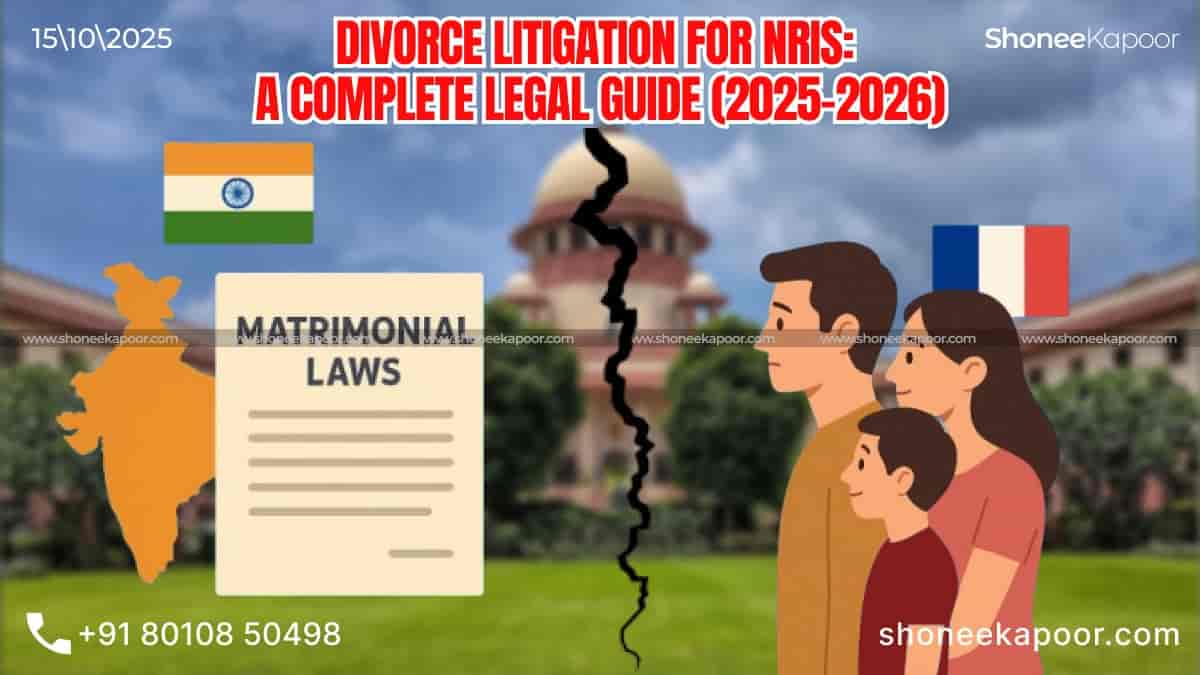
NRI Divorce Litigation in India: Step By Step Legal Guide, Real Cases, Real Data, Real Struggles

Written and analysed by Shonee Kapoor
Legal Consultant, Author & Men's Rights ActivistThe article explores how cross-border marriages turn into complex legal battles when love meets the limits of jurisdiction. It uncovers the real data, challenges, and legal maze faced by NRIs seeking justice in India.
Disputes arise when love transcends national boundaries
Indian citizens live, work, and marry overseas, resulting in a mix of cross-cultural unions, making modern marriages more complex and intricated. What was once a strictly domestic institution has become a cross-continental bond as a result of globalisation blurring the lines between relationships. Indian couples are becoming more and more integrated into the global community through destination weddings in Bali and marriages registered in London; however, when these relationships fail, the emotional, social, and legal rifts frequently extend across continents. However, separation/divorce for an NRI (Non-Resident Indian) entails more than just emotional separation; it also entails navigating a complex web of competing legal systems, jurisdictional disputes, and occasionally, gender-based legal abuse. It is much more than just the ending of a marriage; it’s a clash of legal systems, a struggle between jurisdictions, and frequently a test of one’s forbearance and self-identity. In India, where Indian laws, foreign decrees, and individual rights interact in complex ways, what may appear to be a straightforward legal procedure overseas can turn into years of litigation and stress on not only the spouses but also on their child, distant relatives.
Furthermore, a troubling parallel trend has emerged as matrimonial laws have developed to shield women from actual exploitation: the misuse of these same protections based on gender, especially in international marriages. Numerous NRI men have encountered unfounded accusations, exaggerated maintenance claims, and travel restrictions often without the chance to mount a reasonable defence.
This blog examines the complicated landscape of NRI divorce litigation, covering topics such as jurisdiction, maintenance laws, the validity of foreign decrees, and the often overlooked defence of men’s rights in matrimonial disputes.
Who is an NRI and what role does it play in divorce cases?
An Indian citizen who lives outside of India for employment, business, or any other reason indicating an extended stay overseas is known as an NRI (Non-Resident Indian).
In divorce cases, the NRI status becomes significant because it impacts:
- Jurisdiction (which nation’s court has the authority to hear the case),
- Acknowledgement of foreign rulings, and
- Enforcement of custody and maintenance orders.
However, if the marriage was consummated in India, being an NRI does not exempt one from Indian matrimonial laws.
The laws that regulate NRI divorce cases
India’s matrimonial laws are based on personal laws rather than a single, unified code, so the law that applies will vary depending on the religion practiced at the time of the marriage. In NRI divorces, where the couple may be living overseas but their marriage is still formally based in India, this becomes particularly important. The following laws are applicable based on the type of marriage and religion:
For Hindus, Jains, Sikhs, and Buddhists, the Hindu Marriage Act of 1955 (HMA)
It governs:
- The solemnisation of marriages between Hindus;
- The grounds for divorce (such as cruelty, desertion, adultery, or mental disorder);
- Maintenance and alimony provisions under Sections 24 and 25; and
- Custody of children and other matrimonial reliefs.
For civil or interfaith unions, the Special Marriage Act of 1954 (SMA)
For interreligious or civil unions, the SMA offers a secular framework for marriage and divorce. It is applicable when two people of different nationalities or religions get married, usually by registering in front of a marriage officer as opposed to attending a religious ceremony.
It governs:
- Even if a marriage is performed overseas, it still needs to be registered under SMA.
- Similar to HMA, cruelty, desertion, adultery, or mutual consent are grounds for divorce.
- In addition, the SMA clarifies jurisdiction in cases where one spouse is an NRI.
- For Christians, the 1869 Indian Divorce Act
- For Muslims, the 1937 Muslim Personal Law (Shariat) Application Act
Important Legal Principle: The Law Is Determined by the Place of Marriage
NRIs are frequently misunderstand that the location of residence (abroad) does not dictate which law applies; rather, the location and mode of marriage do.
For instance:
- If two Hindus get married in Mumbai and later move to Canada, the Hindu Marriage Act is applicable and it maintains authority over their divorce and marriage.
- If an interfaith couple lives in London but was married in Delhi under the Special Marriage Act, they must still file for divorce under the SMA rather than UK law.
Jurisdiction: Where Can Divorces Be Filed?
When one or both spouses reside outside of India, the issue of “which court has the power to hear a divorce case” becomes extremely complicated. Where a legitimate divorce petition can be filed is determined by what attorneys refer to as a jurisdictional issue.
Section 19 of the Hindu Marriage Act, 1955 (HMA) lays out the jurisdictional rules for Indian marriages in detail. Other matrimonial laws, like the Indian Divorce Act of 1869 and the Special Marriage Act of 1954, contain similar provisions, but the general ideas are the same.
Section 19 of the Hindu Marriage Act: A Brief Overview
A petition for judicial separation, divorce, or the restoration of marital rights may be submitted to the District Court in the local jurisdiction of the following:
- Where the marriage ceremony was performed;
- This refers to the location of the wedding, whether it was performed through a ceremony, registration, or rituals.
- At the residence of the respondent at the moment of filing;
- The term “resides” describes a real, physical place of residence rather than merely a brief visit. In most cases, the petition must be filed in the district where the respondent the spouse being sued resides.
- The last where the parties lived together;
- Given that many couples may have lived in several cities or nations during their marriage, this is a useful clause. Generally speaking, the “last residence together” is the last location where the couple lived together as husband and wife prior to their split.
- If the wife is the petitioner, at the place where she lives;
- The 1976 amendment to the HMA added that if the wife files for divorce, she may do so in the Family Court where she currently resides, even if that is not where she was married or lived in her previous residence, in order to protect women’s rights.
If the respondent lives outside of India?
Section 19 was amended in 2003, giving petitioners more authority in NRI cases. The petitioner may file for divorce in the Indian Family Court where the respondent resides if the respondent is not in India or has not been contacted for seven years or longer. Because it enables Indian citizens to start divorce proceedings without being hindered by restrictions on travel or foreign residency, this is essential for NRI cases.
Is a divorce granted overseas enforceable in India?
The idea that a divorce decreed by a foreign court automatically ends a marriage in India is one of the most common misconceptions among Non-Resident Indians (NRIs). This isn’t always the case, though. In actuality, unless a foreign divorce decree satisfies certain legal requirements outlined in Section 13 of the Code of Civil Procedure (CPC), 1908, it is not automatically valid or enforceable in India.
When a foreign judgment-including a foreign divorce decree-becomes final in India is defined under Section 13 of the CPC. This section states that a foreign judgement is only enforceable if it meets six essential requirements. India will not recognise a divorce decree from another country if:
- According to Indian law, the foreign court lacked jurisdiction:
- Unless the foreign court had appropriate jurisdiction under Indian law, a divorce decree issued by a foreign court will not be enforceable in India.
- Judgement was not based on the case’s merits:
- When both parties were given an equal opportunity to present their case and the court took the evidence into consideration before rendering a decision, the decree is said to be “on merits.” The divorce is not regarded as being “on merits” if it was decided ex parte (without one party present) or by mutual consent under a law that is not recognised in India.
- It was acquired through deceit, fraud, or false representation:
- It is deemed fraudulent if one party obtains a divorce overseas by hiding information, fabricating a domicile, or acting as though both parties gave their consent.
- Violation of Natural Justice
- According to the idea of natural justice, each party must be given an equal chance to argue their position. In India, a divorce decree is void if one spouse was not given the required notice or if the court denied them the opportunity to defend themselves.
- Grounds Not Recognised Under Indian Law
- The grounds for divorce vary by nation. For instance: “Incompatibility” or “irretrievable breakdown of marriage” may be legitimate overseas (such as in the US or the UK), However these are not acceptable grounds under Indian matrimonial statutes. Thus, it is invalid in India.
- Contradiction with Indian Law or Public Policy:
- A foreign decree may still be rejected even if it satisfies all of the aforementioned requirements if it violates Indian law or public policy, such as encouraging polygamy, religious conversion, or other behaviours that are at odds with Indian values.
The Procedures of Indian Divorce Law for Non-Residents Indian
A Non-Resident Indian (NRI) going through a divorce must navigate both Indian matrimonial law and international procedural obstacles, such as serving notices internationally and submitting petitions via power of attorney. A detailed legal explanation of how the procedure works under Indian law, specifically the Hindu Marriage Act, 1955 (HMA) and associated procedural rules, can be found below which will make it easier for you to avoid false allegations, undergoing complex procedures.
Step 1: Divorce petition filing
Filing a divorce petition in the Family Court with jurisdiction under Section 19 of the Hindu Marriage Act, 1955 or personal law is the first step in the process.A divorce petition may be submitted to the Family Court in accordance with Section 19 HMA:
- Where the marriage was solemnised;
- Where the respondent resides;
- Where the parties last resided together; or
- Where the wife is currently residing (if she is the petitioner).
Following verification, the holder of the Power of Attorney is authorised to file, sign, and represent the petitioner in all Family Court procedural matters.
Step 2: Notification/Summons to a Foreign Party
Once the petition is filed, the Family Court issues a notice/summons to the respondent nby the following ways:
- Acknowledged Speed Post or Registered International Post;
- Email service, particularly when approved by the court (since electronic communication is becoming more and more common);
- By means of the Indian Consulate or Embassy abroad; or
- Through coordination with foreign authorities through the Ministry of External Affairs.
Step 3: Evidence, Hearings, and Representation
The court arranges hearings to record evidence, question witnesses, and hear arguments after service. By permitting digital engagement, Indian courts have responded to the realities of international residency and distance for NRIs.
- Online Engagement: Courts permit NRIs to participate in hearings through video conference, particularly when depositions are being recorded and during the conciliation or mediation phase. In State of Maharashtra v. Dr. Praful B. Desai (2003), the Supreme Court acknowledged that testimony is legitimate evidence under Indian law, and the eCourts Project formally supported this.
- Document Submission: Evidence could consist of: digital communications, passport copies, proof of residency, income and tax records, marriage certificates, etc. If the originals are held overseas, these can be turned in as scanned or notarised copies. Courts accept affidavits and notarised documents from NRIs executed before Indian consular authorities.
- Representation through Advocate: An NRI need not appear physically at every hearing. Once authorised, their advocate in India can handle procedural steps, adjournments, and filings.
Step 4: Divorce Decree
Following the conclusion of hearings and the recording of all evidence, the Family Court renders a decision and issues a divorce decree, which may be contested or granted with mutual consent.
Divorce by mutual consent (Hindu Marriage Act, Section 13B)
The easiest and least confrontational way to end a divorce is through mutual consent. It is submitted in accordance with Section 13B HMA, which mandates:
- A joint petition from both spouses certifying that they have been living apart for a minimum of one year;
- Mutual recognition of the dissolution of the marriage;
- Making two appearances in the Family Court—
- First motion: filing the joint petition.
- Second motion: after a mandatory cooling-off period of six months (can be waived by court under Amardeep Singh v. Harveen Kaur, 2017). Typical Duration: 6–18 months depending on court workload and waiver of the six-month period.
Contested divorce
If one party disputes consent or alleges fault (such as cruelty, desertion, adultery, or conversion), a contested divorce is filed under Section 13(1) HMA. This process comprises:
- Submitting and answering a written statement;
- Formulation of the issues;
- Cross-examination and supporting evidence;
- Concluding remarks; and
- Declaration of judgement.
Step 5: Recognition and Enforcement
A certified copy of the divorce decree is issued by the Family Court upon its approval. This order: must be submitted to Indian authorities; may require attestation if utilised overseas; and is final and enforceable unless it is contested on appeal.
Safeguarding Men’s Rights in NRI Divorce Proceedings
Conflicts between Non-Resident Indians (NRIs) and their spouses have become more complicated and cross-border in nature due to the quick globalisation of Indian marriages. Regretfully, a lot of NRI men end up caught in cross-border legal entanglements, where they deal with procedural bias, legal harassment, and emotional distress.
There is no denying the rise in false criminal complaints, exaggerated maintenance claims, and manipulated custody disputes, especially against Indian men who work or settle overseas, even though real cases of domestic violence must be taken seriously. This imbalance often leads to loss of livelihood, reputation, and liberty before any trial or investigation even begins.
Typical Obstacles NRI Men Face
- The use of matrimonial laws as weapons
- False or inflated complaints are made against many NRI husbands under:
Section 498A IPC, Dowry Prohibition Act, 1961, and Domestic Violence Act, 2005 (PWDVA). - False Income Claims and Ex Parte Maintenance:
In Rajnesh v. Neha (2020), the Supreme Court published comprehensive maintenance guidelines that mandated that both parties submit standardised affidavits of income, assets, and expenses. By doing this, numerous, exaggerated, or parallel maintenance claims in various courts are avoided. - Abuse of Criminal Proceedings to Press for Settlement
Sometimes, dowry laws, PWDVA, or criminal complaints under 498A are used as leverage to compel financial settlements in return for the dropping of charges or the consent to divorce. - Abuse of Child Custody
When one parent is overseas, child custody disputes become even more complicated.
In order to limit the father’s visitation rights, mothers occasionally file Habeas Corpus or custody petitions under the Guardians and Wards Act of 1890.
Legal Protections and Remedies for Men
Removing False FIRs in accordance with Section 482 CrPC
Under Section 482 of the Criminal Procedure Code (CrPC), an NRI husband may petition the High Court to have the FIR dismissed if he is the victim of malicious or false criminal charges for the following reasons: Lack of prima facie evidence; Abuse of legal process; or Settlement between parties.
Minimisation of Several Maintenance Claims
In the 2020 case of Rajnesh v. Neha, the Supreme Court ruled that: “A party cannot request maintenance from more than one forum at the same time under different statutes.” In order to prevent duplication, the ruling instructed all courts to confirm pending maintenance orders.
Protection from Look-Out Circulars (LOCs) and Anticipatory Bail
The court has the authority to request passport impoundment or issue a letter of intent if a criminal case is filed while the suspension is overseas. To avoid causing undue hardship: NRIs can apply for anticipatory bail under Section 438 CrPC; Request Look-Out Circulars (LOCs) recall or suspension, citing cooperation with investigation; Submit a written undertaking to appear virtually or through counsel.
Taking part through Virtual Hearings
The inability of NRIs to be physically present is acknowledged by contemporary courts. NRIs can participate in mediation sessions, hearings, and even testify via video conferencing. For working men overseas, this eliminates needless travel, costs, and disruptions to their careers.
Fighting Defamatory International Divorces
The husband may file a counterpetition in India if a spouse receives a foreign divorce decree without their consent or on unrecognised grounds, requesting: Declaration of invalidity under Section 13 CPC, or Declaration of marital status under Section 7 of the Family Courts Act, 1984. This ensures that the marriage remains valid in India and protects against bigamy allegations or remarriage complications.
Useful Tips for Non-Resident Men Before or During Divorce
Even if your marriage was performed overseas, you should still register it under Indian law. This aids in establishing validity and jurisdiction under Indian statutes such as the SMA or HMA.
Keep track of all correspondence, emails, bank transfers, and trip logs as possible proof of behaviour and financial standing.
To prevent missing court dates, execute a Power of Attorney (PoA) for representation in India.
Foreign decrees may be in conflict with Indian law, so you should never sign or agree to divorce or settlement documents overseas without first speaking with an Indian matrimonial attorney.
To prevent LOCs or ex parte orders, notify Indian authorities or embassies right away of any fabricated or inflated claims.
Employ legal counsel with knowledge of both domestic and international legal ramifications who has experience with NRI and extradition cases.
Taking Stock of the Future: Towards Gender-Neutral Justice
Matrimonial Case Statistics: Understanding the Burden on Family Courts
India’s Family Courts have witnessed a steady increase in matrimonial case filings over the last three years, reflecting both rising awareness of legal remedies and the complexities of modern marriages, including those involving NRIs. The number of cases filed rose from 4.97 lakh in 2021 to 7.26 lakh in 2022, reaching 8.25 lakh in 2023. Simultaneously, courts disposed of 5.32 lakh cases in 2021, 7.44 lakh in 2022, and 8.27 lakh in 2023, consistently exceeding new filings each year (≈106.9% in 2021, 102.6% in 2022, and 100.2% in 2023). This proactive disposal helped control the backlog, which stood at 11.73 lakh at the end of 2021, dropped to 11.31 lakh in 2022, and remained at 11.44 lakh by the end of 2023. While disposal rates have slightly stabilized the backlog, delays continue to affect litigants, including men and NRIs navigating cross-border legal proceedings.
According to the Government of India’s Lok Sabha reply dated 9 February 2024, the highest pending cases are concentrated in Kerala, Maharashtra, Bihar, Haryana, and Delhi. For NRIs, this means that even when legal grounds for divorce exist, navigating India’s court system can take considerable time, often requiring careful coordination between foreign judgments and Indian law.
These statistics highlight the importance of efficient case management and legal preparedness, especially for NRIs seeking timely resolution, fair settlement, and protection of rights in matrimonial disputes.
Landmark Judgments
Y. Narasimha Rao v. Y. Venkata Lakshmi (1991)
This is the cornerstone judgment governing the validity of foreign divorces in India. The Supreme Court declared the U.S. decree invalid and unenforceable in India, stating: “A foreign decree of divorce is valid in India only if it is granted on a ground recognised by Indian matrimonial law and both parties participated in the proceedings.”
Satya v. Teja Singh (1975)
The husband falsely claimed to be a U.S. resident and obtained a divorce in Nevada, while the wife continued to live in India. The Supreme Court ruled the decree null and void in India, observing that: “A judgment obtained by playing fraud on the court is a nullity and non-existence in the eyes of law.”
Rajnesh v. Neha (2020), the Supreme Court published comprehensive maintenance guidelines that mandated that both parties submit standardised affidavits of income, assets, and expenses. By doing this, numerous, exaggerated, or parallel maintenance claims in various courts are avoided.
Amardeep Singh v. Harveen Kaur (2017), Supreme Court of India in Amardeep Singh v. Harveen Kaur (2017) clarified that this six-month period is directory and not mandatory. The Court held that in exceptional circumstances, where reconciliation is not possible, the waiting period can be waived to prevent unnecessary prolongation of the parties’ agony.
The Way Forward: Reaching Fair Matrimonial Justice
Indian matrimonial law must adapt to the demands of international relationships as the world grows more interconnected. Transnational justice is necessary for transnational marriages. The law must make sure that men are not unfairly singled out through procedural abuse or false litigation, even as it has rightfully sought to protect women from exploitation and desertion. The future of NRI divorce cases depends on striking a balance between rights and obligations, protection and justice, and compassion and accountability.
Divorce for NRIs is frequently a legal journey spanning several nations, requiring careful adherence to Indian matrimonial law while negotiating foreign jurisdictions. It is not just a personal separation. Every stage, from petition filing to decree recognition, calls for planning, documentation, and good legal advice. In the end, justice in NRI divorces needs to be universal. Whether they live in Delhi or Dubai, Mumbai or Melbourne, every litigant deserves a fair, open, and compassionate process. In the wise words that each divorcing couple ought to keep in mind:
“When handled correctly, divorce is not the end of life but rather the start of legal clarity.”
Shonee Kapoor
Indian men's rights activist, legal consultant and author focused on matrimonial law, 498A, maintenance, child custody, parental alienation and gender-neutral laws. He is not an advocate or lawyer.
Related Reading
 Legal Articles & News
How To File 498A Or Section 85 BNS Quashing Petition Under Section 528 BNSS?
 Legal Articles & News
How To Handle Stridhan & Dowry-Article Recovery Without Making A Criminal Admission?
 Legal Articles & News
Chargesheet Filed In 498A Or 85 BNS Case: What Should The Husband Do Next?
 Legal Articles & News




Share Your Thoughts
Comments are moderated before publication.