
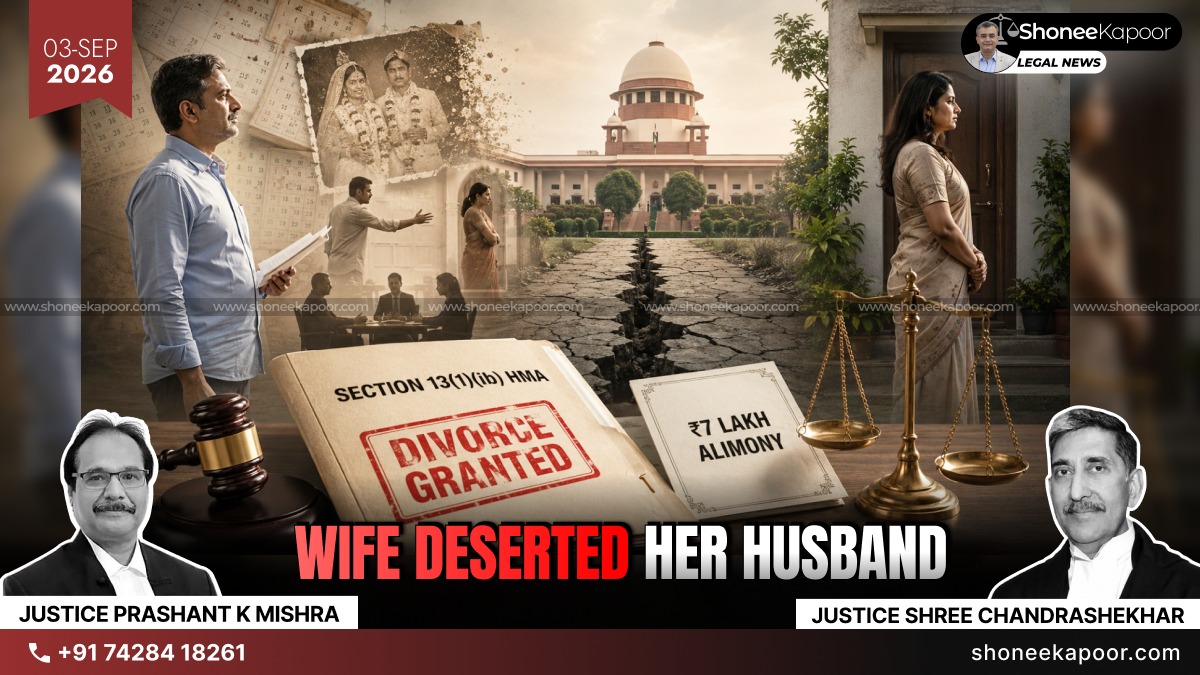
Wife Left Her Husband, Yet He Still Had To Prove Desertion After 20 Years To Get A Divorce: Supreme Court Dissolves Marriage

Curated by NEWS DESK
Editorial DeskCan a wife continue living separately for nearly two decades and still say she never intended to desert her husband? The Supreme Court looked beyond her words and examined what her conduct actually showed.
NEW DELHI: The Supreme Court of India has dissolved a marriage solemnised in 2003 after holding that the wife had deserted her husband and the parties had remained separated since December 2005.
A Bench of Justice Prashant Kumar Mishra and Justice Shree Chandrashekhar partly allowed the husband’s appeal and restored the finding of desertion under Section 13(1)(ib) of the Hindu Marriage Act, 1955. The Court, however, did not interfere with the findings rejecting the husband’s allegation of cruelty.
The couple married on 23 June 2003. According to the husband, problems started soon after marriage. He alleged that his wife looked down upon him because of his educational qualifications and called him “illiterate” and “rustic”. He also claimed that during approximately two years of marriage, she joined his company only four or five times despite repeated persuasion.
The husband alleged cruelty, including denial of marital relations, insults and abusive behaviour. However, the Trial Court did not find these allegations satisfactorily proved. Therefore, the finding against him on the ground of cruelty ultimately remained undisturbed.
The crucial issue was desertion.
On 30 November 2005, the wife went to her parental home. The husband claimed that on 15 December 2005, he went there to bring her back, but she refused to return. The parties never resumed their matrimonial relationship after that date. They also had no children from the marriage.
The husband filed his divorce petition under Section 13 of the Hindu Marriage Act on 20 June 2007, alleging mental cruelty and desertion.
The Trial Court rejected the cruelty allegations. Although it found that the wife had been living separately since 15 December 2005, it did not grant divorce merely on that basis.
The husband challenged the decision before the High Court under Section 28 of the Hindu Marriage Act. The High Court also refused divorce, holding that mere physical separation was insufficient and that the husband had failed to establish animus deserendi, meaning an intention on the wife’s part to permanently abandon the matrimonial relationship.
The matter eventually reached the Supreme Court.
During the proceedings, the dispute was referred to the Supreme Court Mediation Centre, but mediation failed.
The Supreme Court noted that there was no dispute that the husband and wife had been living separately since 15 December 2005. Therefore, the real question was whether the wife’s conduct established the legally required intention to desert.
The Court considered evidence that the husband, along with witness Ram Prakash, had gone to bring the wife back to the matrimonial home, but she refused to accompany them without reasonable cause.
The Supreme Court found this conduct significant and observed that she had “actively chosen to desert” the husband’s company.
The wife had stated in her evidence that she was ready to perform her marital obligations. However, the Supreme Court made it clear that statements cannot be examined in isolation when actual conduct tells a different story.
The Court held that a “mere assertion cannot be sufficient” when the conduct of the spouse reflects otherwise.
Referring to earlier judgments, including Savitri Pandey v. Prem Chandra Pandey, the Court reiterated that desertion requires both factum of separation and animus deserendi. It is not merely about spouses living at different places; the Court must examine whether one spouse intended to permanently abandon matrimonial obligations.
In the present case, the parties had not cohabited since December 2005. The husband had attempted to bring his wife back, but she refused without reasonable cause. The Court therefore disagreed with the High Court’s conclusion that the required intention to desert had not been proved.
The Supreme Court also noted that the marriage had produced no children and all attempts at reconciliation had failed. After more than two decades of a marriage that had practically ceased to exist, forcing the parties to remain legally married would serve no useful purpose.
The Bench ultimately held that the wife had abandoned the matrimonial relationship and that the husband had successfully established desertion.
Importantly, although the Court referred to Shilpa Sailesh v. Varun Sreenivasan and the relevance of prolonged separation in a completely broken marriage, it clarified that it did not decide this appeal by exercising Article 142 jurisdiction. The divorce was granted on the statutory ground of desertion under Section 13(1)(ib) of the Hindu Marriage Act.
The marriage solemnised on 23 June 2003 was accordingly dissolved.
However, the litigation did not end without a financial direction against the husband. During the proceedings, he had expressed willingness to pay Rs 5 lakh as permanent alimony. The Supreme Court instead fixed Rs 7 lakh as permanent alimony, payable to the wife within three months.
If the amount is not deposited within that period, the wife can initiate execution proceedings, and the amount will carry 9% annual interest thereafter.
EXPLANATORY TABLE OF LAWS AND SECTIONS
| Law / Section | What It Provides | Relevance In This Case |
|---|---|---|
| Section 13, Hindu Marriage Act, 1955 | Provides statutory grounds for divorce. | The husband approached the court seeking divorce on cruelty and desertion. |
| Section 13(1)(ib), Hindu Marriage Act, 1955 | Allows divorce where the other spouse has deserted the petitioner for the statutory period. | Supreme Court held that the wife’s conduct established desertion and granted divorce on this ground. |
| Section 28, Hindu Marriage Act, 1955 | Provides for appeals against decrees and certain orders under the Act. | The husband challenged the Trial Court decision before the High Court under this provision. |
| Article 142, Constitution of India | Gives the Supreme Court power to pass orders necessary for doing complete justice. | Discussed through Shilpa Sailesh, but the Supreme Court expressly clarified that the present divorce was not granted by invoking Article 142. |
CASE DETAILS
| Particulars | Details |
|---|---|
| Case Title | B v. R |
| Court | Supreme Court of India |
| Case Number | Civil Appeal No. 10249 of 2014 |
| Neutral Citation | 2026 INSC 939 |
| Decision Date | 2 September 2026 |
| Bench | Justice Prashant Kumar Mishra and Justice Shree Chandrashekhar |
| Judgment By | Justice Prashant Kumar Mishra |
| Appellant | Husband |
| Respondent | Wife |
KEY TAKEAWAYS
- Words mean nothing when conduct proves otherwise. The wife claimed she was willing to continue the marriage, but her actions showed desertion.
- The husband went to bring her back; she refused without reasonable cause. The Supreme Court treated this as crucial evidence of her intention to desert him.
- Nearly 20 years of separation still wasn’t enough by itself. The husband had to legally prove both separation and her intention to abandon the marriage.
- Lower courts denied him divorce on desertion. The husband had to reach the Supreme Court before it finally reversed that finding.
- He finally got freedom after decades of separation and litigation—but with a bill attached. The Supreme Court granted divorce and ordered him to pay Rs 7 lakh in permanent alimony.
Share Your Thoughts
Comments are moderated before publication.