
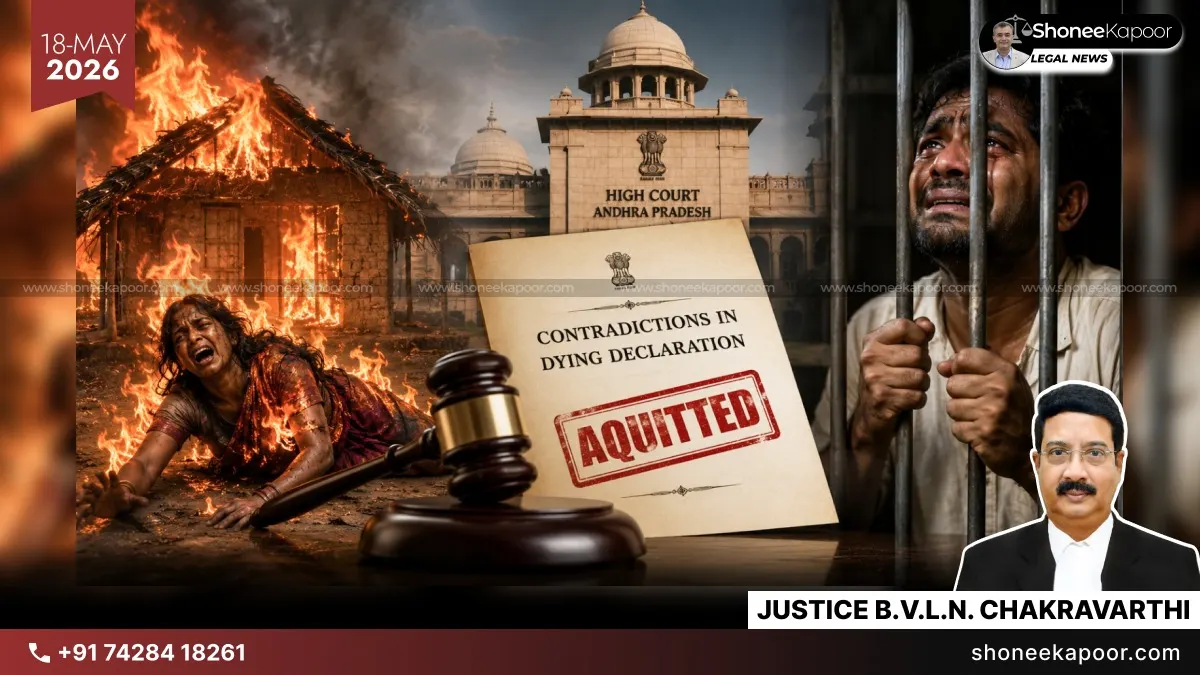
Wife first told doctors it was a fire accident while she was sleeping. Why was that statement hidden from the trial court? Andhra Pradesh High Court found serious contradictions in multiple dying declarations and gave benefit of doubt to the husband.
AMRAVATI: The Andhra Pradesh High Court recently acquitted a husband who was earlier convicted in a case relating to the burn death of his wife after finding serious contradictions in the prosecution story and multiple dying declarations. Justice B.V.L.N. Chakravarthi delivered the judgment while hearing Criminal Appeal.
The High Court observed that when multiple dying declarations are completely inconsistent with each other, the Court must carefully examine the entire evidence before relying on any one statement to convict an accused person.
The case was related to the death of a woman from Kurnool district who suffered burn injuries on 12 January 2007 and later died during treatment. The prosecution alleged that the husband used to suspect the fidelity of his wife and harassed her regularly after consuming alcohol.
According to the prosecution, on the night of the incident, the husband allegedly abused and beat his wife and instigated her to commit suicide. It was alleged that the woman poured kerosene on herself, and the husband lit a matchstick and threw it on her, causing severe burn injuries.
After her death, the husband was charged under Sections 498-A and 302 IPC. However, the trial court acquitted him for offences under Sections 498-A and 302 IPC but convicted him under Section 304 Part-II IPC and sentenced him to ten years imprisonment.
The husband challenged the conviction before the High Court.
During the hearing, the defence argued that the first statement made by the deceased to the doctor at the hospital was completely different from the later dying declarations relied upon by the prosecution. The Court noted that the doctor had recorded in the hospital accident register that the woman stated she suffered burn injuries accidentally while sleeping in the hut at around 8:00 PM.
The High Court found that this first statement was suppressed during the trial and only came on record during cross-examination of the doctor.
The Court observed that the prosecution later relied upon two other dying declarations recorded by the police officer and the Judicial Magistrate in which the woman blamed her husband for the incident.
The Court reiterated:
“In the case of third category of cases is that where there are more than one dying declaration and inconsistencies between the declarations are absolute and the dying declarations are irreconcilable being repugnant to one another. The duty of the Court is to examine the rest of the materials in the form of evidence placed before the court and still conclude that the incriminatory dying declaration is capable of being relied upon”.
The Court found that the testimony of the couple’s young son supported the accidental fire theory. The child stated that the hut caught fire while they were sleeping and that his mother pushed the children outside to save them before accidentally suffering burn injuries herself.
The High Court observed that the prosecution never cross-examined the child witness on this crucial point. It also noted that doctors did not find kerosene smell on the body of the deceased.
After analysing the evidence, the Court held that the first statement made before the doctor appeared more natural and reliable than the later dying declarations. The Court criticised the trial court for ignoring important evidence and relying only on selective dying declarations.
Holding that the prosecution failed to prove the case beyond reasonable doubt, the Andhra Pradesh High Court set aside the conviction and acquitted the husband under Section 304 Part-II IPC.
Explanatory Table: Laws And Sections Involved
| Law / Section | Purpose | Role in This Case |
| Section 302 IPC | Punishment for murder | The husband was originally charged for allegedly causing the death of his wife |
| Section 304 Part-II IPC | Punishment for culpable homicide where there is knowledge of likely death but no intention to murder | The trial court convicted the husband under this section, but the High Court later acquitted him |
| Section 498-A IPC | Cruelty or harassment by husband or relatives towards a married woman | The husband was accused of harassing his wife, but was acquitted of this charge |
| Section 32, Indian Evidence Act | Makes dying declarations admissible as evidence in court | The entire case mainly depended upon multiple dying declarations |
| Section 313 Cr.P.C. | Gives accused an opportunity to explain evidence against him | The High Court noted that important dying declaration contents were not properly put to the accused |
| Section 145, Indian Evidence Act | Allows witness cross-examination using previous statements | Discussed while analysing contradictions and witness credibility |
| Section 155(3), Indian Evidence Act | Permits impeachment of witness credibility through contradictions | The Court noted that the prosecution failed to challenge the child witness properly |
| Section 162 Cr.P.C. | Governs use of police statements during trial | Referred while discussing confrontation of witnesses and previous statements |
| Section 209 Cr.P.C. | Procedure for committing serious criminal cases to Sessions Court | The Magistrate committed the matter to the Sessions Court under this provision |
| Section 405 Cr.P.C. | Certification of appellate judgment to lower court | The High Court directed that the acquittal judgment be certified to the trial court |
Case Details
- Case Title: Dudekula Somaiah v. State of Andhra Pradesh
- Court: Andhra Pradesh High Court
- Case Number: Criminal Appeal No. 678 of 2009
- Bench: Justice B.V.L.N. Chakravarthi
- Neutral Citation: APHC010632442009
- Date of Judgment: 23 April 2026
- Counsels:
- For Appellant: Sri D. Purnachandra Reddy
- For Respondent: Sri C.P. Somayaji, Additional Public Prosecutor
Key Takeaways
- A man cannot be convicted merely on changing and contradictory dying declarations without reliable supporting evidence.
- The first version given immediately after an incident often carries greater evidentiary value than later improved allegations.
- Courts cannot ignore defence-friendly evidence, especially when even child witnesses support the accidental incident theory.
- Suppression of important evidence by investigation agencies can seriously damage the prosecution case against a husband.
- Criminal conviction against men must be based on proof beyond reasonable doubt, not emotional assumptions.
This Could Change Your Case-Get FREE Legal Advice-Click Here!
Disclaimer: The views and opinions expressed in this article are those of the Indian courts and do not necessarily reflect the official policy or position of “ShoneeKapoor.com” or its affiliates. This article is intended for informational and educational purposes only. The content provided is not legal advice, and viewers should not act upon this information without seeking professional counsel. Viewer discretion is advised.
