
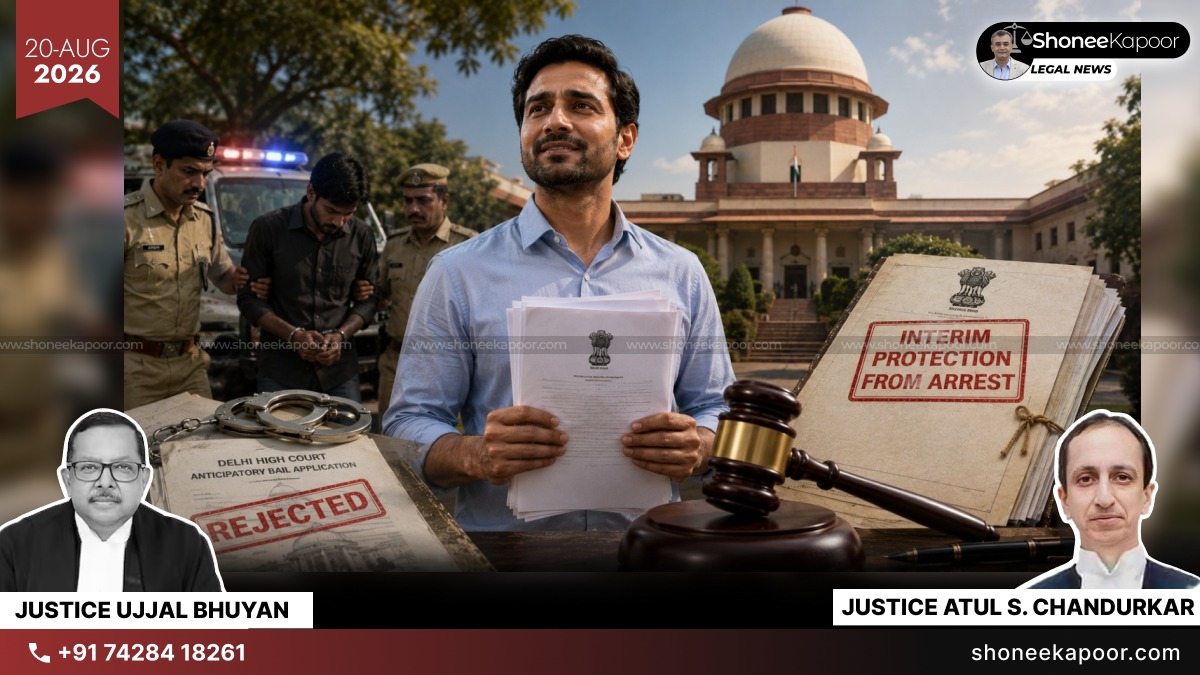
Supreme Court Protects Man From Arrest After Chargesheet Filed Without Custody; Issues Notice In Anticipatory Bail Plea

Curated by NEWS DESK
Editorial DeskIf the investigation was already complete and the chargesheet had been filed without arrest, was custodial arrest still necessary? The Supreme Court has stepped in and protected the petitioner from arrest while examining his challenge to the Delhi High Court order refusing anticipatory bail.
NEW DELHI: The Supreme Court of India has granted interim protection from arrest to Virender @ Virender Kumar in a criminal matter.
The petitioner approached the Supreme Court through SLP (Crl.) No. 14603/2026, challenging the Delhi High Court order dated July 10, 2026 in Bail Application No. 1385/2026, by which his application for anticipatory bail had been dismissed.
The case relates to a crime registered under Sections 313, 376, 354C and 34 IPC and Section 69 of the Bharatiya Nyaya Sanhita, 2023.
Before the Supreme Court, counsel for the petitioner submitted that the High Court order was unreasoned and did not adequately consider material circumstances operating in his favour.
The petitioner submitted that he had already joined and participated in the investigation. He had also remained under interim protection, initially granted by the Sessions Court and later by the Delhi High Court, without any allegation that he had misused the liberty granted to him.
It was further submitted that the investigation had already been completed and the chargesheet filed without taking the petitioner into custody. According to the petitioner, he was residing in a different State from the complainant and his custodial interrogation was not required.
The case therefore raised an important question about arrest after investigation: when an accused has allegedly cooperated throughout the investigation and the chargesheet has already been filed without his custody, whether arrest should still follow merely because anticipatory bail was declined.
After hearing the petitioner’s counsel, the Supreme Court issued notice, returnable on October 7, 2026, and granted interim protection.
The Court directed:
“In the meanwhile, petitioner shall not be arrested in connection with Crime No.97 of 2026 registered at Police Station- Bhalswa Dairy, District- Outer North, Delhi under Sections 313, 376, 354C and 34 of the Indian Penal Code, 1860 (for short, ‘IPC’) and Section 69 of the Bharatiya Nyaya Sanhita, 2023 (for short, ‘BNS’), subject to petitioner co-operating with the investigation.”
Interestingly, the Supreme Court’s order dated August 19, 2026 records that it had directed this protection while issuing notice on August 14, 2026, but the relevant portion was “inadvertently not recorded” in the earlier order.
The Court therefore directed that the omitted portion be incorporated into its August 14 order.
The order does not finally decide the petitioner’s anticipatory bail plea or the merits of the allegations. However, for the time being, it ensures that the petitioner cannot be arrested in the case, provided he continues to cooperate with the investigation.
EXPLANATORY TABLE OF LAWS AND SECTIONS
| Law / Section | What It Means | Application In This Case |
|---|---|---|
| Section 313 IPC | Deals with causing a miscarriage without the woman’s consent. | One of the offences mentioned in Crime No. 97/2026. |
| Section 376 IPC | Provides punishment for rape under the IPC. | The FIR/crime is stated to include this provision. |
| Section 354C IPC | Deals with the offence of voyeurism. | Included among the provisions recorded in the Supreme Court order. |
| Section 34 IPC | Applies the principle of joint liability where a criminal act is done by several persons in furtherance of common intention. | Invoked along with the substantive IPC offences in the case. |
| Section 69 BNS, 2023 | Criminalises sexual intercourse by deceitful means or by making a promise to marry without intention to fulfil it, where the conduct does not amount to rape. | The Supreme Court order records Section 69 BNS as one of the provisions in Crime No. 97/2026. |
CASE DETAILS
| Particular | Details |
|---|---|
| Case Title | Virender @ Virender Kumar v. State of NCT Delhi |
| Court | Supreme Court of India |
| Case Number | SLP (Crl.) No. 14603/2026 |
| Arising From | Bail Application No. 1385/2026, Delhi High Court |
| Impugned Order | July 10, 2026 |
| Supreme Court Order | August 19, 2026 |
| Bench | Justice Ujjal Bhuyan and Justice Atul S. Chandurkar |
| Petitioner | Virender @ Virender Kumar |
| Respondent | State of NCT Delhi |
| Counsel for Petitioner | Tripaksha Litigation through Abhimanyu Kumar, Yash Saxena, Ashish Choudhury, AOR, R.D. Singh, Divya Tripathi, Prachi Grover, Abhishek Arora, Anand Kamal, Sulekha Agarwal and Siddhant Sehgal |
| Counsel for Respondent | Samir Ali Khan, AOR, Pranjal Sharma and Kashif Irshad Khan |
KEY TAKEAWAYS
- A man cooperated with the investigation, yet the threat of arrest still followed him.
- The chargesheet was reportedly filed without taking him into custody, but even then anticipatory bail was denied.
- It took the Supreme Court to stop his arrest and protect his liberty, subject to cooperation with the investigation.
- For men, an accusation can trigger punishment before conviction—court rounds, fear of arrest, stigma and loss of liberty, all before guilt is proved.
- Criminal law cannot become a shortcut to punish men merely because allegations are serious; arrest must serve investigation, not become pre-trial punishment.
Share Your Thoughts
Comments are moderated before publication.