
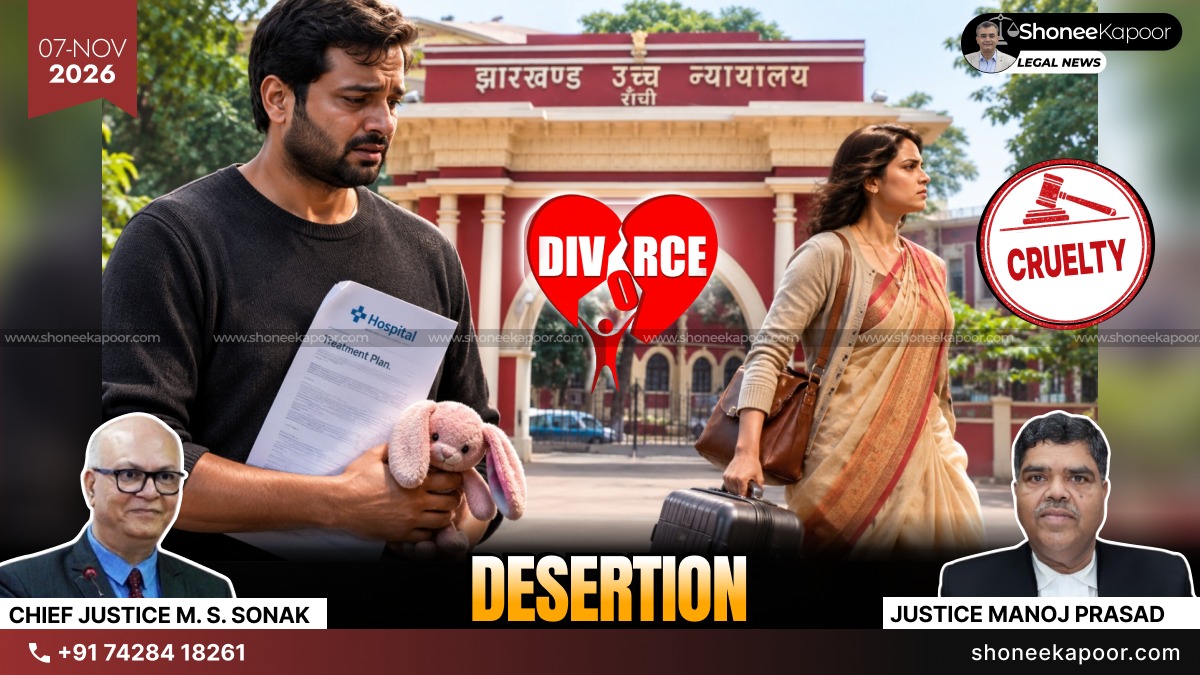
Wife Left 7-Month-Old Daughter With Husband, Ignored Her Cancer Treatment: Jharkhand High Court Upholds Divorce On Cruelty & Desertion Grounds

Curated by NEWS DESK
Editorial DeskJHARKHAND: The Jharkhand High Court has upheld a divorce decree granted to a husband on grounds of cruelty and desertion, after considering that his wife left their seven-month-old daughter in his care and failed to look after her even during cancer treatment.
A Division Bench of Chief Justice M.S. Sonak and Justice Manoj Prasad, in its judgment dated 5 November 2026, dismissed the wife's appeal against the divorce decree passed by the Family Court, Jamshedpur.
The couple married on 23 November 2008 in Bihar and later lived in Jamshedpur. They had a daughter who was diagnosed with cancer and required medical treatment in Mumbai.
The husband alleged that his wife frequently quarrelled with family members, behaved aggressively and physically mistreated their daughter. He further claimed that she left their daughter when the child was only seven months old and never returned to the matrimonial home.
According to the husband, his wife also failed to accompany their daughter for cancer treatment in Mumbai and made no effort to care for the child during her serious illness.
On 24 November 2021, the Family Court granted divorce to the husband under Sections 13(1)(i-a) and 13(1)(i-b) of the Hindu Marriage Act, 1955, after finding sufficient evidence of matrimonial cruelty and desertion.
The Family Court also considered that the wife had registered an FIR under Section 498A IPC against her husband after he filed for divorce. However, her written statement in the matrimonial proceedings contained no specific allegations of dowry demands or cruelty against her.
Read Also:- Section 498a IPC | 498a Judgments | False Dowry Case | 498a Misuse
Challenging the divorce decree before the Jharkhand High Court, the wife denied the allegations and claimed that her husband had taken her to her parental home. Her counsel also argued that allegations about her psychiatric condition were not supported by medical evidence.
However, the High Court found that the wife's written statement contained general and evasive denials, rather than specific replies to the husband's allegations.
Referring to Order VIII Rules 3, 4 and 5 of the Code of Civil Procedure (CPC), the Court explained that evasive denials may be treated as no denial.
The High Court also independently examined the evidence and found that the husband's testimony remained unshaken during cross-examination.
Importantly, the Court considered the wife's admission that she had left her daughter when the child was seven months old and had not taken steps to care for her despite knowing about her cancer.
The Bench held that such conduct amounted to cruelty under Section 13(1)(i-a) of the Hindu Marriage Act, justifying the dissolution of the marriage.
Regarding desertion, the High Court relied on the wife's statement during cross-examination that she had gone to her parental home when her daughter was seven months old and had no contact with her husband thereafter.
The judgment also recorded her statement in Hindi in paragraph 22, supporting the finding that she had left the matrimonial home and remained separated from her husband.
The Court further considered the Section 498A IPC complaint filed against the husband after the divorce proceedings began, particularly because the wife had not made specific allegations of dowry-related cruelty in her written statement.
After examining the evidence, the High Court concluded that the husband had successfully proved cruelty and continuous desertion for more than two years, satisfying the legal requirements for divorce.
However, despite dismissing the wife's appeal, the Court increased her monthly maintenance from ₹10,000 to ₹15,000, considering the parties' financial affidavits and the Supreme Court's judgment in Rajnesh v. Neha.
The Court also allowed both parties to approach the competent court to modify maintenance if their financial circumstances changed.
The Jharkhand High Court dismissed the wife's appeal and upheld the divorce granted to the husband on grounds of cruelty and desertion, while increasing the monthly maintenance payable to her.
EXPLANATORY TABLE OF LAWS AND SECTIONS
| Law / Section | What It Means | Application In This Case |
|---|---|---|
| Section 13(1)(i-a), Hindu Marriage Act, 1955 | Allows divorce on the ground of cruelty. | The husband established cruelty, including the wife's neglect of their daughter during cancer treatment. |
| Section 13(1)(i-b), Hindu Marriage Act, 1955 | Allows divorce for continuous desertion of at least two years immediately before filing the petition. | The Court upheld the finding that the wife had deserted the husband for the required period. |
| Section 7, Hindu Marriage Act, 1955 | Recognises Hindu marriages solemnised through customary rites and ceremonies. | The wife's written statement referred to the marriage ceremonies. |
| Section 19(1), Family Courts Act, 1984 | Provides for appeals against eligible Family Court judgments and orders. | The wife challenged the divorce decree before the Jharkhand High Court. |
| Order VIII Rules 3, 4 and 5 CPC | Require specific denials of allegations; evasive denials may be treated as admissions. | The Court found the wife's written statement contained evasive denials. |
| Section 498A IPC | Deals with cruelty by a husband or his relatives towards a married woman. | An FIR was registered against the husband after he filed for divorce. The Court considered this while examining cruelty. |
CASE DETAILS
| Particular | Details |
|---|---|
| Case Title | Pinki Kumari v. Ravi Kumar |
| Court | Jharkhand High Court, Ranchi |
| Bench | Chief Justice M.S. Sonak and Justice Manoj Prasad |
| Neutral Citation | 2026:JHHC:32564-DB |
| Appeal Number | First Appeal No. 68 of 2021 |
| Original Case | Matrimonial Suit No. 105 of 2015 |
| Original Court | Principal Judge, Family Court, Jamshedpur |
| Family Court Judgment | 24 November 2021 |
| Counsel For Wife | Ms Amrita Sinha, Amicus Curiae |
| Counsel For Husband | Mr Anurag Kashyap, Advocate |
| Final Decision | Wife's appeal dismissed; husband's divorce upheld; monthly maintenance increased from ₹10,000 to ₹15,000 |
KEY TAKEAWAYS
- Husband's Divorce Upheld: Jharkhand High Court confirms cruelty and desertion as grounds for divorce.
- Mother Neglected Cancer-Stricken Daughter: Wife left her seven-month-old daughter and failed to care for her during cancer treatment.
- 498A FIR Filed After Divorce Case: Court considered the subsequent criminal complaint and the absence of specific cruelty allegations in the wife's written statement.
- Wife's Evasive Denials Rejected: General denials could not defeat the husband's evidence of cruelty and desertion.
- Husband Wins Divorce Battle: High Court dismisses the wife's appeal but increases her monthly maintenance from ₹10,000 to ₹15,000.
Share Your Thoughts
Comments are moderated before publication.