
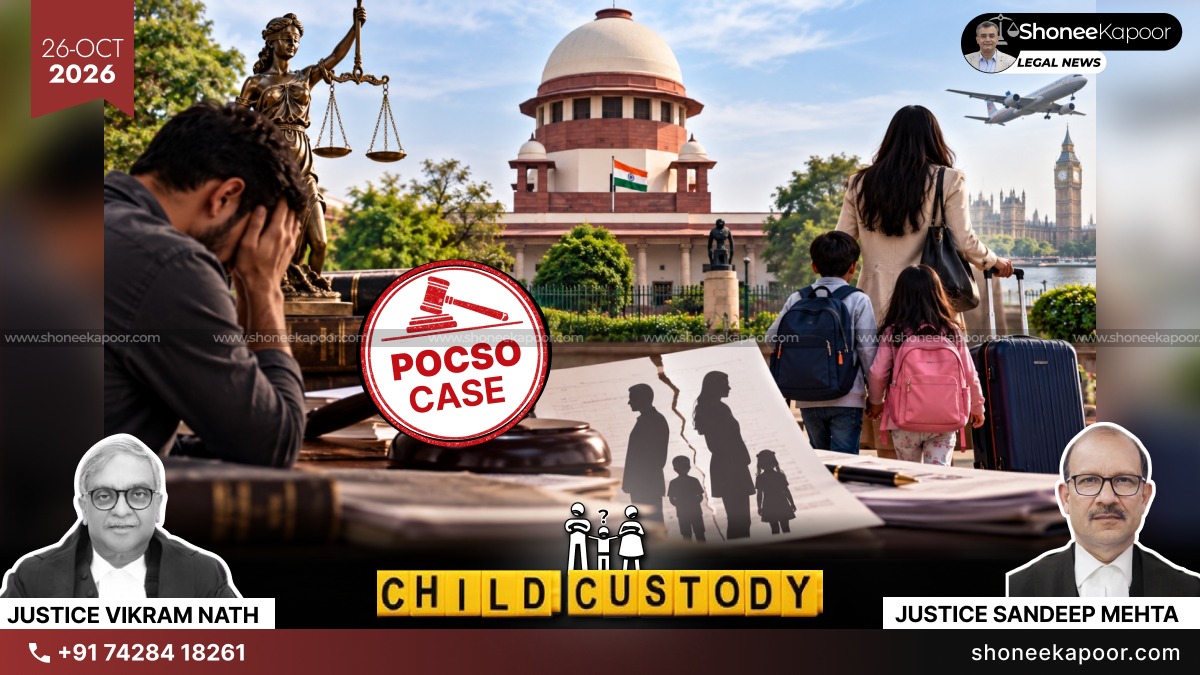
Father Facing POCSO Trial Cannot Get Child Custody Even Without Conviction: Supreme Court

Curated by NEWS DESK
Editorial DeskNEW DELHI: The Supreme Court of India has held that a father facing prosecution under the Protection of Children from Sexual Offences (POCSO) Act cannot be granted child custody in the circumstances of the case, as the children's safety and welfare must come first.
In its September 23, 2026 order, a Bench of Justice Vikram Nath and Justice Sandeep Mehta stayed the custody orders favouring the father and permitted the mother to take their two minor children to the United Kingdom (UK).
The dispute involved a 13-year-old son and a seven-year-old daughter whose parents had been fighting a prolonged child custody battle since their separation in 2018.
The father had approached the courts seeking custody. On July 1, 2024, the Family Court at Patiala House, Delhi, declared him the sole custodian of both children, while allowing the mother visitation rights.
On January 23, 2026, the Delhi High Court upheld the decision and rejected the mother's request to relocate the children to the UK. The High Court considered concerns about parental alienation and the mother's frequent changes of employment.
However, the Supreme Court disagreed with describing the mother's attempts to secure employment as a “nomadic life”, calling that assessment “absolutely unjustified and far removed from reality.”
The case took a serious turn after the son reportedly disclosed alleged sexual abuse by his father during a psychiatric assessment at NIMHANS, Bengaluru, in October 2023.
After the disclosure, the police registered an FIR against the father on November 5, 2023, under the POCSO Act, 2012. Police subsequently filed a chargesheet.
The father denied the allegations and argued that the criminal proceedings were intended to prevent him from obtaining custody. His petition to quash the POCSO FIR remained pending before the Calcutta High Court.
Representing the father, Senior Advocate Shyam Divan argued that the mother had alienated the children from him and that the pending criminal proceedings should not automatically defeat his custody claim.
The father also maintained that the mother's complaints had affected his employment and financial position. His counsel argued that the mother's higher earnings should not become the sole basis for deciding custody.
The mother, represented by Senior Advocate Zoheb Hossain, argued that she had cared for both children for several years and that the son was strongly unwilling to stay with his father.
Read Also:-_ लैंगिक अपराधों से बालकों का संरक्षण अधिनियम, 2012 | POCSO Act in Hindi
The Supreme Court examined the children's interactions, counselling reports and the pending criminal proceedings. It noted that the father had attempted to engage with the children during supervised visitation, but both remained reluctant to interact with him.
The Court also disagreed with the Delhi High Court's observations questioning the POCSO allegations, holding that the criminal case should be examined independently.
It ruled that the High Court's findings on the allegations were premature and ordered that those observations be excluded from consideration in the criminal proceedings.
Addressing the child custody dispute, the Supreme Court observed:
“Once the police have filed a chargesheet after investigation in respect of allegations constituting an offence under the POCSO Act against the respondent-father, granting custody of the child to the respondent-father would be totally unwarranted and unjustified.”
The Bench emphasised that the children's best interests must remain the primary consideration in custody disputes.
Referring to Section 3 of the Juvenile Justice (Care and Protection of Children) Act, 2015, the Court highlighted the principles of children's participation, best interests, safety and protection of rights.
It further held:
“Under no circumstances, the respondent-father, as long as he is facing prosecution, can be considered to be a person entitled to custody of the children.”
The Court expressed concern that handing custody of the son to the father during the pending prosecution could affect the child's ability to give evidence freely.
Importantly, the Bench clarified that even if the father succeeded in getting the POCSO proceedings quashed, the circumstances surrounding the child's disclosure would still remain relevant while deciding custody.
The Supreme Court considered the mother's employment in the UK and her assurance that she would arrange suitable schooling and care for both children.
It permitted her, for the present, to relocate the children to the United Kingdom, subject to furnishing school details through an affidavit within six weeks and undertaking to produce the children before a court whenever directed.
The Court continued the stay on the Family Court and Delhi High Court custody orders until the appeals are disposed of. It also directed that the Court decide the father's pending quashing petition independently, without being influenced by observations in the custody proceedings.
The father has not been convicted in the POCSO case. The Supreme Court's order concerns interim child custody and child welfare during the pending criminal proceedings, not a final determination of his guilt.
The child custody appeals are scheduled for further hearing in January 2027.
EXPLANATORY TABLE OF LAWS AND SECTIONS
| Law / Provision | What It Means | Application In This Case |
|---|---|---|
| Section 7, Guardians and Wards Act, 1890 | Allows courts to appoint or declare a guardian for a minor when necessary for the child's welfare. | The father sought legal guardianship and custody of both children. |
| Section 25, Guardians and Wards Act, 1890 | Deals with returning a ward to a guardian's custody when the court considers it beneficial. | The father's guardianship petition relied on this provision alongside Section 7. |
| POCSO Act, 2012 | Protects children against sexual offences and provides procedures for investigating and prosecuting such offences. | The father was charged in an FIR and chargesheet. The criminal proceedings remained pending. |
| Section 3(iii), Juvenile Justice Act, 2015 | Principle of participation: children have a right to be heard in decisions affecting them. | The Court considered the children's wishes and reactions during supervised visits. |
| Section 3(iv), Juvenile Justice Act, 2015 | Best interest principle: decisions must prioritise the child's welfare and development. | The Court treated child welfare as the main consideration in deciding custody. |
| Section 3(vi), Juvenile Justice Act, 2015 | Principle of safety: children must be protected against harm, abuse and maltreatment. | The pending POCSO prosecution was relevant to assessing the children's safety. |
| Section 3(ix), Juvenile Justice Act, 2015 | Principle of non-waiver of rights: a child's rights cannot be surrendered or treated as waived merely because they are not exercised. | The Court relied on this principle while considering the children's legal protection. |
CASE DETAILS
| Particular | Details |
|---|---|
| Court | Supreme Court of India |
| Case Title | D v. S |
| Case Number | Civil Appeal Nos. 12774 and 12775 of 2026 |
| Arising From | SLP (Civil) Nos. 4306 and 1714 of 2026 |
| Bench | Justice Vikram Nath and Justice Sandeep Mehta |
| Order Authored By | Justice Sandeep Mehta |
| Order Date | September 23, 2026 |
| Neutral Citation | 2026 INSC 1043 |
| Mother's Counsel | Senior Advocate Zoheb Hossain |
| Father's Counsel | Senior Advocate Shyam Divan |
| Original Guardianship Case | Guardianship Petition No. 22 of 2021 |
| Family Court Decision | July 1, 2024 |
| Delhi High Court Case | MAT. APP. (F.C.) No. 279 of 2024 |
| Delhi High Court Decision | January 23, 2026 |
| POCSO FIR | FIR No. 452/2023, dated November 5, 2023 |
| Police Station | Rajarajeshwari Nagar, Bengaluru |
| Pending Quashing Petition | C.R.R. No. 4000 of 2024, Calcutta High Court |
| Supreme Court Decision | Earlier custody orders stayed; mother temporarily permitted to relocate children to the UK |
| Next Hearing | January 2027 |
KEY TAKEAWAYS
- Father Loses Custody Without Conviction: A pending POCSO prosecution was enough to deny the father custody, despite no finding of guilt.
- Two Court Victories, Still No Custody: The father secured favourable orders from the Family Court and Delhi High Court, only to face a Supreme Court setback.
- Parental Alienation Allegations: The father accused the mother of turning his children against him, but his custody claims ultimately failed at this stage.
- Years of Litigation, Father's Rights Restricted: After fighting for custody since 2018, the father now faces continued separation from his children amid pending criminal proceedings.
- Presumption of Innocence vs. Father's Rights: When an allegation remains unproven, should a father lose custody before his guilt is established? Child safety matters, but so does due process.
Share Your Thoughts
Comments are moderated before publication.