
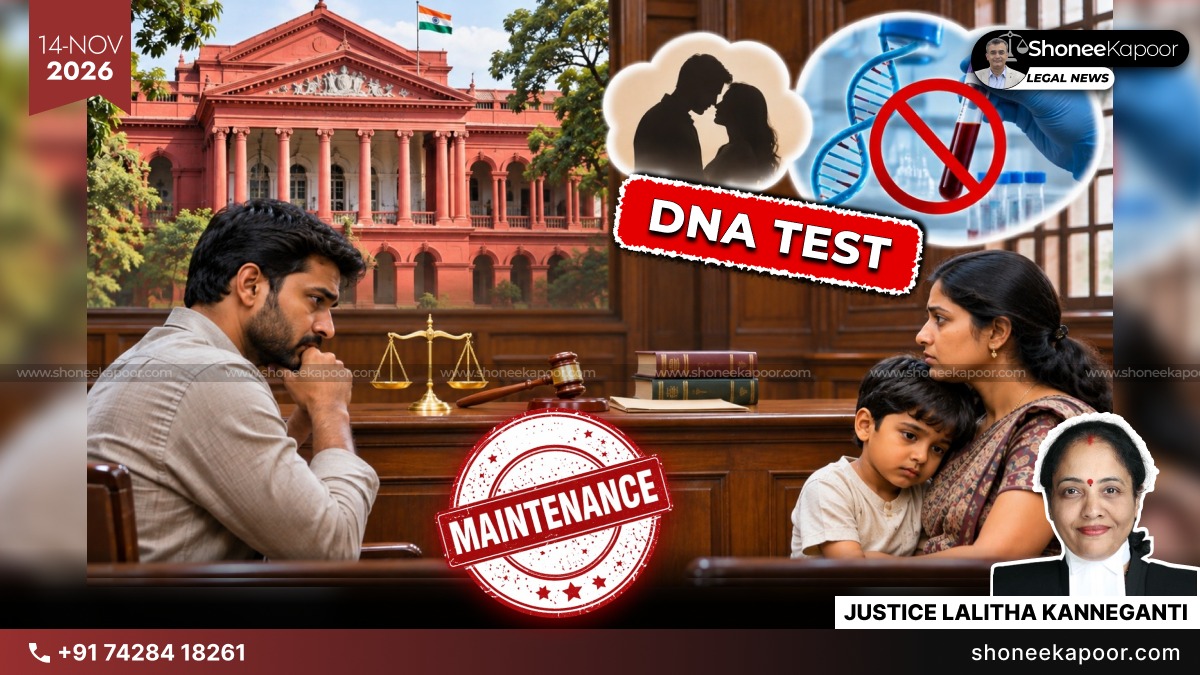
Man Admitting Physical Relationship With Child's Mother Not Conclusive Proof Of Paternity, Doesn't Justify DNA Test: Karnataka High Court

Curated by NEWS DESK
Editorial DeskKARNATAKA: The Karnataka High Court has set aside a Family Court order directing a man to undergo a DNA test to determine a minor child's paternity, holding that admitting a physical relationship with the child's mother does not automatically prove biological fatherhood.
Justice Lalitha Kanneganti held that a DNA test cannot be ordered merely because a man admits having a physical relationship with the mother or because the child requires maintenance. Courts must first examine the available evidence and determine whether such testing is genuinely necessary.
The case arose from a maintenance petition filed on behalf of a minor child against a man who admitted having a physical relationship with the child's mother but denied being the biological father.
During the proceedings, the child's mother sought a DNA test under Section 45 of the Bharatiya Sakshya Adhiniyam, 2023 (BSA) to establish paternity.
On 18 March 2026, the Bengaluru Family Court allowed the application and directed the man and the minor child to provide blood samples for DNA testing.
The man challenged the order before the Karnataka High Court, arguing that his admission of a physical relationship could not be treated as conclusive proof of paternity or sufficient grounds to compel DNA testing.
He also submitted that a similar application had already been rejected in earlier civil proceedings. He argued that forcing him to undergo another examination without sufficient justification would violate his right to privacy and bodily autonomy under Article 21 of the Constitution.
The child's side opposed his petition, relying on his alleged admission, written assurances, financial contributions and interactions with the child. It argued that determining biological paternity was necessary to protect the child's identity and maintenance rights.
The High Court examined whether the child's welfare, maintenance requirements and the man's admission were sufficient grounds for directing DNA testing.
The High Court examined whether the child's welfare, need for maintenance and the man's admission of a physical relationship with the mother were sufficient grounds to order a DNA test, particularly when a similar request had been rejected earlier and the man had raised objections under Article 21 of the Constitution.
The Court observed that Section 125(1)(b) CrPC and Section 144(1)(b) BNSS recognise maintenance rights for minor children born both within and outside marriage. However, a child's entitlement to maintenance and the legal responsibility of the person from whom maintenance is claimed are separate issues.
The High Court specifically observed:
“The admission is relevant but cannot be treated as conclusive proof of paternity.”
The Court explained that a physical relationship between a man and a woman does not automatically establish that the man is the biological father of her child. Such responsibility must be determined through legally admissible evidence.
Regarding the earlier rejection of the DNA testing application, the Court clarified that refusing a DNA test does not necessarily amount to a final decision on paternity. The Family Court must examine whether the earlier proceedings had conclusively decided the issue.
Referring to the Supreme Court's judgment in Ivan Rathinam v. Milan Joseph (2025), the High Court reiterated that DNA testing should not be ordered routinely when other evidence may establish or disprove paternity.
The Supreme Court had observed:
“First and foremost, the courts must, therefore, consider the existing evidence to assess the presumption of legitimacy. If that evidence is insufficient to come to a finding, only then should the court consider ordering a DNA test.”
The High Court also referred to earlier judgments holding that DNA examination requires a strong prima facie case and an established necessity, rather than mere suspicion or convenience.
Citing the Karnataka High Court's earlier decision in Chalapathi v. Sri Chandrappa and Others, the judgment reproduced the following observation:
“A strong prima facie case along with an ‘eminent need’ must first be established before the Court can consider directing such a test.”
The Court further held that admitting a physical relationship does not mean consenting to a DNA test or surrendering constitutional privacy rights.
However, it clarified that Article 21 does not provide absolute immunity from DNA examination. Courts may direct such testing where sufficient evidence establishes its necessity and the interference with privacy is proportionate.
The High Court found that the Family Court had relied mainly on the child's welfare, maintenance needs and the man's admitted relationship without properly examining whether other evidence could establish paternity.
It held that the Family Court had failed to apply the required tests of evidentiary necessity and proportionality before directing an intrusive scientific examination.
Accordingly, the Karnataka High Court set aside the DNA testing order dated 18 March 2026 and remanded the matter to the Family Court for fresh consideration.
The Family Court must now examine the earlier civil proceedings, the applicability of the statutory presumption of legitimacy, the available evidence and whether DNA testing is genuinely necessary.
EXPLANATORY TABLE OF LAWS AND SECTIONS
| Law / Section | What It Means | Application In This Case |
|---|---|---|
| Section 45, Bharatiya Sakshya Adhiniyam, 2023 | Deals with expert opinions, including scientific evidence. | Provision invoked in the DNA testing application. |
| Section 125(1)(b), CrPC | Provides maintenance for eligible legitimate and illegitimate minor children unable to maintain themselves. | Recognises the child's maintenance entitlement. |
| Section 144(1)(b), BNSS, 2023 | Corresponding provision governing maintenance of minor children. | Recognised by the High Court while discussing maintenance rights. |
| Section 112, Indian Evidence Act, 1872 | Establishes a legal presumption of legitimacy for children born during a valid marriage, subject to the statutory exception. | Family Court must examine its applicability. |
| Article 21, Constitution of India | Protects life, personal liberty, privacy and bodily autonomy. | Man objected to compulsory DNA testing. |
| Articles 226 and 227, Constitution of India | Provide High Court writ and supervisory jurisdiction. | Basis of the man's challenge to the Family Court order. |
| Articles 7 and 8, UN Convention on the Rights of the Child | Address a child's identity and related rights. | Relied upon by the child's counsel. |
CASE DETAILS
| Particular | Details |
|---|---|
| Case Title | ABC AND XYZ |
| Court | Karnataka High Court, Bengaluru |
| Bench | Justice Lalitha Kanneganti |
| Judgment Date | 3 November 2026 |
| Neutral Citation | 2026:KHC:61121 |
| Case Number | W.P. No. 11719 of 2026 (GM-FC) |
| CNR Number | KAHC010259362026 |
| Petitioner's Counsel | Advocate Ravinson M. |
| Respondent's Counsel | Advocate Mithun U. and Advocate Shubhasri M.V. for Advocate Usha Reddy K.P. |
| Original Proceedings | Crl. Misc. No. 63/2025 |
| Earlier Civil Proceedings | O.S. No. 25550/2024 |
| Family Court Order | 18 March 2026 |
| Judgment Reserved | 28 September 2026 |
| Final Decision | DNA testing order set aside; application remanded to Family Court for fresh consideration |
KEY TAKEAWAYS
- Intimacy Doesn't Prove Fatherhood: A man cannot be declared a child's biological father merely for admitting a physical relationship.
- Maintenance Claims Need Evidence: A woman's allegation of paternity cannot automatically make a man financially liable.
- Men Have Privacy Rights Too: Admitting a relationship does not mean surrendering bodily autonomy or consenting to DNA testing.
- DNA Tests Cannot Be Forced Casually: Child welfare cannot be used to bypass legal safeguards protecting a man's rights.
- Karnataka HC Sets Aside DNA Order: Courts must establish genuine necessity before compelling a man to undergo DNA testing.
Share Your Thoughts
Comments are moderated before publication.