
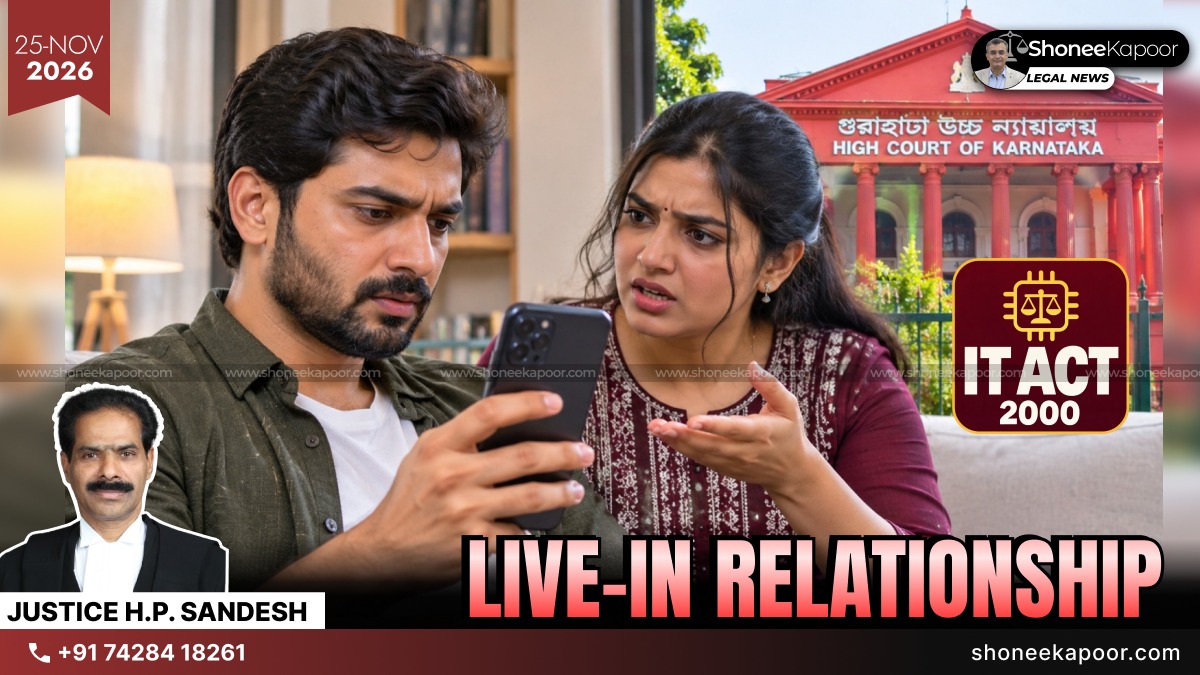
Can A Man Be Accused Of An Offence Under IT Act For Using His Live-In Partner’s Mobile Phone? Karnataka High Court Answers

Curated by NEWS DESK
Editorial DeskKARNATAKA: The Karnataka High Court held that using a live-in partner’s mobile phone during a consensual relationship cannot, by itself, attract criminal proceedings under the Information Technology Act, 2000, without a dishonest or fraudulent intention.
Justice H.P. Sandesh, in an order dated 13 November 2026, quashed three interconnected criminal proceedings involving allegations of rape, cheating, criminal intimidation and unauthorised mobile phone access filed by former live-in partners against each other.
The couple met in 2017 through a modelling-related assignment and subsequently developed a relationship. They started living together in a rented apartment and held an engagement ceremony on 24 February 2018 at Kushalnagar.
However, after their relationship deteriorated in late 2018, both parties initiated criminal proceedings against each other.
The man alleged that he had provided financial assistance of over ₹13.50 lakh to the woman. He accused her of accessing his mobile phone without permission, deleting personal and business-related data and recording his conversations.
The woman subsequently faced proceedings under Sections 65 and 66 of the IT Act. She challenged the FIR, claiming that it was filed to harass her following their personal differences.
While examining the allegations, the High Court considered their admitted live-in relationship and previous interactions involving personal and business matters.
The Court observed:
“To attract Sections 65 and 66 of the IT Act, there must be a dishonest and fraudulent intention.”
The High Court found that, in the circumstances of this case, using mobile phones during their relationship did not establish the necessary criminal intention. It concluded that the complaint arose from personal vengeance following their separation.
Accordingly, the Court quashed the IT Act proceedings against the woman.
Meanwhile, the woman had also accused the man of rape, assaulting her parents, house trespass, abusive behaviour and criminal intimidation.
The man approached the High Court seeking quashing of the FIR registered against him under Sections 376, 323, 448, 504 and 506 IPC.
The Court noted that both parties had voluntarily lived together, maintained a consensual physical relationship and participated in an engagement ceremony with the consent of their families.
Relying on the Supreme Court judgment in Pramod Kumar Navratna v. State of Chhattisgarh and Others, the High Court reiterated:
“Mere breakup of a relationship between consenting parties cannot result in the initiation of criminal proceedings”
The Court found that the allegations emerged after their relationship became strained and held that continuing the criminal prosecution against the man was unjustified.
In another connected case, the man accused the woman and her parents of cheating him. He alleged that ₹17,77,022 had been transferred through bank transactions, of which ₹2,80,022 had been repaid, leaving an outstanding amount of ₹14,97,000.
However, the Court found no intention to cheat at the beginning of the financial transactions.
Read Also:- Legal Position of Live-in Relationship in India
Exercising its inherent powers under Section 482 CrPC, the Karnataka High Court allowed all three petitions and quashed the respective criminal proceedings.
EXPLANATORY TABLE OF LAWS AND SECTIONS
| Law / Section | What It Means | Application In This Case |
|---|---|---|
| Section 65, IT Act, 2000 | Punishes knowing or intentional tampering with computer source documents required to be maintained by law. | Invoked against the woman over alleged interference with mobile data. |
| Section 66, IT Act, 2000 | Punishes computer-related acts specified under Section 43 when committed dishonestly or fraudulently. | Court found the requisite criminal intention missing. |
| Section 43, IT Act, 2000 | Covers unauthorised computer access, data deletion and related acts. | Explains the statutory scope of Section 66. |
| Section 376 IPC | Punishment for rape. | Rape proceedings against the man were quashed. |
| Section 323 IPC | Punishment for voluntarily causing hurt. | Allegations of physical assault. |
| Section 448 IPC | Punishment for house trespass. | Woman alleged unlawful entry into her house. |
| Section 504 IPC | Intentional insult intended to provoke a breach of peace. | Invoked against the man. |
| Section 506 IPC | Punishment for criminal intimidation. | Threat allegations formed part of the connected cases. |
| Section 406 IPC | Punishment for criminal breach of trust. | Originally invoked in the financial dispute but not retained in the charge sheet. |
| Section 420 IPC | Cheating and dishonestly inducing delivery of property. | Court found no dishonest intention at the inception of the transactions. |
| Section 34 IPC | Joint criminal liability for acts committed with common intention. | Invoked against the woman and her parents. |
| Section 482 CrPC | Inherent powers of High Courts to prevent abuse of legal process and secure justice. | Exercised to quash all three criminal proceedings. |
| Article 226, Constitution of India | Confers writ jurisdiction upon High Courts. | Discussed through judicial precedents concerning quashing powers. |
CASE DETAILS
| Particular | Details |
|---|---|
| Case Title | Drishya T.M. @ Nithanya & Others v. State of Karnataka & Others |
| Connected Case Title | Sri G. Prashanth v. State of Karnataka & Another |
| Court | Karnataka High Court, Bengaluru |
| Bench | Justice H.P. Sandesh |
| Judgment Date | 13 November 2026 |
| Case Number | Crl.P. No. 6945/2019, Crl.P. No. 1677/2019 and Crl.P. No. 3769/2019 |
| Counsel for Man | Advocate K. Raghavendra; Advocate M.B. Ravikumar in connected proceedings |
| Counsel for Woman | Advocate G.S. Venkat Subbarao |
| Counsel for State | Mohammed Ayub Ali, Additional SPP |
| IT Act FIR | Crime No. 4912/2018 |
| Police Station | Cyber Crime Police Station, Bengaluru |
| Rape FIR | Crime No. 13/2019 |
| Police Station | Kushalnagar Police Station, Kodagu District |
| Cheating FIR | Crime No. 17/2019, dated 19 January 2019 |
| Police Station | Subramanyanagara Police Station, Bengaluru |
| Charge Sheet Proceedings | C.C. No. 12828/2019 |
| Final Decision | All three petitions allowed; criminal proceedings quashed |
KEY TAKEAWAYS
- Using A Live-In Partner’s Mobile Phone Is Not Automatically A Crime: Karnataka High Court clarifies the scope of the IT Act.
- Criminal Intention Matters: Mere mobile phone use cannot justify criminal prosecution.
- Failed Live-In Relationship Is Not Rape: High Court quashed the rape case against the man.
- Financial Disputes Are Not Automatically Cheating: Dishonest intention must be established from the beginning.
- Breakup Cannot Justify Criminal Prosecution: Men deserve protection against vindictive litigation arising from failed relationships.
Share Your Thoughts
Comments are moderated before publication.