
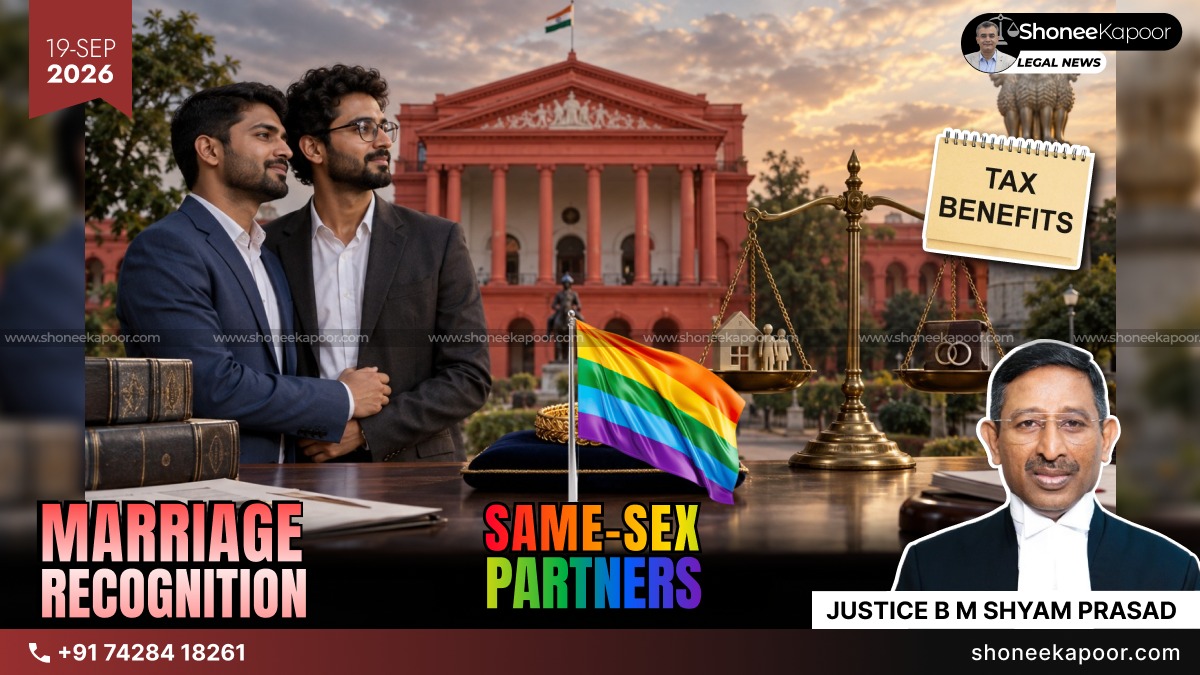
Spouse Means Husband Or Wife; Same-Sex Partners Can't Claim 'Spouse' Tax Benefits In India: Centre Tells Karnataka High Court

Curated by NEWS DESK
Editorial DeskBENGALURU: The Central Government has opposed a plea by a same-sex couple seeking spouse-based tax benefits before the Karnataka High Court, arguing that such a benefit cannot be extended without treating their relationship as a legally recognised marriage.
Anurag Kalia and Akhilesh Godi filed the petition. They have challenged the treatment of the expression “spouse” under the Fifth Proviso to Section 56(2)(x) of the Income Tax Act, 1961, to the extent that it excludes same-sex partners from the tax exemption available for gifts received from a relative.
The dispute arose after one partner allegedly gifted the other a 22-karat gold bracelet, stated to be a family heirloom, on their relationship anniversary. The petitioners contend that such a gift would have received different tax treatment if they were legally recognised as spouses. Earlier coverage valued the bracelet at about ₹1.15 lakh.
Appearing for the Centre before Justice B M Shyam Prasad, Solicitor General Tushar Mehta argued that the word “spouse” under Section 56(2)(x) must be understood with Section 2(41), which defines “relative” and refers to husband or wife among the recognised relationships.
He submitted:
“My submission would be that spouse under Section 56 of the Act would take colour from the definition of relative under Section 2(41), it's a term to include both husband and wife.”
The Centre argued that giving “spouse” a wider meaning could affect several other provisions where the expressions “spouse” and “relative” are used. According to the Union, the petition effectively seeks legal consequences flowing from a same-sex matrimonial relationship even though such a marriage is presently not recognised under Indian marriage law.
The Solicitor General relied upon the Supreme Court's decision in Supriyo v. Union of India, submitting that legal recognition of same-sex marriage was left to the legislature. He also referred to Justice P.S. Narasimha's concurring opinion, arguing that the judiciary cannot create a statutory entitlement by adding categories to an existing provision.
The Centre also gave the example of an unmarried heterosexual couple living together for a long period. According to its argument, such partners do not automatically become spouses merely because their relationship is long-term. The Union therefore maintained that the tax provision distinguishes based on marital status, not sexual orientation.
The government further submitted that marriage carries legal consequences extending into succession, adoption, maintenance and other statutory rights. Expanding the meaning of spouse for one tax exemption, it argued, could therefore have consequences beyond the Income Tax Act.
On the petitioners' Article 14 challenge, the Centre argued that marriage can form a valid legislative classification if there is an intelligible differentia and a rational nexus with the purpose of the law. It also submitted that income is generally taxable unless a specific exemption is provided and cautioned against expanding tax exemptions beyond categories created by the legislature.
Importantly, the Centre clarified that it did not argue that two persons of the same sex cannot live together. Its case is that statutory benefits depend upon the particular legal relationships recognised under the relevant legislation.
The petitioners, represented by Advocates Varshitha K and Dr Dhruv Janssen Sanghavi, want the tax benefit under the Fifth Proviso to Section 56(2)(x) extended to persons in a long-term and stable same-sex relationship. Alternatively, they have asked the Court to interpret “spouse” to cover same-sex couples placed in circumstances comparable to heterosexual couples who may be presumed to be married.
EXPLANATORY TABLE OF LAWS AND SECTIONS
| Law / Provision | What It Means | Relevance To The Case |
|---|---|---|
| Section 56(2)(x), Income Tax Act, 1961 | Deals with taxation of specified money or property received without consideration or for inadequate consideration, subject to statutory exceptions. | The dispute concerns the exemption applicable where a gift is received from a recognised “relative”. The petitioners seek the spouse-linked benefit for their same-sex relationship. |
| Fifth Proviso to Section 56(2)(x) | Provides the relevant statutory exception relied upon in relation to gifts from a relative. | The petitioners have challenged its operation insofar as the spouse/relative exemption does not extend to their relationship. |
| Section 2(41), Income Tax Act, 1961 | Defines “relative” for the statutory scheme referred to by the Centre. | The Solicitor General relied on this definition to argue how “spouse” should be understood in Section 56. |
| Article 14, Constitution of India | Guarantees equality before law and equal protection of laws. | The petitioners challenge the exclusion; the Centre argues that marital status can constitute a valid classification satisfying the constitutional test. |
| Supriyo v. Union of India | Supreme Court decision concerning legal recognition of same-sex marriage. | The Centre relies on the decision to argue that legal recognition of same-sex marriage cannot be created indirectly by expanding “spouse” under the tax law. |
| Bharatiya Nyaya Sanhita | India's substantive criminal law. | The High Court referred to the use of the term “spouse” in other statutes, including the BNS, while examining the implications of the interpretation sought. No particular BNS section is identified in the report. |
CASE DETAILS
| Particular | Details |
|---|---|
| Case Title | Anurag Kalia & Anr. v. Union of India & Anr. |
| Case Number | WP No. 28761/2025 |
| Court | Karnataka High Court |
| Bench | Justice B M Shyam Prasad |
| Petitioners | Anurag Kalia & Anr. |
| Petitioners' Counsel | Advocates Varshitha K and Dr Dhruv Janssen Sanghavi |
| For the Centre during the reported hearing | Solicitor General Tushar Mehta |
| Constitutional Issue | Whether excluding same-sex partners from the spouse-linked tax exemption violates constitutional equality guarantees |
KEY TAKEAWAYS
- A long-term relationship does not automatically make someone a legal “spouse” entitled to marriage-linked benefits.
- The Centre’s argument is clear: spouse benefits cannot be separated from legal recognition of marriage.
- For men, the word “spouse” carries liabilities too, including maintenance and other financial consequences. It cannot be expanded only when benefits are claimed.
- Rights and liabilities must go together. Expanding spouse rights without defining corresponding obligations creates legal uncertainty.
- The High Court has not ruled yet. The real issue is bigger:men should know exactly when a relationship creates legal and financial liability.
Share Your Thoughts
Comments are moderated before publication.