
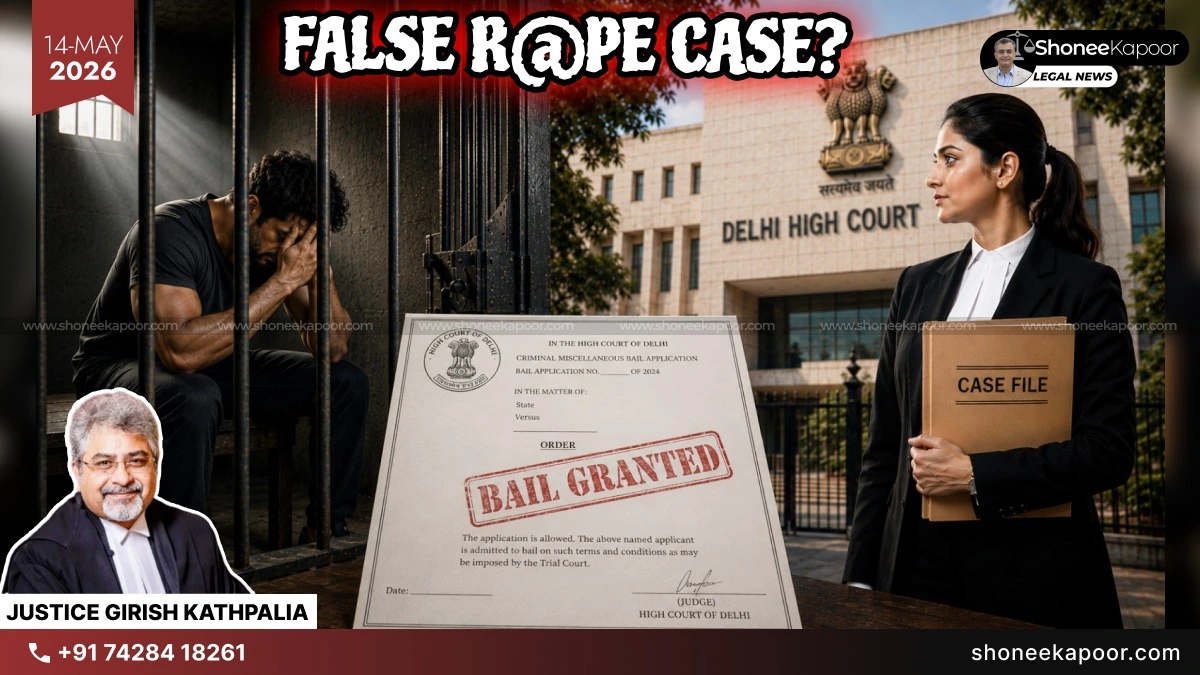
Can a married man’s personal life and interfaith relationship become grounds to deny him bail in criminal proceedings?
The Delhi High Court held that personal morality and religious differences cannot override principles of criminal law and individual liberty.
NEW DELHI: The Delhi High Court, led by Justice Girish Kathpalia, granted bail to a gym trainer accused in a rape and extortion case registered at Seemapuri Police Station in Delhi. While hearing the matter.
The Court observed that:
“Morality has to be kept separate from the offence” while deciding questions related to personal liberty.
According to the case, the woman, who is a practising advocate, alleged that she became friends with the accused at his gym. She claimed that the accused allegedly gave her a laced drink, after which she lost consciousness and was taken to a hotel in Ghaziabad, where she was raped.
She further alleged that the accused clicked objectionable photographs and later used them to threaten and repeatedly sexually assault her. The complaint also stated that the accused demanded Rs.1 lakh from her and she allegedly paid Rs.65,000 due to fear of her pictures being leaked online.
The defence argued before the Court that the relationship between both parties was completely consensual and the FIR was filed only after the relationship turned bitter. The accused also claimed that he had actually spent money on the woman and transferred funds to her during their relationship.
During the hearing, the accused submitted photographs and video clips before the Court. The Court noted that the material showed both individuals “happily engaged in a romantic relationship” and further recorded that:
“None of the pictures/videos depicts any obscene or objectionable material.”
The High Court also observed that the prosecutrix was “neither minor in age, nor an illiterate person” and noted that she was a 30-year-old practising advocate “fully aware of what is good for her.” The Court further pointed out that she never claimed that the relationship started on the basis of a false promise of marriage.
The Court found certain allegations difficult to understand at the prima facie stage. It observed that the gym where the woman allegedly consumed the intoxicating drink was located in Dilshad Colony, Delhi, while the hotel where the alleged rape took place was in Mohan Nagar, Ghaziabad. The Court remarked that:
“It is prima facie difficult to understand as to how after losing consciousness the prosecutrix would have travelled that distance.”
The Court also noted that police could not recover any objectionable photographs or videos from the accused’s mobile phone. Instead, the material found only showed consensual romantic moments between the two. The Court said these pictures and videos-
“Prima facie support the version of the accused/applicant that the relations between two of them were completely consensual.”
During arguments, the prosecution opposed bail by claiming that the accused was a married man with a child and also pointed to the fact that both parties belonged to different religions.
However, the High Court rejected both arguments. The Court clearly stated that:
“Morality has to be kept separate from the offence”
And said the argument regarding religion “is simply rejected.”
Considering that the accused had already spent several months in jail since November 2025, the High Court granted bail and clarified that the observations made in the order would not affect the final outcome of the trial.
Explanatory Table: Laws And Sections Involved
| Law / Section | Purpose | How It Applies In This Case |
| Section 308(2) BNS | Deals with extortion, including forcing or threatening someone for money or property | The prosecutrix alleged that the accused threatened to leak her photographs and demanded money from her. |
| Section 351(2) BNS | Punishes criminal intimidation and threats causing fear | The allegation was that the accused repeatedly threatened the prosecutrix with circulation of pictures on social media. |
| Section 64(2)(m) BNS | Covers aggravated rape allegations under specific circumstances | The prosecutrix claimed that the accused administered an intoxicating substance and sexually assaulted her repeatedly. |
| Section 79 BNS | Protects a woman’s modesty from insulting gestures, words or acts | The allegations regarding objectionable photographs and alleged misuse of private material were linked to this provision. |
| Bail Jurisprudence Under Criminal Law | Protects personal liberty while trial is pending | The Delhi High Court granted bail after observing prima facie indications of a consensual relationship and lack of objectionable material recovered from the accused’s phone. |
Case Details
- Case Title: Sabir vs State (Govt. of NCT Delhi) & Anr.
- Court: Delhi High Court
- Case Number: BAIL APPLN. 1523/2026
- Bench: Justice Girish Kathpalia
- Neutral Citation: 2026:DHC:4171
- Date of Decision: 12 May 2026
- FIR Number: FIR No. 832/2025
- Counsels:
- For Petitioner: Mr. Sanjeev Kumar, Mr. Kapil Khanna and Mr. Asif Khan, Advocates
- For State: Mr. Sanjeev Sabharwal, APP for State
Key Takeaways
- Consensual relationships turning bitter cannot automatically become criminal cases without strong supporting evidence.
- Personal morality, extra-marital affairs or interfaith relationships should not decide a man’s liberty in criminal proceedings.
- Digital evidence matters. Allegations of blackmail through private photos become weak when no such material is recovered.
- Adult and educated individuals are expected to understand the nature and consequences of their voluntary relationships.
- Bail is a matter of personal liberty, not public emotions, social pressure or moral policing against men.
This Could Change Your Case-Get FREE Legal Advice-Click Here!
Disclaimer: The views and opinions expressed in this article are those of the Indian courts and do not necessarily reflect the official policy or position of “ShoneeKapoor.com” or its affiliates. This article is intended for informational and educational purposes only. The content provided is not legal advice, and viewers should not act upon this information without seeking professional counsel. Viewer discretion is advised.
