
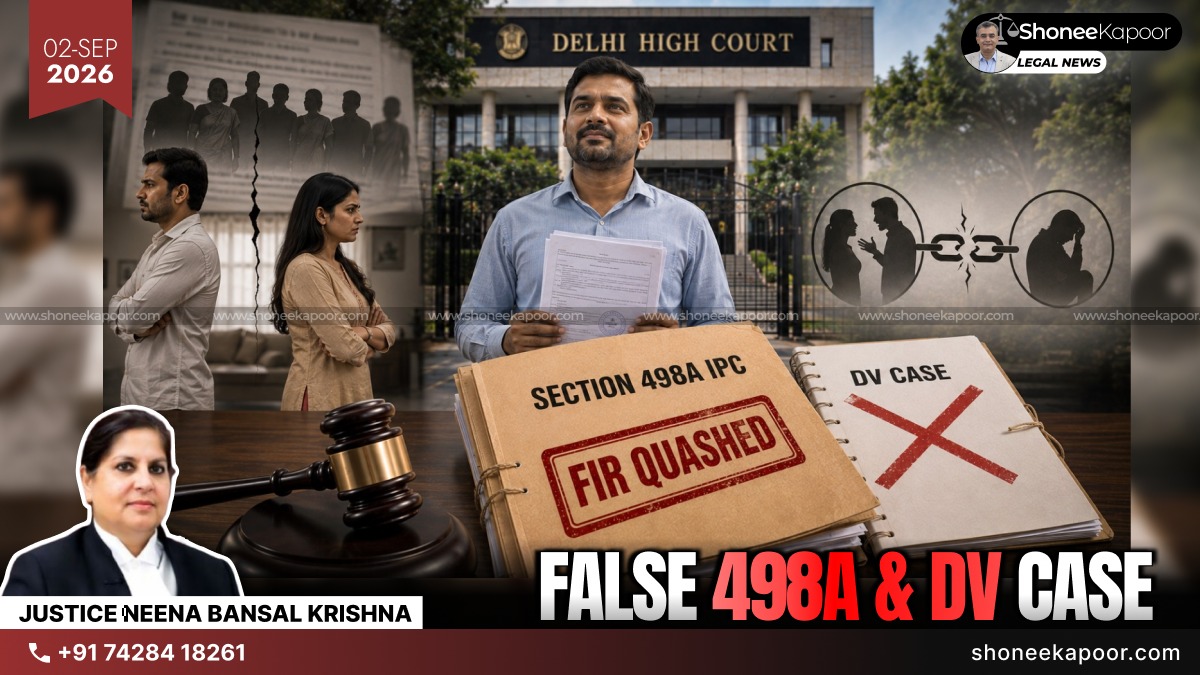
Not Every Marital Dispute Is Cruelty U/S 498A: Delhi High Court Quashes FIR & DV Proceedings Against Husband And Family

Curated by NEWS DESK
Editorial DeskCan ordinary marital disagreements, adjustment problems and vague allegations against an entire husband’s family become criminal cruelty under Section 498A IPC? The Delhi High Court has drawn a clear line between matrimonial discord and a criminal offence.
NEW DELHI: The Delhi High Court has quashed an FIR under Sections 498A, 406 and 34 IPC and a Domestic Violence Act complaint against a husband and his family, holding that vague and general allegations arising from ordinary matrimonial disputes cannot be converted into criminal cruelty.
Justice Neena Bansal Krishna was dealing with two petitions filed by Sandeep Pathak and his family members, seeking quashing of FIR No. 252/2013 registered at P.S. K.N. Katju Marg and Complaint Case No. 494/2016 under the DV Act.
Sandeep Pathak and complainant Lalita Tiwari married on January 25, 2005. According to the husband, the wife found it difficult to adjust in Ranikhet and stayed there only for short periods. He alleged that despite attempts at reconciliation, the matrimonial relationship did not improve.
The husband eventually filed a divorce petition in 2011. The court granted an ex parte divorce decree on September 5, 2012. The decree remained unchallenged. The wife subsequently filed her own divorce petition but withdrew it after learning about the earlier decree.
Thereafter, she initiated proceedings under the Domestic Violence Act and an FIR was registered under Sections 498A/406/34 IPC against the husband and his family.
The High Court examined whether the allegations actually satisfied the legal ingredients of cruelty under Section 498A IPC.
Referring to the Supreme Court decision in Jayedeepsinh Pravinsinh Chavda v. State of Gujarat, the Court noted that simple cruelty is not sufficient for Section 498A unless the conduct satisfies the statutory requirements, including conduct intended to cause serious injury, drive the woman towards suicide or coerce her or her relatives to meet an unlawful demand.
The wife had alleged that eight members of her husband’s family tortured, humiliated, taunted and abused her. However, the High Court found that the allegations lacked specific incidents, dates and details against individual family members.
The Court observed that the wife had stayed in her matrimonial home only for a short period and largely lived at her parental home in Delhi, while the husband used to visit her.
On allegations against the husband, father-in-law and brother-in-law, the Court found that apart from broad claims of torture, humiliation and abuse, no specific incident explaining the alleged cruelty had been narrated.
The Court also rejected the allegation against the husband’s sister that she controlled his finances and influenced property matters. It observed that there was nothing unusual in a family member managing her brother’s affairs and no material showed how this caused deprivation or cruelty to the complainant.
On another allegation that a family member wanted the complainant to help care for his child, the Court specifically held:
“Merely asking the Complainant to assist in caring for a family member cannot, by itself, constitute cruelty within the meaning of Section 498A IPC.”
The High Court ultimately found that the complaint lacked specific dates and details and contained generic, omnibus and vague allegations. It further found no allegation of physical violence causing injury, no medical evidence showing mental or physical harm and no conduct of the nature contemplated under Section 498A IPC.
The Court made the crucial distinction:
“The allegations at best reflect ordinary matrimonial discord and lack of adjustment, but not criminal cruelty.”
It consequently held that the essential ingredients of Section 498A IPC were not made out and that continuing the criminal case would amount to an abuse of the process of law.
The Court separately examined the allegations regarding stridhan and Section 406 IPC. It noted that the wife had generally referred to “jewellery” without identifying the articles, their description, quantity or value. The Court also noted no clear allegation about whom the jewellery had been entrusted to or when its return had been demanded and refused.
Finding no prima facie allegation establishing entrustment and dishonest misappropriation, the Court held that no offence under Section 406 IPC was made out against the petitioners.
The Court also relied on State of Haryana v. Bhajan Lal, where the Supreme Court observed:
“where the uncontroverted allegations made in the FIR or complaint and the evidence collected in support of the same do not disclose the commission of any offence and make out a case against the accused; or where a criminal proceeding is manifestly attended with mala fide and/or where the proceeding is maliciously instituted with an ulterior motive for wreaking vengeance on the accused and with a view to spite him due to private and personal grudge, the FIR may be quashed.”
Accordingly, the High Court quashed FIR No. 252/2013 under Sections 498A/406/34 IPC.
The Court then examined the DV Act complaint. It found that the allegations were substantially the same vague and omnibus allegations already examined while considering the criminal FIR.
Another important factor was the chronology. The parties' marriage had already been dissolved through the September 5, 2012 divorce decree, which had attained finality, before the wife initiated the DV proceedings.
Referring to Kuldeep Kaur v. Swaran Kaur, the Court quoted:
“Once the marriage stands dissolved by a valid decree of divorce, the domestic relationship comes to an end. Consequently, the substratum upon which the right of residence is founded no longer survives, unless a contrary statutory right is shown to persist.”
It further noted:
“In the absence of such a relationship, the foundational requirement for invoking Section 17 of the PWDV Act is lacking.”
The High Court found that the criminal and DV proceedings were initiated after the marital relationship had already been dissolved, and viewed the proceedings in the facts of this case as an attempt to revive matrimonial disputes through criminal litigation.
It ultimately held that continuing the proceedings would amount to an abuse of the process of law. Accordingly, Complaint Case No. 494/2016 under Sections 18, 19, 20, 21 and 22 of the DV Act, along with all proceedings arising from it, was also quashed.
EXPLANATORY TABLE OF LAWS AND SECTIONS
| Law / Section | What It Provides | Relevance In This Case |
|---|---|---|
| Section 498A IPC | Punishes cruelty by a husband or his relatives against a married woman. | Court found the allegations vague and insufficient to establish statutory cruelty. |
| Section 405 IPC | Defines criminal breach of trust involving entrustment and dishonest misappropriation of property. | Relevant to allegations concerning the wife's jewellery/stridhan. |
| Section 406 IPC | Provides punishment for criminal breach of trust. | Quashed because specific entrustment and dishonest misappropriation were not prima facie established. |
| Section 34 IPC | Deals with acts committed by several persons in furtherance of common intention. | Invoked along with Sections 498A and 406 in the FIR. |
| Section 482 CrPC | Gives the High Court inherent powers to prevent abuse of court process and secure the ends of justice. | Invoked for quashing the criminal proceedings. |
| Article 227, Constitution of India | Gives High Courts supervisory jurisdiction over subordinate courts and tribunals. | Invoked along with Section 482 CrPC. |
| Section 12, DV Act | Provides the procedure for approaching the Magistrate for relief under the DV Act. | Wife's DV proceedings were challenged before the High Court. |
| Section 2(f), DV Act | Defines “domestic relationship”. | Relevant to the effect of the final divorce decree on the claimed domestic relationship. |
| Section 17, DV Act | Provides the right to reside in a shared household, subject to the statutory framework. | Discussed while considering whether the foundation for such relief survived after divorce. |
| Section 18, DV Act | Protection orders. | Relief claimed in the DV complaint, which was quashed. |
| Section 19, DV Act | Residence orders. | Relief claimed in the DV complaint. |
| Section 20, DV Act | Monetary relief. | Relief claimed in the DV complaint. |
| Section 21, DV Act | Temporary custody orders. | One of the provisions under which relief was sought. |
| Section 22, DV Act | Compensation and damages. | One of the provisions invoked in the complaint. |
| Section 13(1)(i-a), HMA | Provides divorce on the ground of cruelty. | Husband's divorce proceedings culminated in an ex parte divorce decree. |
CASE DETAILS
| Particulars | Details |
|---|---|
| Case Title | Sandeep Pathak & Ors. v. Lalita Tiwari / Sandeep Pathak & Ors. v. State (NCT of Delhi) & Ors. |
| Court | High Court of Delhi at New Delhi |
| Case Numbers | CRL.M.C. 297/2021 & CRL.M.C. 485/2021 |
| Neutral Citation | 2026:DHC:1982 |
| Reserved On | 09 December 2025 |
| Pronounced On | 10 March 2026 |
| Bench | Hon’ble Ms Justice Neena Bansal Krishna |
| Petitioners' Counsel | Ms Jyoti Dutt Sharma, Mr Chinmaya K. Bhatt and Ms Amrita Pandey, Advocates |
| Counsel for State | Mr Ajay Vikram Singh, APP |
| Complainant | Ms Lalita Tiwari, appearing in person |
KEY TAKEAWAYS
- A failed marriage is not a crime — matrimonial discord cannot automatically become 498A cruelty.
- Vague allegations can drag an entire family into years of litigation — the Court found them generic and omnibus.
- Naming the husband and every in-law is not proof — criminal liability needs specific allegations.
- “Stridhan” is not enough by itself — entrustment and dishonest retention must be specifically shown for Section 406 IPC.
- For men, the process itself becomes punishment — the 498A FIR and DV case were ultimately quashed as an abuse of process.
Share Your Thoughts
Comments are moderated before publication.