
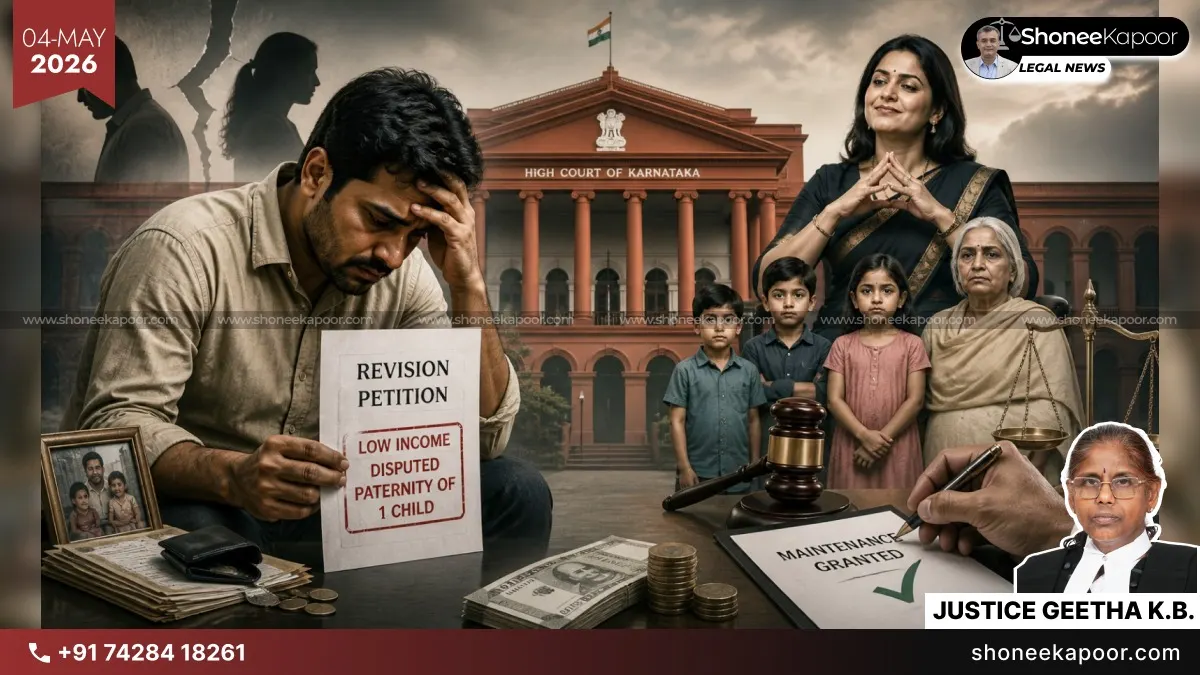
Can a husband escape maintenance liability by claiming low income and denying paternity without proving lack of access?
Husband Maintaining Second Family Cannot Deny Maintenance To First Wife, Children And Aged Mother: Karnataka High Court Reduces Quantum But Upholds Liability
BENGALURU: In a judgment dated 23 April 2026, the Karnataka High Court at Dharwad, presided over by Justice Geetha K.B., dealt with a case where the husband had entered into a second marriage while his first wife, 3 children, and aged mother sought maintenance.
The Court partly allowed the husband’s revision petition and reduced the maintenance amount, but firmly upheld his legal responsibility to maintain his first family.
The case arose when the Family Court at Belagavi had directed the husband to pay a total of ₹30,000 per month as maintenance to his wife, children, and mother. Challenging this, the husband approached the High Court not only claiming that the amount was excessive and beyond his financial capacity, but also disputing the paternity of one of the children and seeking to avoid liability towards that child.
The High Court examined the facts and clarified that simply stating low income is not sufficient. At the same time, it noted that no documentary evidence was produced to establish the exact income of the husband. The Court observed that when income is not clearly proved, the maintenance awarded must be reasonable and not exaggerated.
On the issue of paternity, the Court relied on the settled legal presumption and held:
“Birth during marriage, conclusive proof of legitimacy:- The fact that any person was born during the continuance of a valid marriage between his mother and any man… shall be conclusive proof that he is the legitimate child of that man, unless it can be shown that the parties to the marriage had no access to each other…”
Applying this principle, the Court found that the husband failed to prove lack of access and therefore could not deny responsibility towards the child.
The husband had argued that the wife had deserted him and was therefore not entitled to maintenance. However, the Court rejected this argument and made it clear that the husband’s second marriage itself gives the wife a valid reason to live separately. The Court held:
“According to this provision, the wife is not entitled to receive maintenance… if she is living in adultery, or if, without any sufficient reason, she refuses to live with her husband…”
The Court clarified that a wife cannot be forced to live with a husband who has remarried, and such circumstances provide sufficient justification for her to live separately while still claiming maintenance.
On the issue of the aged mother, the Court emphasized that it is both a legal and moral duty of the son to maintain his parents. It noted that even if the mother is earning a small amount, it is not enough for her basic needs, especially considering her age and medical condition.
Importantly, the Court also drew an adverse inference against the husband for not producing proper income records, observing that a person who is maintaining a second family cannot claim to have no income at all.
However, balancing all circumstances, the Court found that the maintenance awarded by the Family Court was excessive in the absence of concrete proof of income. Accordingly, it modified the order and reduced the maintenance to ₹5,000 per month each for the wife and mother, and ₹2,500 per month for each child until they attain majority.
Explanatory Table: Laws & Sections Inbolved
| Law / Section | Purpose | How Applied in This Case |
| Section 125 Cr.P.C. | Provides maintenance to wife, children, and parents | Court held husband must maintain wife, children, and aged mother |
| Section 125(4) Cr.P.C. | Specifies when wife is not entitled to maintenance | Court held wife had valid reason to live separately due to husband’s second marriage |
| Section 19(4) Family Courts Act, 1984 | Allows High Court to review Family Court orders | Husband filed revision challenging maintenance order |
| Section 116 Bharatiya Sakshya Adhiniyam, 2023 | Presumption of legitimacy of child born during marriage | Court rejected paternity denial and presumed child to be legitimate |
| Principle of Adverse Inference | Court can draw negative inference if evidence is withheld | Court held husband hid income details, indicating sufficient earning capacity |
Case Details
- Case Title: Sri. Guruprasad vs Smt. Sangeeta & Others
- Court: High Court of Karnataka, Dharwad Bench
- Case Number: RPFC No. 100139 of 2025
- Bench: Hon’ble Mrs. Justice Geetha K.B.
- Date of Judgment: 23 April 2026
- Neutral Citation: NC: 2026:KHC-D:5958
- Counsels:
- For Petitioner (Husband): Sri. M.C. Hukkeri, Advocate
- For Respondents: Sri. Anand Ashtekar, Advocate
- Court Guardian for Minor: Sri. Pranav Umesh Badagi
Key Takeaways
- The legal system puts an overwhelming and often disproportionate financial burden on men, even when they are already supporting multiple families.
- The husband’s denial of paternity was effectively disregarded, highlighting how men face an almost impossible standard to disprove fatherhood, even in doubtful situations.
- Courts continue to presume earning capacity in the absence of proof, resulting in men being saddled with maintenance liabilities without proper financial verification.
- Husband’s second marriage is treated as sufficient ground for the wife to claim maintenance, while his denial of paternity of a child is ignored.
- Even when courts reduce excessive maintenance, the core issue remains unchanged — men are ultimately held liable at all costs, reinforcing a system that operates heavily against them.
This Could Change Your Case-Get FREE Legal Advice-Click Here!
Disclaimer: The views and opinions expressed in this article are those of the Indian courts and do not necessarily reflect the official policy or position of “ShoneeKapoor.com” or its affiliates. This article is intended for informational and educational purposes only. The content provided is not legal advice, and viewers should not act upon this information without seeking professional counsel. Viewer discretion is advised.
