
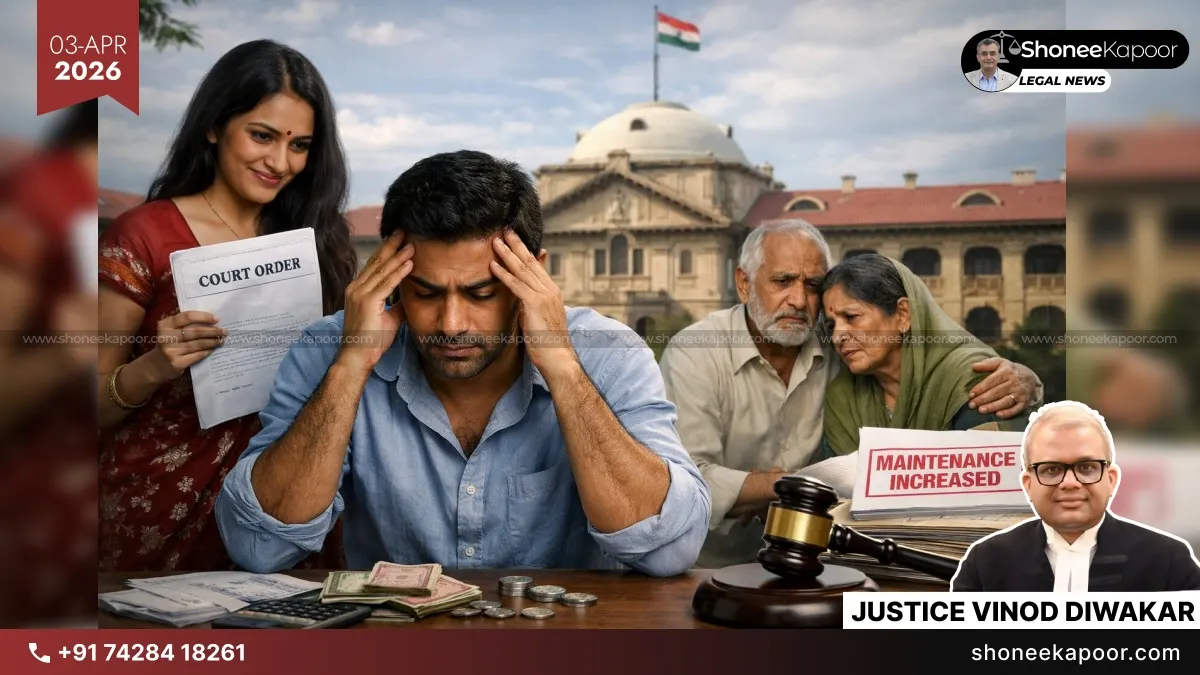
Husband Cannot Escape Maintenance Liability Despite Low Salary And Family Burden Of Siblings & Old Parents: Allahabad HC Upholds Wife’s Increased Maintenance

Curated by NEWS DESK
Editorial DeskAllahabad High Court refused to interfere with the Family Court’s order increasing maintenance. Is a husband’s financial capacity being assumed rather than properly evaluated by courts?
PRAYAGRAJ: Justice Vinod Diwakar of the Allahabad High Court dismissed a husband’s challenge against the enhancement of maintenance, reinforcing that a man cannot avoid his primary duty towards his wife and child by citing other financial burdens.
The case arose when the Family Court increased maintenance from ₹3,500 to ₹8,000 per month for the wife and from ₹1,500 to ₹4,000 for the minor son. The husband, a railway employee earning around ₹55,000 per month, approached the High Court claiming that the increase was excessive and beyond his financial capacity.
He argued that he was a Group-D employee with limited income and had multiple responsibilities, including taking care of his aged parents and supporting his unmarried siblings. According to him, the Family Court failed to properly consider his liabilities before enhancing the maintenance amount.
However, the High Court examined the record and found that the Family Court had already taken into account all relevant factors, such as the parties’ income and status, and the needs of the wife and child. The Court clearly stated:
“The learned Family Court has taken into consideration the relevant factors, including the income of the revisionist, the status of the parties, and the requirement of the respondent while determining and enhancing the amount of maintenance.”
The Court reiterated the core principle behind maintenance laws and observed:
“It is well settled that the object of granting maintenance is to prevent the wife from falling into destitution and vagrancy and to ensure that she is able to maintain herself with dignity in a manner commensurate with the status and financial capacity of the husband.”
Rejecting the husband’s plea, the Court further clarified that financial obligations towards parents or siblings cannot override the legal duty towards the wife. It held:
“Merely because the revisionist has certain familial obligations would not absolve him of his primary responsibility to maintain his legally wedded wife.”
The Court also emphasized the limited scope of revisional jurisdiction, stating:
“The revisional jurisdiction of this Court is limited in scope and is ordinarily exercised only where there is manifest illegality, perversity, or material irregularity in the order impugned.”
Finding no such error in the Family Court’s order, the High Court concluded that the challenge had no merit and dismissed the revision petition.
This judgment again reflects how courts prioritize maintenance obligations without deeply scrutinizing the actual financial pressure on the husband. Even when multiple dependents and limited income are clearly placed on record, the system continues to impose higher financial burdens, leaving little room for balanced assessment of a man’s real capacity.
Explanatory Table: Laws & Provisions Involved
| Law / Provision | Purpose | How Applied in This Case |
| Section 125 Cr.P.C. | Provides basic right to maintenance for wife, child, and parents | Foundational principle behind maintenance; ensures wife does not suffer destitution |
| Section 127 Cr.P.C. | Allows alteration (increase/decrease) of maintenance based on changed circumstances | Used by Family Court to enhance maintenance considering husband’s income |
| Section 397 Cr.P.C. | Revisional jurisdiction of High Court/Sessions Court | High Court exercised limited power; refused to interfere due to absence of illegality |
| Section 401 Cr.P.C. | Powers of High Court in revision | Reinforced that interference is only in cases of perversity or material irregularity |
| Family Courts Act, 1984 | Establishes Family Courts for speedy resolution of matrimonial disputes | Family Court order given due weight; High Court declined to substitute its view |
| Social Welfare Principle of Maintenance Law | Prevents destitution and ensures dignified survival of wife | Court emphasized maintenance as a welfare mechanism, not punishment of husband |
| Judicial Principle: Financial Capacity vs Liability | Balancing income with obligations | Court prioritized wife’s right over extended family liabilities of husband |
Case Details
- Case Title: Ajay Verman v. State of U.P. and 2 Others
- Court: High Court of Judicature at Allahabad
- Case Number: Criminal Revision No. 1108 of 2026
- Bench: Hon’ble Justice Vinod Diwakar
- Neutral Citation: 2026:AHC:51036
- Date of Judgment: March 12, 2026
- Counsels:
- For Revisionist: Arvind Kumar Srivastava, Virendra Singh
- For Opposite Party: G.A.
Key Takeaways
- Courts continue to prioritise wife’s maintenance over the husband’s total financial burden, even when multiple dependents exist.
- A modest salaried man (₹55,000/month) is still treated as fully capable of paying increased maintenance without detailed scrutiny of real expenses.
- Financial responsibility towards parents and siblings is legally sidelined in favour of wife and child.
- Revisional jurisdiction offers almost no practical relief to husbands once maintenance is enhanced by Family Courts.
- The system reinforces a one-sided obligation model where the husband’s capacity is presumed rather than rigorously evaluated.
This Could Change Your Case-Get FREE Legal Advice-Click Here!
Disclaimer: The views and opinions expressed in this article are those of the Indian courts and do not necessarily reflect the official policy or position of “ShoneeKapoor.com” or its affiliates. This article is intended for informational and educational purposes only. The content provided is not legal advice, and viewers should not act upon this information without seeking professional counsel. Viewer discretion is advised.
Related Articles
Unheard Voices: Understanding Men’s Rights and Legal Inequality in India
India speaks proudly of women’s empowerment but ignores the men who suffer in silence. With rising false accusations,...

Legal Mistakes Men Make During Divorce: Costly Errors That Destroy Cases
Costly legal mistakes Indian men make during divorce, maintenance, custody, 498A/BNS cruelty cases and evidence colle...

Legal Risks Men Face In Modern Relationships In India: 498A, Maintenance, False Promise To Marry, Live-In Cases & DV Act
Modern relationships can expose Indian men to criminal cases, maintenance claims, DV Act proceedings, false promise t...
Relevant Judgements
Can an NRI Husband Be Forced to Pay Maintenance in India? Supreme Court Rules Explained for Overseas Indian Men
Living abroad does not automatically protect an NRI husband from maintenance claims in India.But can Indian courts pa...
Share Your Thoughts
Comments are moderated before publication.