
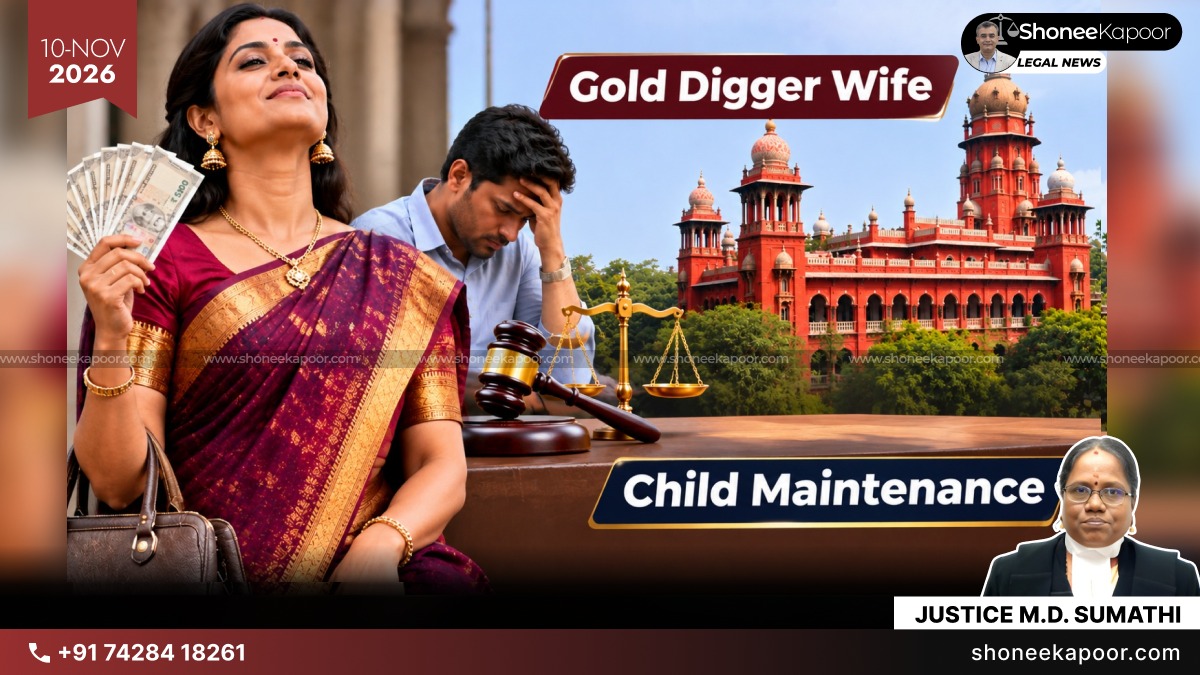
Wife Earning More Than Husband And Still Seeking Child Maintenance: Can She Be Labelled A 'Gold Digger'? Madras High Court Answers

Written and analysed by Vaibhav Ojha
Head Of Legal CommunicationsCHENNAI: The Madras High Court has ruled that women seeking genuine financial support for their children cannot be labelled "gold diggers" merely for demanding maintenance. The Court also clarified that a mother's financial independence does not remove the father's responsibility towards his child.
Justice M.D. Sumathi, in an order dated October 28, 2026, dismissed a father's criminal revision petition challenging the Madurai Family Court's direction to pay ₹6,14,887 towards his minor daughter's educational, medical and other expenses.
The case arose from a maintenance petition filed by the wife in 2014 under Section 125 CrPC, seeking financial support for herself and her daughter.
In July 2015, the Family Court initially directed the husband to pay ₹5,000 each per month to the wife and daughter. That order was later set aside, and the matter was sent back for fresh consideration.
Read Also:- Husband Must Pay Maintenance Despite Child Custody With Him: Delhi High Court
On January 20, 2017, the Family Court ordered the father to pay ₹20,000 per month for his daughter, along with specified educational and unusual medical expenses. However, the wife's personal maintenance claim was dismissed.
Both parties challenged the order before the High Court. During the proceedings, they reached a compromise on November 2, 2018.
Under the compromise, the father agreed to clear the mortgage on a flat and settle the property jointly with the wife in favour of their daughter. Until the settlement was completed, he was required to continue paying maintenance and the child's expenses.
However, the property settlement was not completed. The mother subsequently approached the Family Court seeking recovery of outstanding amounts.
She claimed ₹19,62,743 towards monthly maintenance and additional expenses. After adjusting ₹6,02,000 already received, she demanded ₹13,60,743.
The Family Court examined the payment records, school fees, transport charges and medical bills. It also considered additional payments made by the father, including a ₹5 lakh bank transfer.
After accounting for ₹11,87,000 in payments, the Court found that no further monthly maintenance arrears remained payable under that head.
The Court also excluded certain expenses, including Hindi tuition, drawing, dance and day-care charges, because they were outside the earlier maintenance order.
After examining the remaining eligible expenses, the Family Court directed the father to pay ₹6,14,887.
The father challenged this direction before the High Court. He argued that the Family Court had wrongly accepted certain bills, overlooked school-fee payments and failed to consider the possibility of medical insurance reimbursement.
He also alleged that the mother's intention was to extract money from him.
The High Court rejected the challenge, observing that the Family Court had not blindly accepted the mother's demands. Instead, it had examined the records, adjusted established payments and excluded expenses that were not legally payable.
Importantly, the judgment recognised that a father has the right to challenge disputed expenses, question bills and seek credit for payments already made. However, such objections must be supported by proper evidence.
The Court further noted that the mother was employed as a professor at Bangalore University. Nevertheless, her employment did not extinguish the father's independent responsibility towards their daughter.
The Court observed:
"The employment or financial independence of the mother does not extinguish the father's independent legal and moral responsibility towards the child. The responsibility of providing for the child cannot be shifted entirely upon the mother merely because she is financially capable of maintaining herself."
The High Court also referred to the Delhi High Court's decision in Hitesh Makhija v. Ritu Makhija, 2025 SCC OnLine Del 9664, concerning parental responsibility and the burden borne by the parent providing daily care.
The Court expressed strong disapproval of using insulting labels against women who approach courts seeking genuine child-related expenses.
It observed:
"This Court considers it necessary to express its disapproval of the tendency to stigmatize women who seek financial support by describing them as “gold diggers” or by attributing ulterior financial motives to them without adequate basis. Such expressions are particularly objectionable when the demand concerns the education, healthcare and upbringing of a minor child. They shift attention away from the actual question of legal responsibility and attempt to place the character of the woman, rather than the merits of the claim, on trial."
The Court specifically recognised that fathers are entitled to dispute amounts that are not legally payable. It also stated that payments already made must be properly credited and expenses falling outside an existing judicial order can be excluded.
The Court further explained that child maintenance should not become a punishment imposed upon the father because his marriage has failed. Its purpose is to meet the child's legitimate needs, not to provide an unjustified financial benefit to either parent.
Addressing the use of derogatory language against mothers seeking financial support, the Court stated:
"Such expressions are not merely unkind words uttered in the heat of a dispute. When used to demean a mother who approaches the court for the legitimate needs of her child, they reflect a deeply unfair attitude towards the responsibilities undertaken by women after the breakdown of a marriage. A woman who asks for money towards her child's education, medical treatment, food and other necessities is not, merely by making such a demand, seeking to enrich herself at the expense of the father. She may simply be asking him to discharge the responsibility that the law and parenthood place upon him."
The Court emphasised that a child's financial needs continue even after the parents separate. Expenses relating to education, medical treatment, transport and other necessities cannot be ignored because of disputes between the husband and wife.
At the same time, the judgment recognised that both parents must act responsibly and that the financial circumstances of the parties may be relevant when determining their respective obligations.
The Court added:
"The message that must emerge from this case is clear. The end of a marriage cannot be treated as the end of a father's responsibility. A mother's ability to earn cannot be used as a reason to diminish the father's obligation. A woman's dignity cannot be attacked merely because she seeks the financial contribution legally due for her child. And a child who is already affected by the separation of its parents must not be made to endure further distress through avoidable and prolonged disputes over its basic needs."
The High Court further clarified that its observations were not intended to condemn men as a class or suggest that every maintenance claim made by a woman is justified.
It reiterated that maintenance disputes must be decided through evidence, applicable law and a proper examination of the amounts claimed.
In the present case, the Court found that the Family Court had already considered the father's payments, examined the disputed expenses and excluded amounts outside the earlier order.
Consequently, the Madras High Court dismissed his criminal revision petition and upheld the Family Court's September 22, 2022 order directing payment of ₹6,14,887 towards his daughter's expenses.
EXPLANATORY TABLE OF ALL LAWS AND SECTIONS MENTIONED
| LAW / SECTION | EXPLANATION | RELEVANCE TO CASE |
|---|---|---|
| Section 125 CrPC | Provides for maintenance of eligible wives, children and parents. | Mother originally sought maintenance for herself and her minor daughter under this provision. |
| Section 397 CrPC | Provides revisional powers to examine the correctness, legality or propriety of certain subordinate court orders. | Father challenged the Family Court's payment order through criminal revision. |
| Section 401 CrPC | Defines the High Court's powers while exercising criminal revisional jurisdiction. | High Court examined whether the Family Court's order required interference. |
CASE DETAILS
| PARTICULARS | DETAILS |
|---|---|
| Court | Madras High Court, Madurai Bench |
| Case Title | Xyz v. Abc |
| Case Number | Crl.R.C.(MD) No. 1285 of 2022 |
| CNR Number | HCMD011261102022 |
| Date of Judgment | 28 October 2026 |
| Bench | Justice M.D. Sumathi |
| Petitioner's Counsel | Mr. D. V. Omprakash |
| Respondents' Counsel | Mr. R. Raja for Mr. T. R. Jeyapalam |
| Original Maintenance Case | M.C. No. 84 of 2014 |
| Family Court Application | Crl.M.P. No. 164 of 2019 |
KEY TAKEAWAYS
- ₹6.14 Lakh Burden: Madras HC upheld the father's liability despite the mother being employed as a professor.
- Mother's Income No Exemption: A financially independent mother does not automatically reduce the father's child maintenance obligation.
- Fathers Can Challenge Bills: Inflated, duplicate or legally inadmissible expenses can be contested with evidence.
- Not Every Demand Is Valid: Courts must verify expenses, adjust previous payments and reject unsupported claims.
- Maintenance Is Not Punishment: The Court clarified that fathers cannot be financially punished for a failed marriage.
Share Your Thoughts
Comments are moderated before publication.