
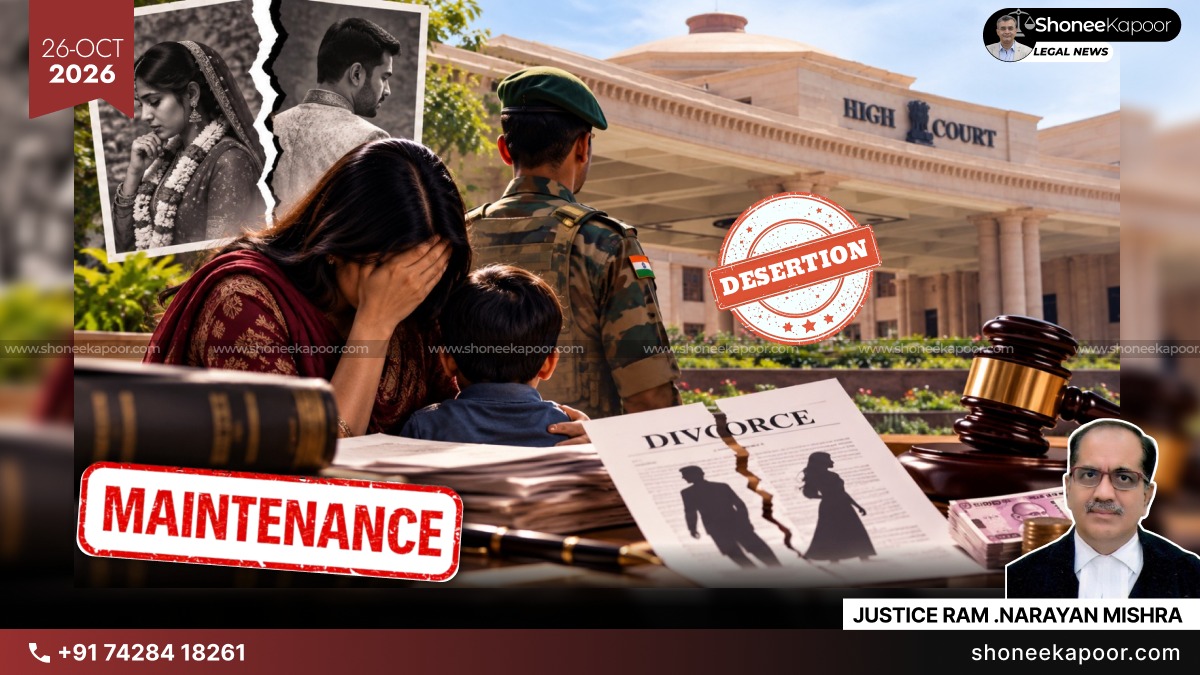
Section 125 CrPC | Husband Gets Divorce On Ground Of Wife’s Desertion, Yet He Must Pay Maintenance? Allahabad HC Explains

Curated by NEWS DESK
Editorial DeskUTTAR PRADESH: The Allahabad High Court, Lucknow Bench, has held that a divorced woman can claim maintenance under Section 125 CrPC even when her husband obtained divorce on the ground of desertion, provided she has not remarried and cannot maintain herself.
Justice Ram Manohar Narayan Mishra set aside a Sultanpur Family Court order rejecting Suneeta's maintenance application and directed the court to reconsider the case.
Suneeta had married Rajesh Kumar Yadav, who later joined the Indian Army. Following matrimonial disputes, she approached the court seeking maintenance for herself and her child.
She alleged dowry demands, harassment and her husband's involvement with another woman. Rajesh denied these allegations and maintained that Suneeta had voluntarily deserted him despite his willingness to keep her.
The Family Court rejected her maintenance claim on December 22, 2018, finding that she had failed to establish sufficient reasons for living separately. It also relied on payments deducted from her husband's Army salary.
However, the High Court examined Army records showing that 15% of Rajesh's salary had been deducted towards maintenance. A 2011 Army letter specifically sanctioned this amount for their son, Ayush, while other records described the payments as maintenance for both mother and child.
Read Also:- Conditions for No Maintenance to wife in India
The Court also noted that Rajesh had obtained an ex parte divorce decree on September 25, 2014, on the ground of desertion. His subsequent marriage to Neelam Yadav was also reflected in the records.
The High Court relied on the Supreme Court's judgment in Rohtash Singh v. Ramendri, which recognised the distinction between maintenance claimed during marriage and maintenance claimed after divorce.
The Court observed:
“Therefore, the law is very clear on this aspect that a divorced woman is also entitled to maintenance until she gets remarried or she is capable of maintaining herself by her own earnings, if there is no legal embargo.”
It explained that Section 125(4) CrPC, which restricts maintenance in certain circumstances, applies where the marriage continues. A divorced woman remains a wife for the limited purpose of maintenance under Explanation (b) to Section 125(1) CrPC.
The Court further stated:
“Though the marital relations came to an end by the divorce granted by the Family Court under Section 13 of the Hindu Marriage Act, the respondent continues to be "wife" within the meaning of Section 125 Cr.P.C. on account of Explanation (b) to Sub-section (1).”
The High Court clarified that maintenance for the period before divorce must be considered separately. Even where desertion justified the divorce, it does not automatically defeat a subsequent claim for maintenance.
The Court found that Suneeta's independent income had not been proved. It held that she could seek maintenance from September 25, 2014, the date of divorce, until remarriage, subject to the applicable legal requirements.
For their son, the Court recognised maintenance entitlement until majority but directed that periods already covered by Army maintenance payments must be excluded to prevent duplicate recovery.
Consequently, the High Court set aside the Family Court's rejection order and remanded the matter for a fresh decision, preferably within six months.
Meanwhile, Rajesh was directed to pay Rs.4,000 per month as interim maintenance to Suneeta. Both parties must disclose their income, assets and liabilities before the Family Court.
EXPLANATORY TABLE OF LAWS AND SECTIONS
| Law / Section | What It Means | Application In This Case |
|---|---|---|
| Section 125(1) CrPC | Provides maintenance to eligible wives, children and parents unable to maintain themselves. | Basis of Suneeta's maintenance claim. |
| Explanation (b), Section 125(1) CrPC | Includes a divorced woman who has not remarried within the definition of wife. | Preserves her eligibility to claim maintenance after divorce. |
| Section 125(4) CrPC | Restricts a wife's maintenance entitlement in specified circumstances, including unjustified refusal to live with her husband. | The Court explained how it differs from post-divorce maintenance. |
| Section 19(4), Family Courts Act, 1984 | Gives the High Court revisional jurisdiction over specified Family Court orders under Chapter IX CrPC. | Used to challenge the rejection of maintenance. |
| Section 9, Hindu Marriage Act, 1955 | Provides for restitution of conjugal rights. | Rajesh stated that he had initiated proceedings seeking restoration of marital cohabitation. |
| Section 13, Hindu Marriage Act, 1955 | Provides grounds for divorce, including desertion. | Rajesh obtained an ex parte divorce decree in 2014. |
| Section 15, Hindu Marriage Act, 1955 | Governs when divorced persons may legally remarry. | Discussed through the Madras High Court judgment relied upon by the husband. |
| Section 11, Hindu Marriage Act, 1955 | Concerns marriages that are void under specified conditions. | Discussed in the quoted Supreme Court precedent on remarriage. |
| Section 5, Limitation Act, 1963 | Permits condonation of delay in specified proceedings on sufficient cause. | Discussed in the cited Madras High Court ruling. |
| Article 227, Constitution of India | Gives High Courts supervisory jurisdiction over subordinate courts and tribunals. | Mentioned in the Madras High Court precedent. |
| Section 91(1), Army Act, 1950 | Concerns deductions from pay and allowances of certain Army personnel. | Cited in the Army's sanction of maintenance deductions. |
| Army Rule 193 and Army Order 2/2001 | Relevant Army provisions governing maintenance-related deductions. | Cited in the 2011 Army communication authorising payments for Ayush. |
CASE DETAILS
| Particular | Details |
|---|---|
| Case Title | Smt. Suneeta v. State of U.P. and Another |
| Court | Allahabad High Court, Lucknow Bench |
| Bench | Justice Ram Manohar Narayan Mishra |
| Judgment Date | September 18, 2026 |
| Reserved On | June 19, 2026 |
| Case Number | Criminal Revision No. 254 of 2019 |
| Revisionist | Smt. Suneeta |
| Opposite Parties | State of Uttar Pradesh and Rajesh Kumar Yadav |
| Revisionist's Counsel | Kanhaiya Lal, Ajay Kumar, Saddam Khan, Shankar Lal Pandey |
| Opposite Parties' Counsel | Government Advocate, Gaurav Pandey, Manmohan Singh, Sandeep Kumar Ojha |
| Original Maintenance Case | Maintenance Case No. 1304 of 2014, Family Court, Sultanpur |
| Earlier Registration | Criminal Case No. 352 of 2009 |
| Challenged Order | December 22, 2018 |
| Divorce Decree | September 25, 2014 |
| Interim Maintenance | Rs.4,000 per month |
| Final Decision | Revision allowed; rejection order set aside; maintenance case remanded for fresh decision, preferably within six months |
KEY TAKEAWAYS
- Desertion Does Not End Maintenance Liability: Even after obtaining divorce on the ground of wife's desertion, a husband may still have to pay maintenance.
- Divorce Is Not Financial Freedom: A divorced wife can claim maintenance under Section 125 CrPC if she has not remarried and cannot maintain herself.
- No Double Maintenance: Payments already made by the husband through Army authorities must be accounted for to prevent duplicate recovery.
- Husband's Financial Burden Continues: Despite obtaining a divorce decree in 2014, the husband was directed to pay Rs.4,000 monthly interim maintenance.
- Husband's Payments and Wife's Income Matter: Courts must examine both parties' financial disclosures, previous maintenance payments and the applicable period before fixing liability.
Share Your Thoughts
Comments are moderated before publication.