
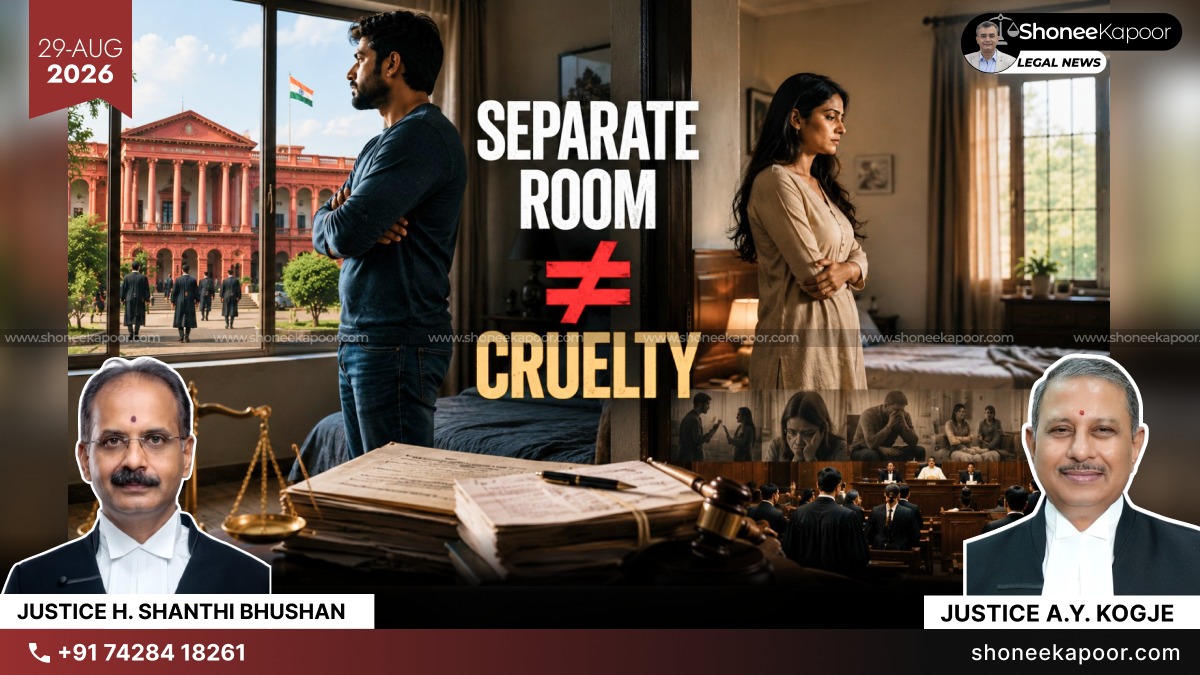
Husband Living In A Different Room from His Wife Under The Same Roof Is Cruelty? Karnataka High Court Answers

Curated by NEWS DESK
Editorial DeskCan a husband and wife staying in separate rooms under the same roof itself prove matrimonial cruelty? The Karnataka High Court said no, but still upheld the divorce after considering the couple’s entire matrimonial history.
BENGALURU: The Karnataka High Court has held that a husband and wife living in separate rooms in the same house cannot, by itself, be treated as cruelty under Section 13(1)(ia) of the Hindu Marriage Act, 1955.
However, the Court upheld the decree of divorce granted to the wife after finding that the overall evidence showed prolonged matrimonial discord, repeated disputes, separation and failed attempts at reconciliation.
A Division Bench of Justice D K Singh and Justice H. Shanthi Bhushan dismissed the husband’s appeal against an August 11, 2025 judgment of the Principal Judge, Family Court, Bengaluru. The Family Court had dissolved the marriage on the ground of cruelty and directed the husband to pay ₹25,000 per month as permanent alimony.
The couple married on November 11, 2001 and had two children. The wife alleged physical, verbal and emotional cruelty, neglect, frequent abuse and suspicious and possessive behaviour by the husband. She also alleged that he had distanced her from her relatives.
The wife further stated that although they continued to stay in the same building for some time, they occupied different rooms and were effectively living separate lives. She later left the matrimonial home with the children.
The husband denied the allegations and claimed that they were false, exaggerated and unsupported by proper evidence. He alleged that the wife was influenced by her parents and relatives and was herself responsible for the deterioration of their marriage. He also relied on an earlier Section 498A IPC case initiated by the wife, which had ended in his acquittal.
The High Court specifically clarified that merely occupying separate rooms cannot automatically become proof of cruelty:
“Standing by itself, such an arrangement cannot be treated as cruelty. The mere fact that spouses occupy separate rooms, without anything more, would not justify a finding of cruelty.”
The Court explained that the circumstances surrounding such an arrangement must also be examined. In this case, the separate living arrangement formed part of a longer matrimonial history involving repeated disputes, allegations of abuse, estrangement, earlier matrimonial litigation and an unsuccessful attempt at reconciliation.
The Court also clarified that even filing an earlier matrimonial proceeding cannot automatically amount to cruelty:
“The institution of an earlier matrimonial proceeding cannot, by itself, be regarded as an act of cruelty.”
The husband argued that the wife’s earlier Section 498A IPC complaint and his subsequent acquittal should be considered cruelty against him. The High Court, however, refused to accept such a broad proposition.
“The mere filing of a criminal complaint by one spouse against the other does not, in every case, amount to matrimonial cruelty. Likewise, an acquittal in a criminal proceeding cannot, by itself, lead to the conclusion that the complaint was false or malicious. Criminal proceedings and matrimonial proceedings operate in different fields, and the standard of proof applicable to them is also different.”
The ruling therefore makes an important distinction for matrimonial litigation. A husband’s acquittal in a criminal case does not automatically establish that the complaint against him was false or malicious. At the same time, allegations made by either spouse cannot be accepted merely because one version appears emotionally more convincing.
The Bench observed:
“The Court is conscious that matrimonial proceedings ordinarily involve competing versions of the same relationship and that the case of either spouse cannot be accepted merely because it appears more persuasive at an emotional level. The finding must necessarily rest upon the evidence available on record.”
After examining the evidence and surrounding circumstances, the Court concluded that the matrimonial problems went beyond ordinary disagreements between spouses.
The Court explained the legal test for cruelty:
“Cruelty” is essentially a question of fact and degree. There can be no fixed formula by which every matrimonial dispute can be characterised as cruelty. At the same time, a spouse cannot be expected to endure, for an indefinite period, conduct which causes sustained mental pain and destroys the basic elements of companionship, trust and matrimonial security.
The High Court held that the cumulative effect of prolonged discord, separation, failed reconciliation and the conduct proved on record was sufficient to establish mental cruelty under Section 13(1)(ia) of the Hindu Marriage Act.
The husband also argued that since the wife had sought divorce only on cruelty under Section 13(1)(ia) and not desertion under Section 13(1)(ib), separation or irretrievable breakdown could not independently justify divorce.
The High Court partly accepted this proposition, clarifying that desertion or irretrievable breakdown cannot become independent grounds unless available and established under law. However, it found that the Court considered separation in this case only as a surrounding circumstance while determining cruelty, not as an independent ground for divorce.
The Court also refused to interfere with the direction requiring the husband to pay ₹25,000 per month as permanent alimony. The record showed his gross monthly salary at approximately ₹4.13 lakh and his net salary at approximately ₹2.77 lakh. The wife stated that she earned around ₹24,000 per month while working at a nursery/pre-school.
The High Court held that the wife's income alone does not automatically disentitle her from permanent alimony. The Court must consider her income along with the duration of the marriage, the status and income of both parties, the standard of living, reasonable needs, and circumstances concerning the children.
Accordingly, the Court dismissed the husband’s appeal, confirmed the divorce decree, and upheld the direction to pay ₹25,000 monthly permanent alimony.
EXPLANATORY TABLE OF LAWS AND SECTIONS
| Law / Section | What It Provides | Relevance In This Case |
|---|---|---|
| Section 13(1)(ia), Hindu Marriage Act, 1955 | Permits divorce where one spouse has treated the other with cruelty after marriage. It includes legally recognised physical or mental cruelty. | The wife obtained divorce on this ground. The High Court held that separate rooms alone were insufficient, but the cumulative evidence established mental cruelty. |
| Section 13(1)(ib), Hindu Marriage Act, 1955 | Provides desertion as a separate ground for divorce where the statutory requirements are satisfied. | The husband argued that the wife had not sought divorce under this provision. The Court clarified that separation was considered only as a circumstance relevant to cruelty and not as an independent ground of desertion. |
| Section 19(1), Family Courts Act, 1984 | Provides for an appeal to the High Court against specified judgments or orders of a Family Court. | The husband used this provision to challenge the Family Court's divorce judgment. His appeal was dismissed. |
| Section 498A, Indian Penal Code | Penalises legally defined cruelty by a husband or his relatives towards a married woman. | The wife had earlier initiated criminal proceedings against the husband and his family. The husband relied on his acquittal to argue cruelty against him, but the High Court held that acquittal alone does not prove that a complaint was false or malicious. |
| Permanent Alimony | Financial support may be awarded after considering the parties’ income, status, needs, standard of living and other relevant circumstances. | The Court upheld ₹25,000 per month payable by the husband and held that the wife’s own earnings did not automatically bar her from receiving alimony. |
CASE DETAILS
| Particular | Details |
|---|---|
| Case Title | Husband v. Wife |
| Case Number | MFA No. 8362 of 2025 (FC) |
| Neutral Citation | 2026:KHC:42461-DB |
| Court | High Court of Karnataka at Bengaluru |
| Date of Judgment | August 11, 2026 |
| Bench | Justice D K Singh and Justice H. Shanthi Bhushan |
| Counsel for Husband / Appellant | Sri S.G. Muniswamy Gowda, Advocate |
| Counsel for Wife / Respondent | Sri Swaroop S., Advocate |
| Original Proceeding | M.C. No. 3429/2021, Principal Judge, Family Court, Bengaluru |
KEY TAKEAWAYS
- Living in separate rooms under the same roof is not cruelty by itself.
- A husband’s 498A acquittal does not automatically prove the wife’s complaint was false or malicious.
- Courts must judge cruelty from the complete matrimonial history, not one isolated allegation.
- Even where the wife is earning, the husband may still be ordered to pay permanent alimony.
- Matrimonial litigation can leave a man fighting on multiple fronts even after criminal proceedings end in acquittal.
Share Your Thoughts
Comments are moderated before publication.