
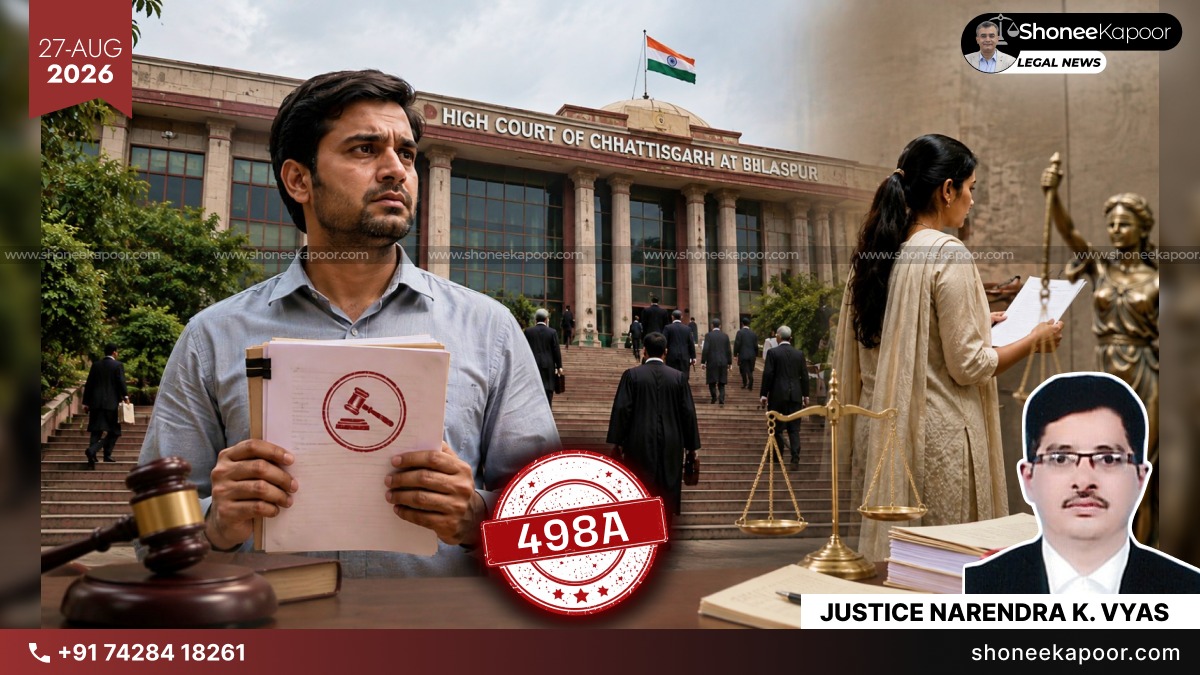
Husband And Family Acquitted In 498A, Still Dragged Into A DV Case On Same Allegations? Chhattisgarh High Court Says Wife Can Proceed

Curated by NEWS DESK
Editorial Desk
A husband and his family were already acquitted in a Section 498A IPC case based on the same allegations. Can the wife still pursue a separate case under the Domestic Violence Act against them?
BILASPUR: The Chhattisgarh High Court has held that an acquittal under Section 498A IPC does not stop a woman from pursuing proceedings under Section 12 of the Protection of Women from Domestic Violence Act, 2005.
Justice Narendra Kumar Vyas passed the order while dealing with a petition filed by Manoj Kurre and his family members under Section 528 BNSS. They had challenged the registration of a Domestic Violence complaint before the Judicial Magistrate First Class, Champa.
According to the complaint, the wife alleged that her husband was not taking care of her and subjected her to mental torture in connection with an alleged demand of ₹1 lakh and a motorcycle. She also sought ₹3,000 per hearing as litigation expenses and ₹30,000 towards litigation costs.
The husband and his family argued that an FIR under Section 498A IPC had earlier been registered on the same set of allegations and the accused had already been acquitted. They also informed the High Court that the husband and wife had obtained a divorce and a child custody matter was pending before a Division Bench of the High Court.
On this basis, they argued that continuing another proceeding arising from the same matrimonial allegations amounted to an abuse of the process of law and sought quashing of the DV complaint.
The respondents were served with notice but did not appear before the High Court. The Court therefore proceeded on the record and material placed by the petitioners.
The main question before the Court was whether an earlier acquittal arising from the same allegations made the subsequent Section 12 Domestic Violence Act complaint illegal.
The High Court rejected this argument. It held that Section 498A IPC and Section 12 of the Domestic Violence Act operate in different fields and have different objects. The Court noted that the DV Act was enacted to provide more effective protection to women facing violence within the family.
The Court also relied on Section 36 of the Domestic Violence Act, which makes the remedies under the Act additional to remedies available under other laws.
The High Court held:
“Since both the acts operate in different spheres, the acquittal of the petitioner under Section 498A of the I.P.C. will not prohibit or restrict the complainant from filing a complaint under Section 12 of the Act of 2005.”
The Court therefore found no illegality in the Trial Court taking cognisance of the DV complaint.
However, the High Court added an important protection for the accused. It clarified that dismissal of the petition would not affect the merits of the pending DV case and that the Trial Court must decide it independently:
However, it is clarified that dismissal of the present Cr.M.P. shall not preclude the learned trial Court from deciding the complaint on its own merits, uninfluenced by any observation made in the present order.
Thus, the High Court did not hold that the domestic violence allegations stood proved. It only held that the earlier 498A acquittal by itself cannot bar the DV proceedings, leaving the allegations to be independently examined by the Trial Court on their merits.
EXPLANATORY TABLE OF LAWS AND SECTIONS
| Law / Section | What It Provides | Relevance In This Case |
|---|---|---|
| Section 498A IPC | Punishes a husband or his relatives for legally defined cruelty towards a married woman. | The petitioners argued that they had already been acquitted in the 498A case arising from the same allegations. |
| Section 12, Domestic Violence Act, 2005 | Allows an aggrieved woman to approach the Magistrate seeking relief under the DV Act. | The wife had filed the complaint that the husband and his family sought to quash. |
| Section 36, Domestic Violence Act, 2005 | Provides that remedies under the DV Act are in addition to and not in derogation of other laws. | The High Court relied on this provision to hold that the earlier 498A proceedings did not legally bar the DV complaint. |
| Section 528 BNSS | Preserves the inherent powers of the High Court to prevent abuse of court process and secure the ends of justice. | The husband and his family invoked this provision to seek quashing of the DV complaint. |
CASE DETAILS
| Particulars | Details |
|---|---|
| Case Title | Manoj Kurre & Ors. v. Smt. Sunita Kurre & Anr. |
| Court | High Court of Chhattisgarh at Bilaspur |
| Case Number | CRMP No. 1472 of 2025 |
| Neutral Citation | 2026:CGHC:37370 |
| Bench | Hon'ble Shri Justice Narendra Kumar Vyas |
| Petitioners | Manoj Kurre, Raju Kurre, Amarnath Kurre, Rambriksh Kurre and Mahettarin |
| Respondents | Smt. Sunita Kurre and minor Ayam Kurre through his mother |
| Counsel for Petitioners | Mr Parag Kotecha, Advocate |
| DV Complaint | Complaint Case No. 02/2020 |
| Trial Court | Judicial Magistrate First Class, Champa, District Janjgir-Champa |
| Order Date | 20 August 2026 |
KEY TAKEAWAYS
- 498A acquittal does not end DV proceedings: A husband and his family may still have to contest a DV case based on the same allegations.
- 498A and DV Act operate differently: The High Court held that both proceedings serve separate legal purposes.
- Same allegations are not an automatic bar: Earlier acquittal alone cannot quash a DV complaint.
- DV case must be proved independently: The complaint must still be decided on its own evidence and legal requirements.
- Continuation does not mean guilt: The Trial Court must decide the DV case on its own merits.
Share Your Thoughts
Comments are moderated before publication.