
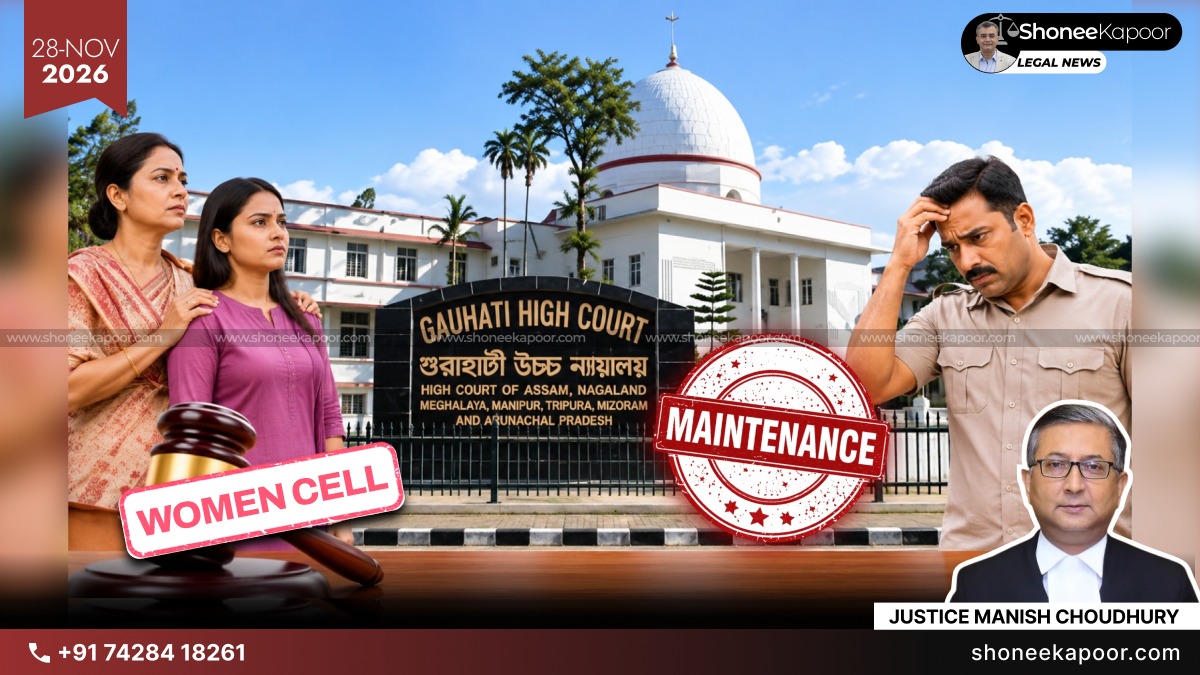
Women Cell Cannot Override Court Orders And Direct Husband To Pay Maintenance: Gauhati High Court

Curated by NEWS DESK
Editorial DeskASSAM: The Gauhati High Court has quashed an order passed by the Women Cell, Lakhimpur, directing a railway employee’s employer to deduct ₹5,000 every month from his salary towards his adult daughter’s maintenance, despite two courts having already rejected the maintenance claim.
In his judgment dated 26 November 2026, Justice Manish Choudhury clarified that a Women Cell cannot exercise judicial powers to determine maintenance rights.
The petitioner was working as a Grade IV employee at the N.F. Railway Mechanical Workshop in Dibrugarh.
In 2019, a woman approached the Trial Court under Section 125 CrPC, demanding monthly maintenance of ₹20,000 each for herself and her daughter, amounting to ₹40,000.
She claimed that the petitioner had married her and subsequently deserted them. She also levelled allegations of cruelty against him.
The man denied the marital relationship but admitted that he was the biological father of her daughter.
After examining the evidence, the Trial Court found that the woman had failed to establish a legally valid marriage with the petitioner.
The Court also found that the daughter was approximately 22 years old and did not suffer from any physical or mental condition that would make her eligible for maintenance under Section 125(1)(c) CrPC.
On 18 March 2020, the Trial Court dismissed both maintenance claims.
The woman subsequently challenged the decision before the Revisional Court. However, on 8 June 2023, the Revisional Court upheld the findings and dismissed her revision petition.
Despite these judicial decisions, the daughter approached the Women Cell, Lakhimpur, seeking maintenance from her father.
The man appeared before the Women Cell on 24 February 2024. Three days later, the Women Cell decided to grant monthly maintenance of ₹5,000.
On 12 March 2024, the Assistant Commissioner, acting as a member of the Women Cell, directed the railway authorities to deduct the amount directly from the man's salary.
Aggrieved by the order, the man approached the Gauhati High Court under Article 226 of the Constitution of India.
The State submitted that the earlier judicial orders had not been brought to the Women Cell's notice and that its decision was intended as a conciliatory measure.
The High Court examined the statutory provisions governing maintenance and noted that the earlier judicial decisions had attained finality because they had not been challenged before a higher judicial forum.
The Court distinguished between conciliation and judicial adjudication, holding that the Women Cell could facilitate settlement but could not independently determine maintenance rights.
The High Court found that the impugned order was passed:
“without any power, authority and jurisdiction”
Consequently, the High Court quashed the ₹5,000 maintenance order dated 12 March 2024 and allowed the man's writ petition without imposing costs.
EXPLANATORY TABLE OF LAWS AND SECTIONS
| Law / Section | What It Means | Application In This Case |
|---|---|---|
| Article 226, Constitution of India | Empowers High Courts to issue writs against unlawful administrative actions. | Man challenged the Women Cell's order. |
| Section 125 CrPC | Provides maintenance to eligible wives, children and parents. | Original maintenance claims were filed under this provision. |
| Section 125(1)(a) CrPC | Provides maintenance to an eligible wife unable to maintain herself. | Woman failed to establish a legally valid marriage. |
| Section 125(1)(b) CrPC | Provides maintenance to eligible minor children, whether born within or outside marriage. | Daughter had already attained majority. |
| Section 125(1)(c) CrPC | Provides maintenance to eligible adult children unable to maintain themselves due to physical or mental abnormality or injury, excluding married daughters. | Adult daughter did not satisfy the statutory conditions. |
| Section 125(1)(d) CrPC | Provides maintenance to parents unable to maintain themselves. | Discussed while explaining the scope of Section 125 CrPC. |
| Section 399 CrPC | Provides revisional powers to the Sessions Judge. | Earlier maintenance rejection was challenged in revision. |
| Section 401 CrPC | Prescribes the High Court's revisional powers. | Discussed alongside Section 399 CrPC while explaining judicial remedies. |
CASE DETAILS
| Particular | Details |
|---|---|
| Case Title | Kushal Taw v. The State of Assam and 3 Ors. |
| Court | Gauhati High Court |
| Bench | Justice Manish Choudhury |
| Judgment Date | 26 November 2026 |
| Neutral Citation | 2026:GAU-AS:17613 |
| Case Number | W.P.(C) No. 2441/2024 |
| Case Identification Number | GAHC010091612024 |
| Counsel for Petitioner | Advocate A.K. Kanu |
| Counsel for Respondents 1–3 | N. Goswami, Junior Government Advocate, Assam |
| Respondent No. 4 | Petitioner's adult daughter |
| Hearing Dates | 25 and 26 November 2026 |
| Trial Court | Sub-Divisional Judicial Magistrate (M), Dhakuakhana, Lakhimpur |
| Original Maintenance Case | Misc. Case No. 05/2019 |
| Revisional Court | Additional Sessions Judge (FTC), Lakhimpur |
| Criminal Revision | No. 11/2022 |
| Women Cell Case | Case No. 82559/2024 |
| Final Decision | Maintenance order quashed; writ petition allowed without costs. |
KEY TAKEAWAYS
- Two Courts Rejected Maintenance: Yet the man was dragged into another unnecessary legal battle.
- Women Cell Assumed Judicial Powers: Overstepped its jurisdiction to impose maintenance on a man.
- Man’s Hard-Earned Salary Targeted: ₹5,000 monthly deduction ordered without lawful authority.
- Forced To Fight For His Own Money: The man had to approach the High Court to secure justice.
- Women’s Welfare Is Not A Licence To Violate Men’s Rights: Who compensates the man for unnecessary litigation, financial burden and mental agony?
Share Your Thoughts
Comments are moderated before publication.