
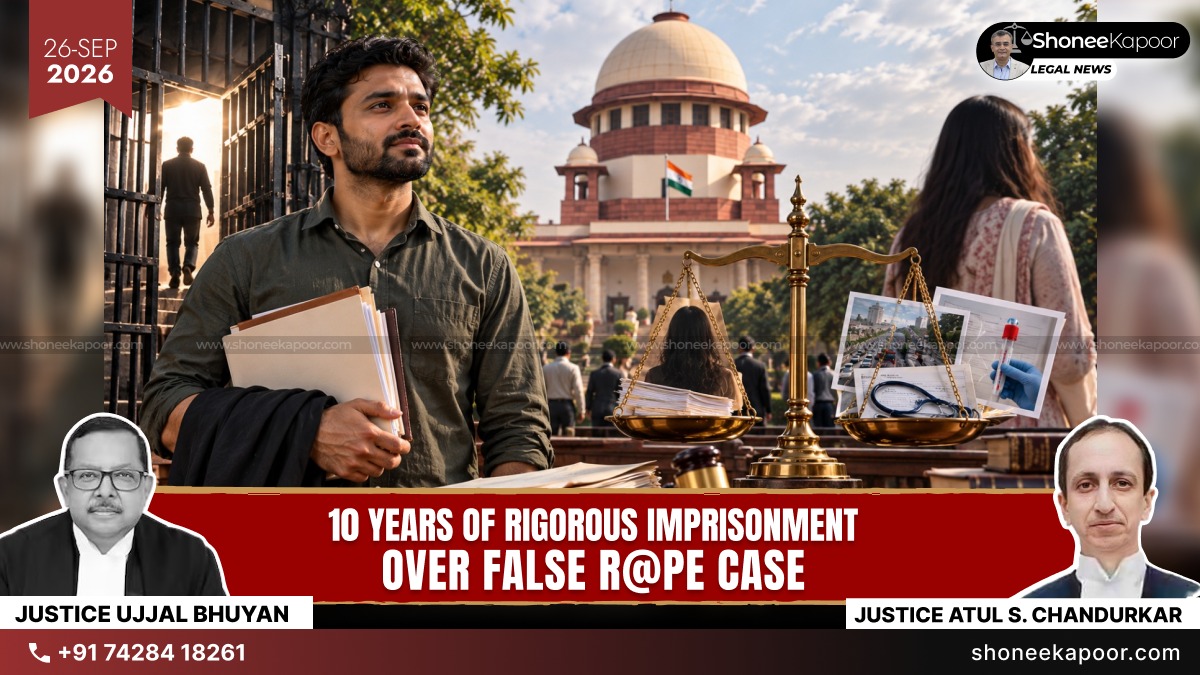
False Rape Case | “Allegation Of Forcible Sex Hard To Accept When Woman Voluntarily Travelled & Stayed With Accused”: Supreme Court Acquits Man

Curated by NEWS DESK
Editorial DeskNEW DELHI: The Supreme Court of India has acquitted a man in a rape case, setting aside his conviction under Section 376 IPC and the sentence of 10 years’ rigorous imprisonment.
A Bench of Justice Ujjal Bhuyan and Justice Atul S. Chandurkar held that the same testimony of the prosecutrix could not be rejected for one interconnected charge and accepted for another without properly considering the evidence as a whole.
The case arose from allegations relating to June 2009. According to the prosecution, the prosecutrix had gone out to buy household articles when she met the appellant. She alleged that he took her first to a flat in Ludhiana and later to Malerkotla, where he had sexual intercourse with her against her will.
An FIR was registered under Sections 363, 366A and 376 IPC, while the chargesheet was filed under Sections 366 and 376 IPC.
The Sessions Court ultimately found that the prosecution had failed to establish the Section 366 IPC charge. After examining the evidence regarding her age, the Trial Court accepted her age as 19 years and also found it doubtful that she had been taken to the places without her consent.
Despite this finding, the same court convicted the appellant under Section 376 IPC and sentenced him to 10 years’ rigorous imprisonment. The Punjab and Haryana High Court upheld that conviction.
The Supreme Court found this approach legally unsustainable.
Referring to the Trial Court’s reasoning, the Supreme Court said:
“We are afraid the learned Sessions Judge has gone completely wrong while justifying the conviction of the accused-appellant under Section 376 IPC. The High Court also fell in error in accepting such convoluted logic.”
The Court examined the prosecutrix’s evidence in detail and found material contradictions. She had travelled with the appellant through busy roads and brightly lit intersections but had not raised an alarm or tried to get off the scooter. There was also a contradiction over whether they returned from Malerkotla to Ludhiana by car or by train.
The medical evidence also showed that there was no external injury on her body and no injury to her private parts.
Read Also:- How to defend a False rape cases in India
After examining the circumstances, the Supreme Court observed:
“Her evidence is riddled with contradictions. Mere presence of spermatozoa in the vaginal swab of the prosecutrix would not prove rape given the surrounding circumstances.”
On the question of consent, the Court further held:
“If her evidence is taken as a whole, certainly a view can be taken that her version that the accused-appellant had sexual intercourse with her forcibly without her consent does not merit acceptance. The version of the prosecutrix is not believable at all.”
The Supreme Court clarified that a rape conviction can be based on the sole testimony of the prosecutrix, but such testimony must inspire the confidence of the Court.
It then laid down the crucial principle:
“There cannot be partial rejection of the evidence of the prosecutrix for the purpose of Section 366 IPC and partial acceptance of the very same statement for the purpose of proving the charge under Section 376 IPC. If the prosecutrix's evidence is unimpeachable, it must be accepted in its entirety. There cannot be part acceptance and part rejection of the statement of the prosecutrix.”
The Court also cautioned against replacing legal proof with a judge’s personal moral assessment.
It held:
“While the conduct of the appellant may be immoral and unethical, that by itself would not justify a conviction under Section 376 IPC without any clinching evidence.”
The Supreme Court further said:
“Such a charge must be proved on the basis of hard evidence and not on the basis of the surmises and conjectures based on the value judgment of the presiding judge. Immorality of an act sans credible evidence cannot justify a conviction.”
The Court consequently set aside the rape conviction and sentence imposed by the Sessions Court and affirmed by the High Court. The Court cleared Paramjit Singh Bedi of the charge under Section 376 IPC, and allowed his criminal appeal.
EXPLANATORY TABLE OF LAWS AND SECTIONS
| Law / Section | What It Means | Relevance In This Case |
|---|---|---|
| Section 363 IPC | Punishment for kidnapping a person from lawful guardianship | This section was mentioned in the original FIR. |
| Section 366A IPC | Punishment for inducing a minor girl to go somewhere for illicit intercourse, under the law applicable at the relevant time | This section was also mentioned in the original FIR. |
| Section 366 IPC | Punishment for kidnapping or abducting a woman with intent to compel marriage or force or induce her into illicit intercourse | The Trial Court found the prosecution failed to prove this charge and acquitted the appellant under Section 366 IPC. |
| Section 359 IPC | Explains the kidnapping recognised under the IPC | The Supreme Court discussed it while examining the scope of the kidnapping allegation. |
| Section 361 IPC | Explains when taking or enticing a minor from the custody of a lawful guardian without the guardian’s consent amounts to kidnapping | Relevant because the prosecution claimed the prosecutrix was a minor, while the Trial Court accepted her age as 19 years. |
| Section 362 IPC | Defines abduction as compelling a person by force, or inducing a person by deceitful means, to go from any place | Relevant to whether the prosecutrix had been forcibly or deceitfully taken with the appellant. |
| Section 375 IPC | Defines the offence of rape and the circumstances in which sexual intercourse constitutes rape | The Court applied the pre-2013 provision because the alleged incidents occurred in June 2009. |
| Section 376 IPC | Provides the punishment for rape | The appellant had been convicted and sentenced to 10 years’ rigorous imprisonment, but the Supreme Court ultimately set aside the conviction and sentence. |
| Section 114A, Evidence Act, 1872 | Provides a presumption of absence of consent in specified rape prosecutions when the statutory conditions are satisfied and the woman states that she did not consent | The High Court relied on this provision. The Supreme Court, however, examined the denial of consent in the context of the entire testimony and surrounding evidence. |
| Section 313 CrPC | Allows the court to personally question the accused about circumstances appearing against him in the prosecution evidence | The appellant’s statement was recorded under this provision during the trial. |
CASE DETAILS
| Particulars | Details |
|---|---|
| Case Title | Paramjit Singh Bedi v. State of Punjab |
| Court | Supreme Court of India |
| Case Number | Criminal Appeal No. 203 of 2015 |
| Neutral Citation | 2026 INSC 1054 |
| Date of Judgment | 25 September 2026 |
| Bench | Justice Ujjal Bhuyan and Justice Atul S. Chandurkar |
| Judgment Authored By | Justice Ujjal Bhuyan |
| Appellant | Paramjit Singh Bedi |
| Respondent | State of Punjab |
| Counsel for Appellant | Mr. Rajiv Kataria, Advocate; M/s Delhi Law Chambers, AOR; Ms. Debjani Das Purkayastha, Advocate; Mrs. Deepshikha Shah, Advocate |
| Counsel for State of Punjab | Ms Nupur Kumar, AOR |
| Supreme Court Decision | Appeal allowed. Conviction and sentence under Section 376 IPC set aside. Appellant cleared of the charge. |
KEY TAKEAWAYS
- A serious rape allegation cannot replace hard evidence. The Supreme Court acquitted the man after finding the prosecutrix’s evidence riddled with contradictions.
- The same testimony cannot be selectively believed to convict a man. The Court said there cannot be “part acceptance and part rejection” of the prosecutrix’s statement in these interconnected charges.
- A man faced a 10-year sentence despite serious evidentiary inconsistencies. The Trial Court convicted him under Section 376 IPC and the High Court upheld it before the Supreme Court intervened.
- Moral judgment is not criminal proof. The Supreme Court made it clear that even conduct considered immoral or unethical cannot justify a rape conviction without clinching evidence.
- Due process protects men too. After examining the evidence as a whole, the Supreme Court set aside the conviction and cleared the appellant of the Section 376 IPC charge.
Share Your Thoughts
Comments are moderated before publication.