
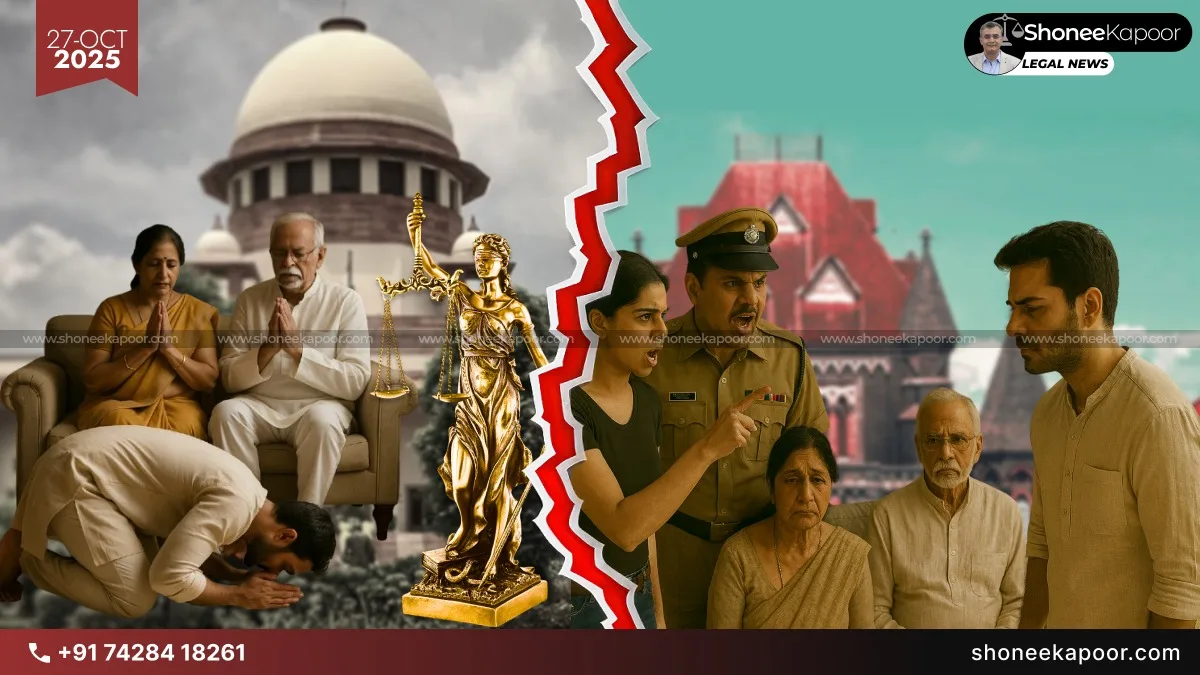
Men’s Rights Milestone: Supreme Court Crushes False 498A Case – Innocent In-Laws Freed from Years of Legal Torture

Written and analysed by Shonee Kapoor
Legal Consultant, Author & Men's Rights ActivistIn a powerful ruling, the Supreme Court declared that Vague and omnibus 498A claims don’t stand in law; justice cannot survive on presumption or persecution.
NEW DELHI: The Supreme Court of India declared in Sanjay D. Jain & Ors. v. State of Maharashtra & Ors. that false criminal proceedings against a father-in-law, mother-in-law, and sister-in-law who were falsely implicated under Sections 498A, 377, and 506 IPC were “vague, general, and devoid of particulars.” The court’s decision was a landmark one, delivered on September 26, 2025. The Bench, which included Chief Justice B.R. Gavai, Justices K. Vinod Chandran and Atul S. Chandurkar, noted that it would be “an abuse of the process of law” to continue such proceedings.
Another important step in preventing the abuse of Section 498A (cruelty by husband or relatives) and protecting innocent family members from years of unwarranted trial trauma is this ruling, which was rendered in a case from Nagpur, Maharashtra.
Timeline of Events
| DATE | EVENT |
|---|---|
| 14 July 2021 | Marriage solemnised between the complainant and Piyush Jain (son of appellant no. 1 and 2). |
| 6 February 2022 | FIR No. 20/2022 registered at Bajaj Nagar Police Station, Nagpur under Section 498A IPC; later Sections 377 and 506 added. |
| 2022–2023 | Investigation conducted and charge-sheet filed against the husband and his family members. |
| 19 March 2024 | Bombay High Court (Nagpur Bench) dismissed the in-laws’ petition under Section 482 CrPC seeking quashing of FIR. |
| 2024 (SLP Filed) | The in-laws approached the Supreme Court of India challenging the High Court’s refusal to quash the FIR. |
| 26 September 2025 | Supreme Court delivered its judgment, quashing all criminal proceedings against the in-laws, terming the allegations “vague and general.” |
Court’s Findings
After reviewing the FIR and charge sheet against the in-laws, the Supreme Court concluded that there was no mention of any particular cruelty or dowry demand. The Court held: “Vague and general allegations cannot lead to the forming of a prima facie case.”
It noted that only a single instance where the complainant received a call from her mother-in-law asking for clothes and jewellery was cited. Beyond that, all accusations were “of a general nature as well as vague without any particulars.”
The Bench clarified, restating the established legal position: “The cruelty caused by the husband and his family members should be of such nature that it is inflicted with the intention to cause grave injury or drive the victim to commit suicide. Such allegations are absent in the present case.”
On the charges under Sections 377 and 506 IPC, the Court was categorical: “The allegations in this regard have been made only against the complainant’s husband and not against the present appellants. There is no allegation whatsoever in that context that would require them to face trial.”
The ruling went on to reiterate the idea put forth in State of Haryana v. Bhajan Lal (1990), highlighting the need for courts to step in when criminal law is applied to settle personal grievances or administer social punishment. “Continuation of these proceedings would amount to an abuse of the process of law.”
Legal Significance
This ruling represents yet another court recognition of the expanding abuse of Section 498A IPC, a law that was first passed to safeguard women but is now being used more and more as a weapon to harass entire families. The court reaffirmed that specific, credible allegations are required to support a criminal trial; criminal law cannot proceed based on emotional outrage or a hazy suspicion.
This decision is both a relief and a reminder that the legal system still acknowledges that innocence cannot be given up on the altar of presumption for men and their families who have been wrongfully accused of cruelty or dowry harassment. The Supreme Court reminded lower courts that not all marital dissolutions are criminal conspiracies and that the law shouldn’t be used as a means of retaliation by providing protection to the husband’s family members.
Explanatory Table of Laws and Sections Referenced
| Law / Case | Section | Explanation / Relevance in this Case |
|---|---|---|
| Indian Penal Code, 1860 | Section 498A | Criminalises cruelty by husband or relatives; requires specific acts of harassment or grave injury. The Court found these missing. |
| Indian Penal Code, 1860 | Sections 377, 506 read with 34 | Allegations of unnatural sex and criminal intimidation were directed only at the husband, not the in-laws. |
| Code of Criminal Procedure, 1973 | Section 482 | Provides inherent powers to quash proceedings to prevent abuse of process and secure justice. |
| State of Haryana v. Bhajan Lal (1990) | – | Landmark precedent outlining when FIRs can be quashed particularly when allegations are vague or malicious. |
| Digambar & Anr. v. State of Maharashtra (2024 INSC 1019) | – | Cited by the Court to reaffirm that false or omnibus 498A allegations against in-laws must be quashed. |
Case Summary
- Case Title: Sanjay D. Jain & Ors. v. State of Maharashtra & Ors.
- Citation: SLP (Crl.) No. 12584/2024
- Court: Supreme Court of India
- Jurisdiction: Criminal Appellate Jurisdiction
- Date of Judgment: 26 September 2025
- Bench Composition: CJI B.R. Gavai, Justices K. Vinod Chandran & Atul S. Chandurkar
- Appellants’ Counsel: Mr. Kartik Shukul, Advocate, Mr. Anurag Gharote, Advocate
- Respondents’ Counsel: Mr. Adarsh Dubey, Advocate – for the State of Maharashtra, Mr. Sachin Patil, Advocate – for the Complainant (wife / Respondent No. 2)
- Statutory Ground: Sections 498A, 377, 506 read with 34 IPC; Section 482 CrPC
- Main Issue: Whether vague and general allegations under Section 498A can justify prosecution against the husband’s relatives?
- Judgment Outcome: FIR and proceedings against in-laws quashed; continuation held to be an abuse of process.
- Result: Major relief for innocent relatives falsely accused in matrimonial disputes.
Summary of Facts
- On July 14, 2021, the complainant married Piyush Jain. As co-accused, the accused appellants were identified as Sanjay D. Jain (father-in-law), his wife (mother-in-law), and their daughter (sister-in-law).
- The complainant claimed that her husband coerced her into engaging in inappropriate sexual behaviour, resulting in mental cruelty, and that her in-laws demanded gifts and a dowry after the marriage. She also said that every time she went to her parents’ house, she was constantly harassed for more gifts and dowry.
- Sections 498A and 34 IPC were used to file FIR at the Bajaj Nagar Police Station in Nagpur on February 6, 2022. Later, Sections 377 and 506 IPC were added.
- The husband and his family petitioned the Bombay High Court (Nagpur Bench) under Section 482 CrPC to have the FIR quashed. The High Court dismissed the plea on March 19, 2024, ruling that there was a prima facie case and that a trial was necessary.
- The in-laws (apart from the husband) petitioned the Supreme Court, arguing that the FIR only included general and ambiguous statements rather than specific or direct accusations.
- They claimed that making them stand trial was an abuse of the legal system.
- Opposing the appeal were the State of Maharashtra and the complainant’s attorney, who claimed that the complaint revealed repeated dowry demands and called for a full trial.
- The Court determined that the in-laws were not responsible for any specific act of cruelty or dowry demand after reviewing the FIR and charge sheet. They were all “omnibus and vague.” The allegations under Sections 377 and 506 IPC applied only to the husband, not to the appellants.
- Result: The Supreme Court quashed the FIR and all criminal proceedings against the in-laws, declaring that continuation of such cases would be an abuse of law, while clarifying that the husband’s trial would proceed independently.
Why This Judgement Matters for Every Indian Household?
False accusations of cruelty and dowry are made against thousands of Indian men and their families each year; this social stigma ruins reputations long before the truth is even put to the test by the courts. This ruling serves as a safeguard for equity and a warning against abuse. The Court has reminded society that justice must be gender-neutral by clearly defining the difference between legitimate victims and accusations that are used as weapons.
This decision is a beacon of hope for the innumerable parents and sisters who have been wrongfully implicated in criminal cases based only on their familial ties. It emphasises that the goal of the law is to protect, not to persecute. “Justice cannot be selective. When Parliament stays silent, the judiciary must ensure that law does not become an instrument of injustice.” This is a significant step for men’s rights, not just a court order. It gives hope that families’ pleas for justice are still heard by India’s highest court.
Disclaimer: The views and opinions expressed in this article are those of the Indian courts and do not necessarily reflect the official policy or position of “ShoneeKapoor.com” or its affiliates. This article is intended for informational and educational purposes only. The content provided is not legal advice, and viewers should not act upon this information without seeking professional counsel. Viewer discretion is advise.
Share Your Thoughts
Comments are moderated before publication.