
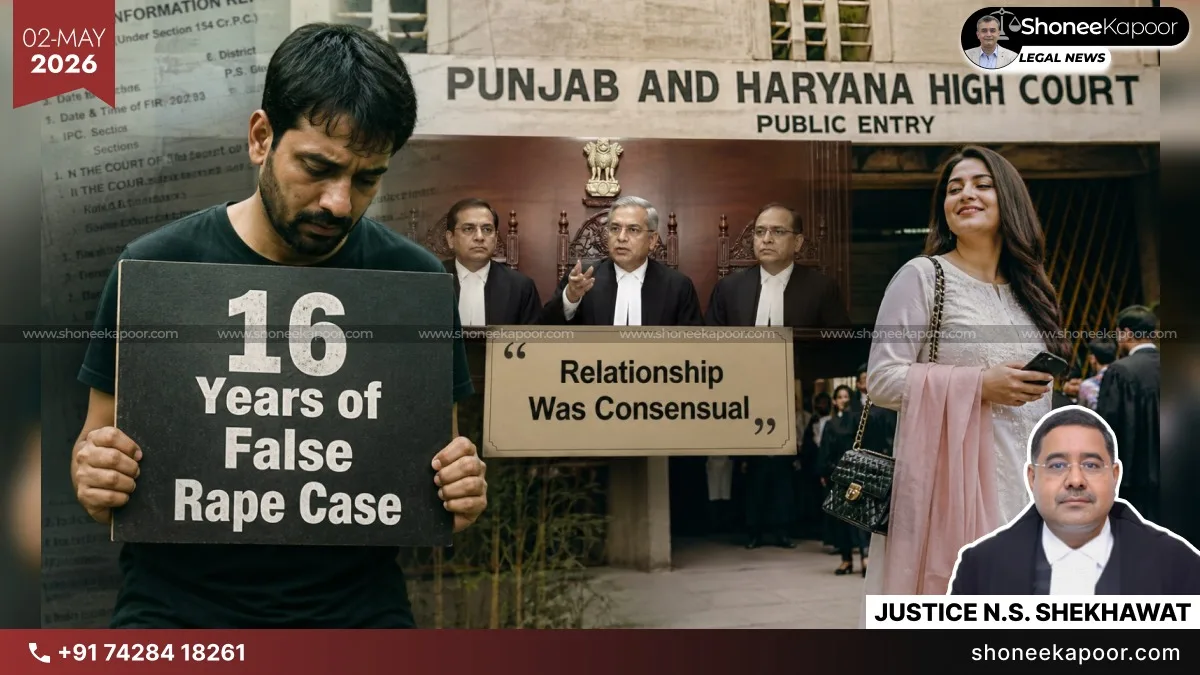
Can a 16-year delay still prove rape on promise of marriage? High Court says facts don’t support it—what changed the case outcome?
CHANDIGARH: The Punjab and Haryana High Court has quashed a rape FIR filed after a delay of more than 16 years, holding that the relationship between the parties was consensual and did not meet the legal requirements of rape on the pretext of marriage.
The case was heard by Justice N.S. Shekhawat, who examined the long delay and the nature of the relationship before passing the order.
The Court observed:
“Petitioner was married to…in the year 2001, when the respondent No. 2/complainant was aged about 16 years and was not even of marriageable age. Even, she admits that she was aware of the marriage of the petitioner with Simranjit Kaur since the year 2001-2002, but surprisingly, she lodged the present FIR on 29.07.2017, i.e., after a delay of about 16 years. Even, it is unbelievable that the respondent No. 2/complainant permitted the petitioner to make physical relations with her for last several years only on the basis of false assurance by the petitioner to marry her.”
The Court further noted that the complainant was a well-educated adult and continued the relationship for several years despite knowing the man was already married. It found it difficult to accept that she could not understand the situation for such a long time.
After reviewing the facts, the Court held that the relationship was consensual and the legal ingredients required under Sections 376 (rape) and 506 (criminal intimidation) of the IPC were not satisfied.
The petition was filed under Section 528 of the BNSS to quash FIR No. 0128 dated July 29, 2017, registered at Police Station City Rupnagar.
According to the complaint, the accused had physical relations with the woman for years on a false promise of marriage, threatened her, and involved family members in harassment and wrongful confinement.
However, the accused, who is a serving police official, argued that the allegations were not believable, especially the claim that the relationship started when the complainant was around 10–11 years old. He also pointed out the unexplained delay of nearly two decades and the fact that the complainant knew about his marriage since 2001–02 but still continued the relationship.
The State and the complainant opposed the plea, stating that the relationship was based on a false promise of marriage and therefore consent was not valid.
The Court analysed the law on consent under Section 375 IPC and “misconception of fact” under Section 90 IPC, referring to earlier Supreme Court rulings.
It also relied on the judgment in Jai Dhupar v. State of Haryana and another, where it was held:
“Specifically in the context of a promise to marry this Court has observed that there is a distinction between a false promise given on the understanding by the maker that it will be broken, and the breach of a promise which is made in good faith but subsequently not fulfilled.
Where the promise to marry is false and the intention of the maker at the time of making the promise itself was not to abide by it but to deceive the woman to convince her to engage in sexual relations, there is a misconception of fact that vitiates the woman’s consent. On the other hand, a breach of a promise cannot be said to be a false promise. To establish a false promise, the maker of the promise should have had no intention of upholding his word at the time of giving it.
The consent of a woman under Section 375 is vitiated on the ground of a misconception of fact where such misconception was the basis for her choosing to engage in the said act.”
Based on these legal principles and the facts of the case, the Court concluded that no offence was made out and quashed the FIR.
Explanatory Table Of Laws And Sections
| LAW / SECTION | STATUTE | LEGAL MEANING | APPLICATION IN THIS CASE |
| Section 376 IPC | Indian Penal Code | Defines offence of rape; requires absence of valid consent | Court held ingredients not satisfied due to consensual relationship |
| Section 506 IPC | Indian Penal Code | Criminal intimidation; threat to cause harm | Allegations made but not substantiated sufficiently |
| Section 375 IPC | Indian Penal Code | Defines “rape” and explains consent | Court analysed consent and found it was not vitiated |
| Section 90 IPC | Indian Penal Code | Consent given under “misconception of fact” is invalid | Court held no proven misconception for 16 years |
| Section 528 BNSS | Bharatiya Nagarik Suraksha Sanhita | Power to quash FIR / criminal proceedings | Used to quash FIR due to lack of offence |
| Doctrine of False Promise to Marry | Judicial Interpretation | Distinguishes false promise from breach of promise | Court found no evidence of initial fraudulent intent |
Case Details
- Case Title: XYZ vs ABC
- Court: Punjab and Haryana High Court
- Bench: Justice N.S. Shekhawat
- FIR Details: FIR No. 0128 dated 29.07.2017, Police Station City Rupnagar
- Petition Provision: Section 528, BNSS
- Counsel for Petitioner: Ms. Samridhi Sareen, Advocate
- Counsel for State: Mr. Bhanu Pratap Singh, Addl. A.G., Punjab
- Counsel for Respondent No. 2: Mr. S.S. Sarwara, Advocate
Key Takeaways
- A relationship continuing for years with full knowledge cannot suddenly be converted into rape after a fallout.
- Courts are now recognising that delay and conduct destroy credibility, especially when allegations surface decades later.
- False “promise to marry” claims are being used as a tool to criminalise failed relationships and pressure men.
- Law is clear: rape requires absence of consent, not regret after consent.
- This judgment reinforces that criminal law cannot be weaponised to settle personal scores or rewrite past relationships.
This Could Change Your Case-Get FREE Legal Advice-Click Here!
Disclaimer: The views and opinions expressed in this article are those of the Indian courts and do not necessarily reflect the official policy or position of “ShoneeKapoor.com” or its affiliates. This article is intended for informational and educational purposes only. The content provided is not legal advice, and viewers should not act upon this information without seeking professional counsel. Viewer discretion is advised.
