
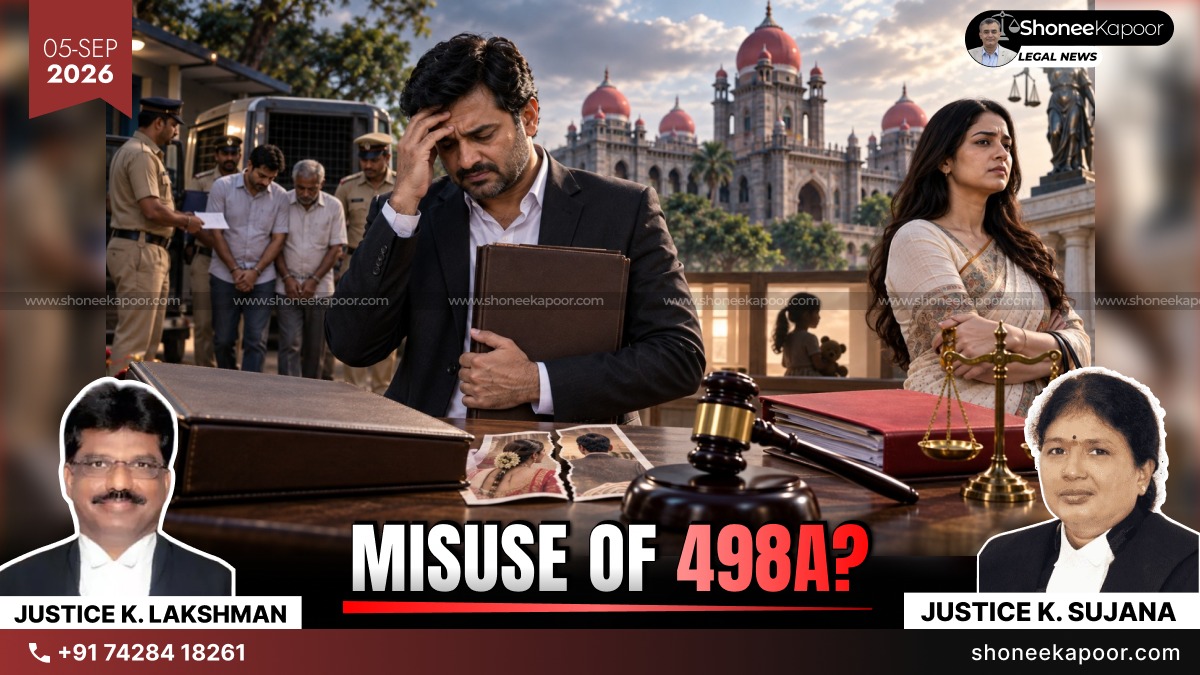
False 498A Case | Husband & Father Spent 5 Days In Jail, Later Acquitted —Telangana High Court Says FIR Alone Does Not Prove Cruelty

Curated by NEWS DESK
Editorial DeskCan an acquitted husband seek divorce for cruelty merely because his wife filed a Section 498A IPC case that sent him and his father to jail for five days? The Telangana High Court answered this while setting aside the divorce granted to the husband.
HYDERABAD: The Telangana High Court has held that merely filing a criminal complaint against a husband and his family under Section 498A IPC and Sections 3 and 4 of the Dowry Prohibition Act does not, by itself, amount to cruelty or give the husband a ground for divorce.
A Division Bench of Justice K. Lakshman and Justice K. Sujana set aside the divorce granted by the Family Court after finding that the husband had failed to prove his allegations of cruelty through sufficient evidence.
The parties married on February 5, 2009, and had a daughter in November 2009. They had been living separately since August 2010.
The husband sought divorce under Section 13(1)(ia) of the Hindu Marriage Act, 1955, alleging cruelty. He claimed that his wife harassed and ill-treated him, repeatedly went to her parental home, wanted to live separately from his parents, assaulted him and his mother and threatened to implicate his family in false criminal cases.
He also alleged that the wife filed a false criminal case against him and his family. The husband and his father were arrested and remained in judicial custody for five days before being released on bail, while his mother and sister obtained anticipatory bail. The criminal case under Section 498A IPC and Sections 3 and 4 of the Dowry Prohibition Act later ended in acquittal.
The wife denied the allegations and claimed that she had been mistreated in the matrimonial home. She also filed proceedings seeking restitution of conjugal rights under Section 9 of the Hindu Marriage Act.
The Family Court granted divorce to the husband and dismissed the wife's restitution petition. The wife challenged both findings before the High Court.
The High Court noted that the husband had also alleged that his wife suffered from psychological disorders and hysteria, but he produced no document or independent witness to prove it. The Court held that the burden of proving those allegations was upon him.
Explaining how matrimonial cruelty has to be assessed, the Bench observed:
“What is cruelty in one case may not amount to cruelty in another case.”
The Court further noted that although the husband had made several allegations against his wife, he did not examine his parents, panchayat elders or any other supporting witness. Except for examining himself, he produced no witness to establish the alleged cruelty.
On the criminal case filed against the husband and his family, the Court specifically held:
“Mere lodging of complaint against husband and his family members for the offence under Section 498-A of IPC and Sections 3 & 4 of Dowry Prohibition Act does not amount to cruelty. Therefore, on the said ground, respondent/husband cannot seek dissolution of marriage.”
Thus, the fact that the criminal proceedings ultimately ended in acquittal was not treated as sufficient, by itself, to establish matrimonial cruelty.
The High Court also found that the Family Court had relied upon the parties' long separation and concluded that the marriage had irretrievably broken down. Rejecting this approach, the Bench held:
“It is a well-settled law that neither the learned Family Court nor this Court can dissolve the marriage of the parties by granting a decree of divorce on the ground of ‘irretrievable breakdown of marriage’.”
Since the husband had failed to prove cruelty through cogent evidence and the Family Court had relied upon a legally unavailable ground, the High Court set aside the decree of divorce.
The wife's appeal concerning restitution of conjugal rights was disposed of because the parties had been living separately since 2010. However, the Court granted her liberty to file a fresh petition seeking restitution of conjugal rights.
EXPLANATORY TABLE OF LAWS AND SECTIONS
| Law / Section | What It Means | Relevance In This Case |
|---|---|---|
| Section 13(1)(ia), Hindu Marriage Act, 1955 | Allows a spouse to seek divorce on the ground of cruelty. | The husband sought divorce for cruelty under this provision. The HC held that he failed to prove cruelty through cogent evidence. |
| Section 9, Hindu Marriage Act, 1955 | Provides the remedy of restitution of conjugal rights where one spouse withdraws from the other's society without reasonable excuse. | The wife sought restitution of conjugal rights. The court disposed of her earlier petition, with liberty to file a fresh one. |
| Section 498A, IPC | Penal provision dealing with cruelty by a husband or his relatives towards a married woman. | The wife had filed a criminal case against the husband and his family. The case eventually ended in acquittal. |
| Sections 3 & 4, Dowry Prohibition Act, 1961 | Section 3 deals with giving/taking dowry; Section 4 deals with demanding dowry. | These offences were also part of the criminal proceedings against the husband and his family. |
| Section 125, CrPC | Provides for maintenance to eligible wives, children and parents. | The wife had obtained ₹5,000 per month and the daughter ₹4,000 per month. The judgment recorded that the husband was paying it. |
| Section 19 | The judgment states that the Family Court appeals were preferred under Section 19. | This was the appellate provision invoked for challenging the Family Court's common order |
CASE DETAILS
| Particular | Details |
|---|---|
| Case Title | XXXX v. XXXX |
| Court | High Court for the State of Telangana at Hyderabad |
| Case Numbers | Family Court Appeal Nos. 202 and 229 of 2017 |
| Date of Judgment | 6 August 2026 |
| Bench | Justice K. Lakshman and Justice K. Sujana |
| Judgment By | Justice K. Lakshman |
| Appellant | Wife |
| Respondent | Husband |
| Appellant/Wife's Counsel | Sri Seshadri Goalla |
| Original Husband's Divorce Case | O.P. No. 270 of 2011 |
| Wife's Restitution Case | O.P. No. 1888 of 2013 |
| Family Court Order Challenged | 31 January 2017 |
| Original Court | XVI Additional District and Sessions Judge-cum-XVI Additional Metropolitan Sessions Court-cum-III Additional Family Court, Ranga Reddy District at Malkajgiri |
KEY TAKEAWAYS
- Husband and father spent five days in jail, but even acquittal did not automatically prove cruelty.
- A 498A and dowry FIR alone is not cruelty, the Telangana High Court held.
- The husband alleged assault, harassment and threats of false cases, but failed to prove them with strong supporting evidence.
- The Family Court granted divorce citing breakdown of marriage, but the High Court said irretrievable breakdown cannot be used by Family Courts or High Courts as a divorce ground.
- The message for men is harsh: you may face arrest, jail and criminal trial, yet still have to separately prove cruelty to get a divorce.
Share Your Thoughts
Comments are moderated before publication.