
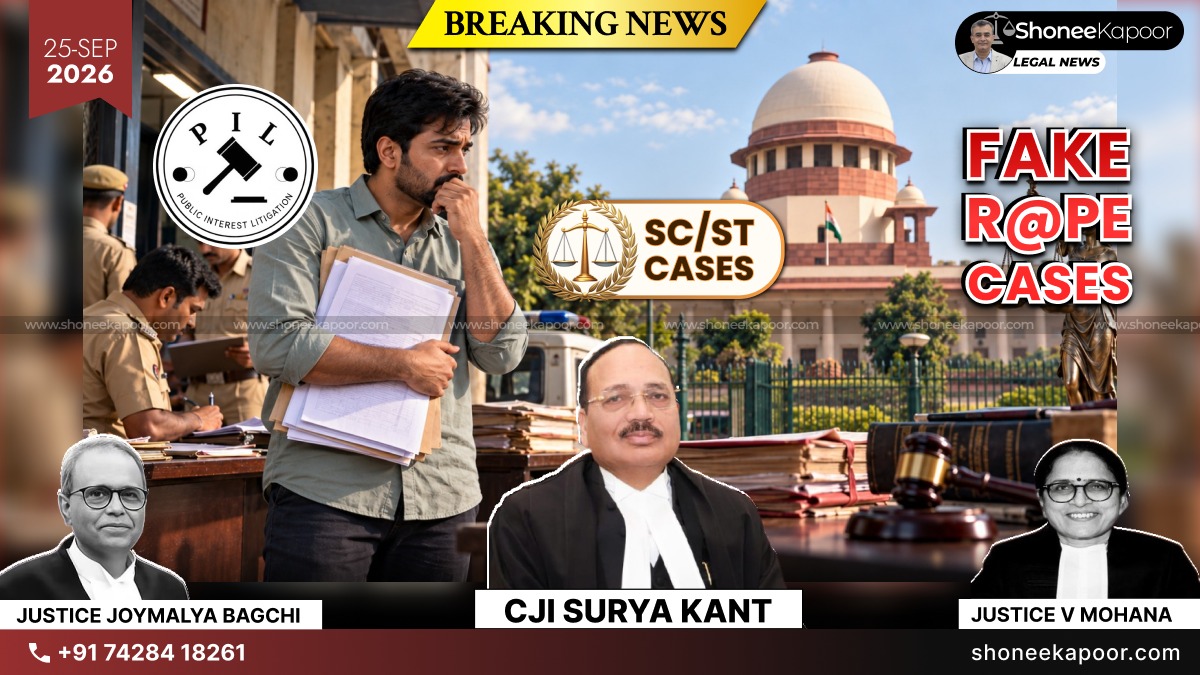
BREAKING | PIL Seeking Action Against Fake Rape & SC/ST Cases: CJI Surya Kant Led Supreme Court Bench To Hear Case Next Week

Curated by NEWS DESK
Editorial DeskNEW DELHI: The Supreme Court of India has agreed to hear next week a Public Interest Litigation seeking measures against the alleged misuse of criminal law through false FIRs and fabricated complaints, including allegations of rape and offences under the SC/ST Act.
Advocate Ashwini Upadhyay mentioned the matter before Chief Justice of India Surya Kant, who sought listing of the petition. The PIL claims that serious criminal provisions are sometimes used for harassment, coercion, personal rivalry and local disputes. The Court had earlier issued notice in the matter.
Upadhyay submitted that people may be falsely implicated in grave criminal cases because of personal enmity or disputes. Referring to one instance, he claimed that a religious preacher had to go into hiding after a “fake rape case” was allegedly registered against him. He also cited former ISRO scientist Nambi Narayanan to show how wrongful prosecution can continue to affect a person even after exoneration.
While referring to disputes that allegedly get converted into criminal proceedings, Upadhyay submitted:
“A civil dispute becomes a criminal case,”
The petition argues that such misuse can cause serious and sometimes irreversible consequences for an accused person. A grave allegation itself can expose a person to criminal proceedings, loss of liberty, social stigma, and damage to reputation long before a court finally tests the accusation.
Read Also:- How to defend a False rape cases in India
During the earlier hearing, CJI Surya Kant also referred to situations where complaints were allegedly filed without the actual complainant's knowledge, including through forged signatures. The CJI referred to another matter where a woman told the Court that a political leader named in her complaint was not involved. The Court raised concerns over the possible influence of “money power or muscle power” in criminal proceedings.
The CJI had further observed that the Court could be accused of “gagging” if it intervened, but stressed the importance of addressing abuse of legal processes and developing a society where citizens understand both their own fundamental rights and the rights of others.
The PIL seeks installation of prominent “Display Boards” at police stations, tehsil and district court premises, panchayat bhawans, municipal offices and educational institutions. These boards would inform people about the legal provisions and punishments relating to false complaints, false charges, false statements, false information and false evidence.
The petitioner has also sought directions requiring police and other authorities to inform a complainant about the penal consequences of filing a false or malicious complaint before accepting it. Another prayer seeks a mandatory undertaking or affidavit from complainants confirming that the allegations, statements, information, evidence and charges made by them are true and correct.
The petition relies upon Article 14 and Article 21 of the Constitution. It argues that failure to create uniform safeguards against abuse can result in unequal application of criminal law and damage the liberty, dignity and reputation of innocent citizens.
The PIL also refers to Chapter XIV of the Bharatiya Nyaya Sanhita, 2023, which contains offences concerning false evidence and offences against public justice. According to the petitioner, penal provisions alone are insufficient unless an effective mechanism makes people aware of the consequences of filing fabricated cases.
The plea describes false complaints and fabricated cases as “menaces” and argues that malicious prosecution can make the criminal process itself a punishment, even where the accused is ultimately acquitted.
The Supreme Court has not yet accepted the allegations of widespread misuse as established facts or granted the safeguards sought in the PIL. At this stage, the petitioner's claims and proposed measures remain under judicial consideration. The Court has only agreed to list the matter for further hearing.
EXPLANATORY TABLE OF LAWS AND PROVISIONS
| Law / Provision | What It Means | Relevance To This Case |
|---|---|---|
| Article 14, Constitution of India | Guarantees equality before law and equal protection of laws. | The PIL argues that lack of uniform safeguards against false complaints permits unequal and selective misuse of criminal law. |
| Article 21, Constitution of India | Protects life and personal liberty and has been judicially recognised as protecting dignity and reputation. | The petitioner argues that false prosecution can damage liberty, dignity and reputation even before final acquittal. |
| SC/ST (Prevention of Atrocities) Act, 1989 | Special criminal law dealing with specified offences and atrocities against members of Scheduled Castes and Scheduled Tribes. | The PIL alleges that false cases under stringent provisions, including the SC/ST Act, may be used for harassment or coercion. |
| Bharatiya Nyaya Sanhita, 2023, Chapter XIV | Contains offences relating to false evidence and offences against public justice. | The PIL relies on existing penal consequences for false information and evidence while seeking additional preventive and awareness measures. |
| Rape offences under criminal law | The BNS contains penal provisions dealing with rape and related sexual offences. | Fake rape allegations are specifically cited by the petitioner as one category of alleged misuse requiring safeguards. |
CASE DETAILS
| Particular | Details |
|---|---|
| Case Title | Ashwini Kumar Upadhyay v. Union of India & Anr. |
| Court | Supreme Court of India |
| Bench | CJI Surya Kant, Justice Joymalya Bagchi and Justice Mohana |
| Petitioner | Advocate Ashwini Kumar Upadhyay |
| Advocate-on-Record for PIL | Ashwani Kumar Dubey, |
| Hearing / Mentioning Date | September 24, 2026 |
| Earlier Order | Notice was issued on February 26, 2026 |
| Relief Sought | Preventive measures against allegedly false complaints and fabricated FIRs, public display of penal consequences, prior information to complainants and mandatory undertaking/affidavit |
| Current Status | Supreme Court agreed to list the PIL for hearing next week |
KEY TAKEAWAYS
- False Cases Can Become Punishment: A man can lose his liberty, reputation and years of life even before allegations are proved.
- Supreme Court To Examine Safeguards: The PIL seeks measures against false rape complaints, fabricated FIRs and alleged misuse of the SC/ST Act.
- “A Civil Dispute Becomes A Criminal Case”: The petitioner highlighted how personal and local disputes can allegedly be converted into serious criminal prosecutions.
- Accountability For False Complaints Sought: The PIL seeks mandatory undertakings/affidavits and prior warning about punishment for false complaints and evidence.
- Acquittal Cannot Return Lost Years: The petition argues that malicious prosecution can cause loss of liberty, stigma and irreversible reputational damage even where the accused is eventually acquitted.
Share Your Thoughts
Comments are moderated before publication.