
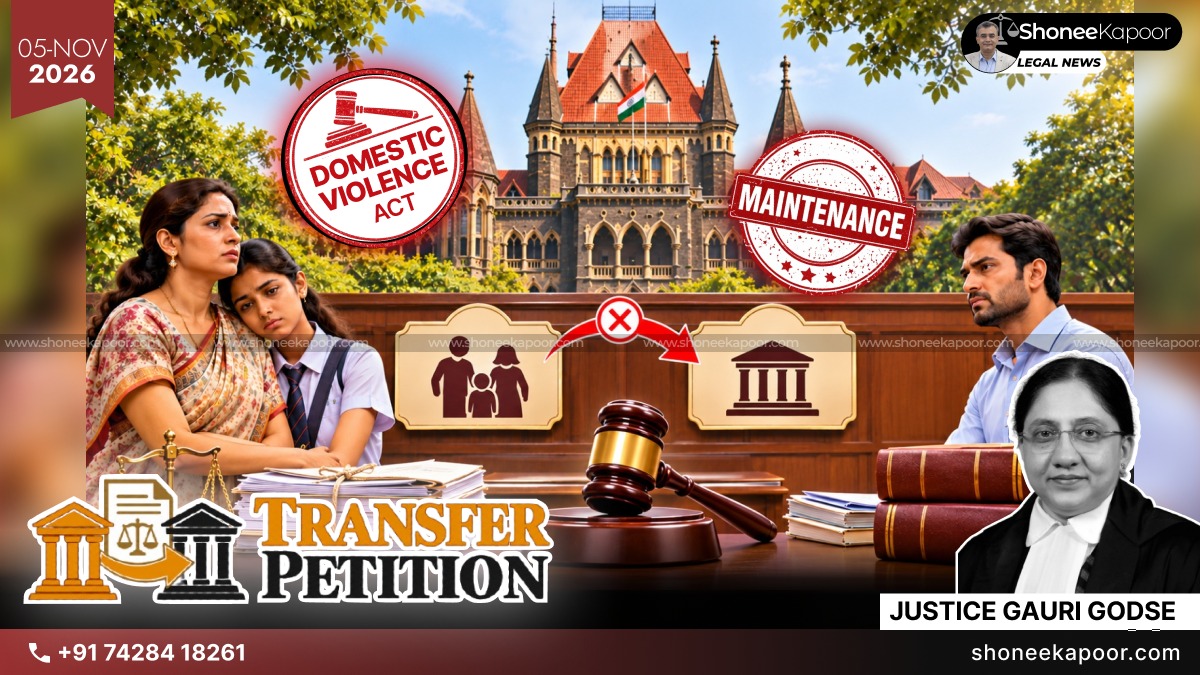
Wife Cannot Transfer Husband’s Maintenance Modification Case Under DV Act To Family Court: Bombay High Court Rejects Plea

Curated by NEWS DESK
Editorial DeskMAHARASHTRA: The Bombay High Court has ruled that a Family Court cannot decide an application under Section 25(2) of the Domestic Violence Act seeking modification of maintenance and rent orders originally passed by a Magistrate. The Court dismissed a wife's application seeking transfer of her husband's maintenance modification proceedings to the Family Court.
Justice Gauri Godse delivered the judgment on October 23, 2026, clarifying Family Courts' jurisdiction in domestic violence maintenance disputes.
The dispute began when the wife filed proceedings under the Protection of Women from Domestic Violence Act, 2005. On August 1, 2019, the Magistrate awarded her ₹25,000 monthly maintenance, ₹20,000 for her daughter and ₹20,000 towards rent.
Both parties challenged the order. On September 17, 2022, the Sessions Court increased the rent to ₹30,000 and directed payment of maintenance of ₹30,000. The husband subsequently challenged the order before the High Court and the Supreme Court.
In January 2026, the husband filed an application under Section 25(2) of the DV Act before the Andheri Magistrate, seeking modification of the maintenance and rent amounts due to changed circumstances.
However, the wife approached the Bombay High Court under Section 24 CPC, seeking transfer of the husband's application to the Family Court, where divorce proceedings, restitution of conjugal rights proceedings and a maintenance counterclaim were already pending.
The wife argued that attending proceedings before two different courts caused hardship, particularly because she was caring for her daughter, who was studying in Class 10. She also claimed that the evidence in both proceedings would overlap.
The husband's counsel opposed the transfer, arguing that the wife regularly appeared before the Magistrate and that the Family Court lacked jurisdiction to modify orders passed by the Magistrate under Section 25(2) of the DV Act.
The High Court examined Sections 7 and 8 of the Family Courts Act, 1984, along with Sections 25 and 26 of the DV Act.
The Court observed:
"However, the legislature has not amended Sections 7 or 8 of the Family Courts Act regarding the learned Magistrate's jurisdiction to exercise the special powers conferred under the DV Act."
The Court explained that Section 26 of the DV Act allows Family Courts to grant reliefs under Sections 18 to 22, but does not automatically authorise them to decide maintenance modification applications under Section 25.
The Court further held:
"Thus, Section 26 of the DV Act, as an enabling and supplementary provision, cannot be interpreted to mean that the Family Court is the competent Magistrate under Section 2 (i) of the DV Act to try and decide the application under Section 25 of the DV Act."
The High Court also rejected the wife's argument regarding inconvenience. It noted that both courts were situated close to her residence and that the pending Family Court proceedings involved different legal issues.
Importantly, the Court clarified that the Magistrate who originally decided the DV Act proceedings was the competent court to consider the husband's application to modify maintenance.
Accordingly, the Bombay High Court dismissed the wife's transfer application, allowing the husband's Section 25(2) DV Act maintenance modification proceedings to continue before the Magistrate.
However, the Court did not reduce or cancel the maintenance. It directed that the husband's modification application must be decided independently on its merits, without being influenced by the observations in the transfer judgment.
EXPLANATORY TABLE OF LAWS AND SECTIONS
| Law / Section | What It Means | Application In This Case |
|---|---|---|
| Section 2(i), DV Act | Defines the Magistrate competent under the Act. | Used to determine the proper court for modification. |
| Section 12(5), DV Act | Provides for an endeavour to dispose of applications within 60 days of the first hearing. | The court considered the objective of speedy disposal. |
| Sections 18–22, DV Act | Cover protection, residence, monetary, custody and compensation reliefs. | Reliefs that may also be sought before a Family Court under Section 26. |
| Section 23, DV Act | Allows interim and ex parte orders. | Discussed through an earlier precedent on transferring DV proceedings. |
| Section 25(2), DV Act | Allows alteration, modification or revocation of orders following changed circumstances. | Husband invoked this provision to seek modification of maintenance and rent. |
| Section 26, DV Act | Permits specified DV Act reliefs in other pending legal proceedings. | Does not confer jurisdiction to decide this Section 25(2) application. |
| Section 24 CPC | Provides powers to transfer or withdraw proceedings. | Wife's transfer request was dismissed. |
| Sections 7–8, Family Courts Act | Define Family Court jurisdiction and exclusion of other courts' jurisdiction. | Court found no authority to decide the husband's modification application. |
| Section 25, Hindu Marriage Act | Governs permanent alimony and its variation. | Discussed through the Supreme Court's Rakesh Malhotra decision. |
| Section 125 CrPC / Chapter IX CrPC | Provides maintenance remedies for eligible dependants. | Discussed while examining Family Court jurisdiction and earlier case law. |
CASE DETAILS
| Particular | Details |
|---|---|
| Case Title | Deepika Jimesh Ranawat v. Jimesh Mahendra Ranawat and Others |
| Court | Bombay High Court |
| Judgment Date | October 23, 2026 |
| Neutral Citation | 2026:BHC-AS:43444 |
| Bench | Justice Gauri Godse |
| Case Number | Miscellaneous Civil Application No. 272 of 2026 |
| CNR Number | HCBM010417392026 |
| Counsel for Wife / Applicant | Advocates Sandeep C. Kekane, Yasir A. Khan, Dhavan Shah, Saaksshi Singh and Nishant Kanse, instructed by Pavan Mali |
| Counsel for Respondent No. 2 | Senior Advocate Manjula Rao, with Advocates Manmohan Amonkar, Saurabh Rajeshirke and Atharva Deve |
| Original Court | Magistrate Court, Andheri, Mumbai |
| Modification Application | Miscellaneous Application No. 269 of 2026 |
| Main Legal Issue | Whether a Family Court can decide modification of maintenance under Section 25(2) of the DV Act |
| Final Decision | Wife's transfer application dismissed; husband's modification plea remains before the Magistrate |
KEY TAKEAWAYS
- Wife's Transfer Plea Rejected: Bombay High Court dismissed the wife's request to transfer her husband's maintenance modification case to the Family Court.
- Husband's Right to Seek Modification: Husband can seek changes to DV Act maintenance and rent orders under Section 25(2) based on changed circumstances.
- Family Court Has No Jurisdiction: The Family Court cannot decide the husband's Section 25(2) DV Act modification application originally filed before the Magistrate.
- Wife's Inconvenience Argument Rejected: Pending matrimonial cases and inconvenience cannot override statutory jurisdiction.
- Husband's Legal Remedy Protected: The husband's maintenance modification plea will proceed before the Magistrate, with the amount to be decided on merits.
Share Your Thoughts
Comments are moderated before publication.