
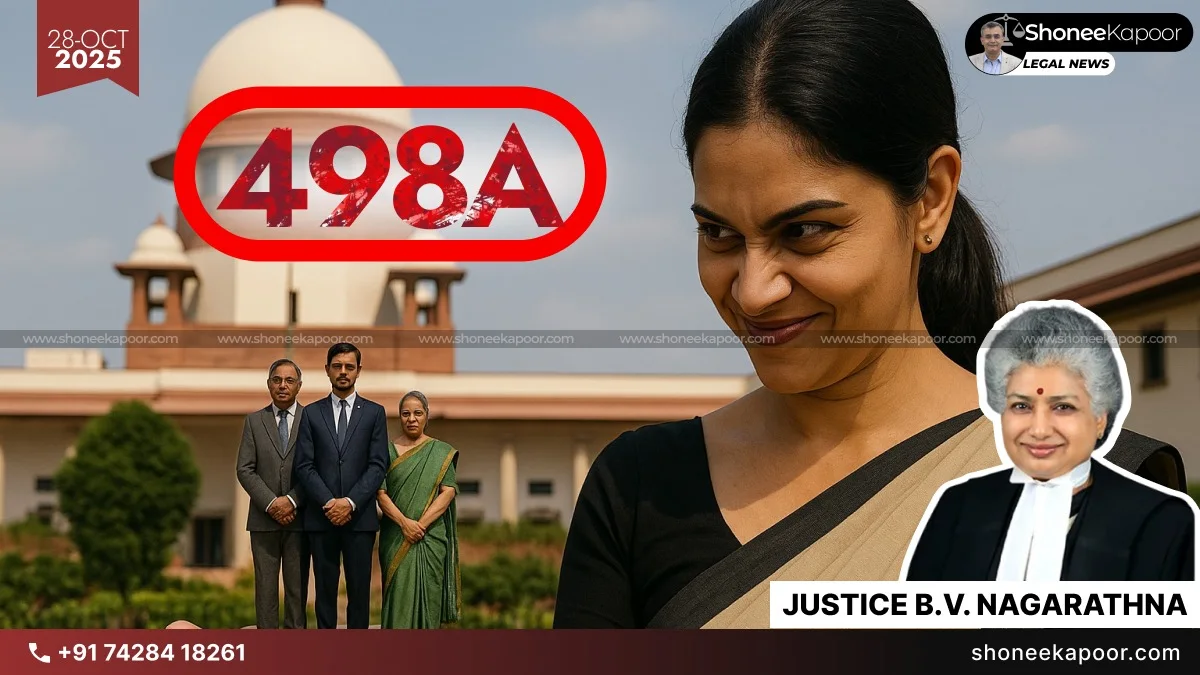
Landmark 498A Case | “False Allegations Can Destroy Innocent Families, Must Be Examined Carefully”: Supreme Court

Written and analysed by Vaibhav Ojha
Head Of Legal CommunicationsThe Supreme Court quashed a dowry harassment case against a man falsely accused by his sister-in-law, stressing that courts must examine marital cruelty claims with utmost care to prevent misuse and injustice.
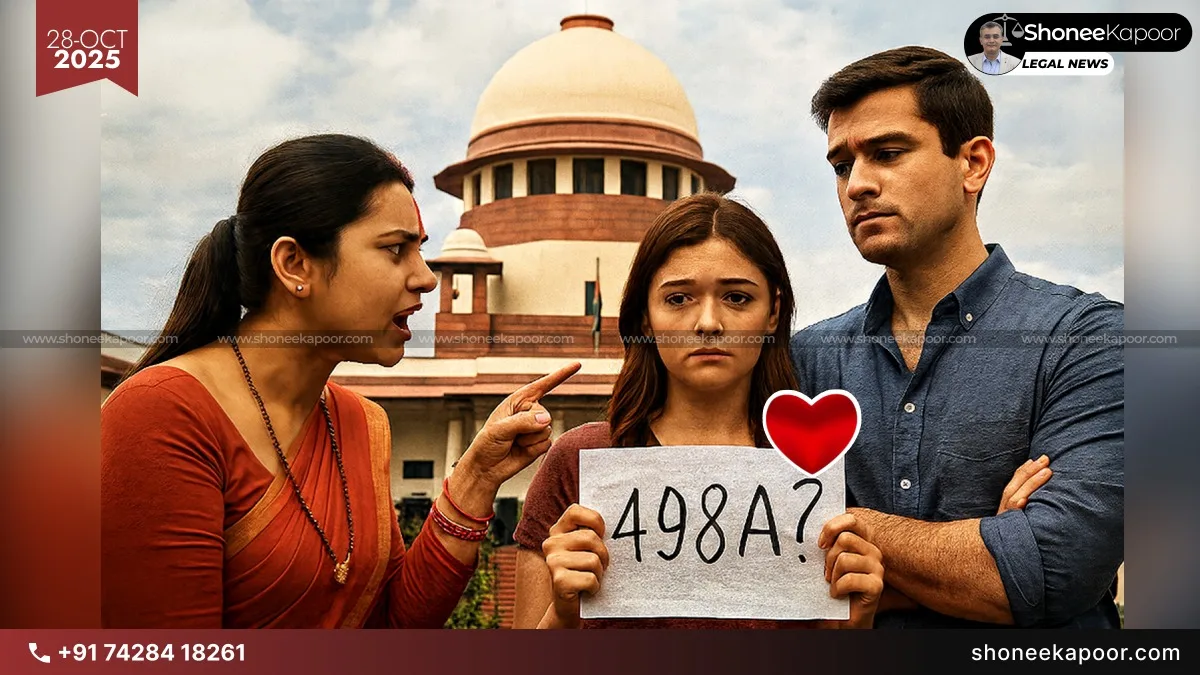
NEW DELHI: In a major judgment protecting men and their families from false dowry harassment cases, the Supreme Court of India has ruled that courts must act with care, caution, and practicality while dealing with matrimonial cruelty complaints.
The Bench of Justice B.V. Nagarathna and Justice R. Mahadevan, in Shobhit Kumar Mittal v. State of Uttar Pradesh (Criminal Appeal, 2025), quashed a criminal case filed under Section 498A IPC and Dowry Prohibition Act provisions, calling the allegations vague and baseless
The bench stressed:
“Courts have to be careful and cautious in dealing with complaints and must take pragmatic realities into consideration while dealing with matrimonial disputes where the allegations have to be scrutinized with great care and circumspection in order to prevent miscarriage of justice and abuse of process of law.”
Case Background
The case arose from an FIR lodged by Smt. Jyoti Garg at Civil Lines Police Station, Meerut, accusing her husband Mohit Mittal, her mother-in-law Shashi Mittal, and her brother-in-law Shobhit Kumar Mittal (the appellant) of dowry-related harassment. She alleged that repeated demands for dowry led to severe mental and physical suffering, including a brain vein burst that caused partial paralysis.
The FIR invoked Sections 323 (voluntarily causing hurt) and 498A IPC (cruelty by husband or relatives), along with Sections 3 and 4 of the Dowry Prohibition Act.
High Court’s Decision and Supreme Court’s Intervention
When the accused sought relief, the Allahabad High Court refused to quash the FIR on February 27, 2024, stating that a prima facie case existed. Dissatisfied, the brother-in-law moved the Supreme Court.
The apex court found that the allegations were general and unspecific, with no details about time, place, or specific acts of cruelty. The Court noted:
“The FIR lacks concrete and precise allegations.”
It further remarked that the complainant failed to establish any link between her medical condition and the alleged acts of harassment. The Court declared:
“The term ‘cruelty’ cannot be established without specific instances. The tendency of invoking the aforesaid provisions, without mentioning any specific detail, weakens the case of the prosecution and casts serious aspersions on the probability of the version of the complainant. Therefore, this Court cannot ignore the missing specifics in the FIR which is the basic premise for invoking the criminal machinery of the State.”
Thus, the Supreme Court set aside the Allahabad High Court’s decision and quashed the criminal case against the appellant.
Supreme Court’s Warning on Misuse of Section 498A
The bench relied on the guiding principles from State of Haryana v. Bhajan Lal (1992), reminding that courts can quash criminal proceedings when allegations do not make out a clear offence or are inherently improbable.
Referring to Dara Lakshmi Narayana v. State of Bihar (2025), the Court reiterated:
“A mere reference to the names of family members in a criminal case arising out of a matrimonial dispute, without specific allegations indicating their active involvement should be nipped in the bud.”
It added:
“It is a well-recognised fact, borne out of judicial experience, that there is often a tendency to implicate all the members of the husband’s family when domestic disputes arise out of a matrimonial discord. Such generalised and sweeping accusations unsupported by concrete evidence or particularised allegations cannot form the basis for criminal prosecution. Courts must exercise caution in such cases to prevent misuse of legal provisions and the legal process and avoid unnecessary harassment of innocent family members.”
The Court further warned against the growing misuse of Section 498A, saying:
“The inclusion of Section 498A of the IPC was intended to curb cruelty inflicted on a woman by her husband and his family, ensuring swift intervention by the State. However, in recent years, there has been a growing tendency to misuse provisions like Section 498A of the IPC as a tool for unleashing personal vendetta against the husband and his family by a wife.”
It emphasized that while genuine victims of cruelty must not be silenced, courts must filter false complaints:
“We are not, for a moment, stating that any woman who has suffered cruelty in terms of what has been contemplated under Section 498A of the IPC should remain silent and forbear herself from making a complaint or initiating any criminal proceeding. That is not the intention… but we should not encourage a case like the present one, where as a counterblast to the petition for dissolution of marriage… a complaint under Section 498A is lodged by the wife.”
Final Outcome
The Supreme Court ruled that continuing the criminal case against Shobhit Kumar Mittal would be an abuse of legal process, and therefore quashed FIR No. 347 of 2023 registered at Civil Lines Police Station, Meerut, noting that “none of the offences alleged against the accused/appellant is made out.”
The bench concluded that the order will not affect other pending proceedings between the parties, which will be decided separately according to law.
Summary
This judgment is a strong reminder that matrimonial cruelty cases must be examined carefully and vague or vindictive allegations should not be allowed to ruin innocent lives. The Supreme Court’s ruling reinforces the balance between protecting genuine victims and preventing misuse of legal provisions like Section 498A IPC.
Explanatory Table of Laws & Sections Mentioned
| Law / Section | Provision Title | Meaning / Legal Explanation (Simple English) | Punishment / Effect |
| Section 323 IPC | Punishment for Voluntarily Causing Hurt | Applies when someone intentionally or knowingly causes bodily pain, disease, or infirmity to another person. | Imprisonment up to 1 year, or fine up to ₹1,000, or both. |
| Section 498A IPC | Cruelty by Husband or Relatives of Husband | Protects married women from cruelty by husband or in-laws, which includes physical/mental harm or dowry-related harassment. | Imprisonment up to 3 years and fine. |
| Explanation (a) to Section 498A | Definition of Cruelty | Covers acts likely to drive a woman to suicide or cause grave injury to life, limb, or health (physical or mental). | Part of the offence definition. |
| Explanation (b) to Section 498A | Harassment for Dowry | Includes any harassment aimed at coercing a woman or her relatives to meet unlawful dowry demands. | Constitutes cruelty under Section 498A. |
| Section 3 of Dowry Prohibition Act, 1961 | Penalty for Giving or Taking Dowry | Any person giving, taking, or abetting dowry can be punished. | Minimum imprisonment 5 years and fine of ₹15,000 or value of dowry. |
| Section 4 of Dowry Prohibition Act, 1961 | Penalty for Demanding Dowry | Punishes direct or indirect demands for dowry from bride’s or groom’s family. | Imprisonment between 6 months and 2 years, and fine up to ₹10,000. |
| Article 226 of Constitution of India | Power of High Courts to Issue Writs | Allows citizens to approach High Courts for protection of fundamental or legal rights. | Used to seek quashing of FIRs or unlawful actions. |
| Section 41A CrPC | Notice of Appearance Before Police Officer | Requires police to issue notice instead of arrest for certain offences. | Procedural safeguard against misuse of arrest powers. |
| State of Haryana v. Bhajan Lal (1992) | Landmark Judgment on Quashing FIRs | Laid down 7 categories where courts can quash criminal proceedings to prevent misuse of law. | Used as guiding precedent in this case. |
| Dara Lakshmi Narayana v. State of Bihar (2025) | Precedent on False 498A Implications | Warned against naming all family members in matrimonial cases without clear role or evidence. | Cited by SC to highlight misuse of 498A IPC. |
Case Summary
| Particular | Details |
| Case Title | Shobhit Kumar Mittal v. State of Uttar Pradesh & Another |
| Citation | 2025 INSC 1152 |
| Court | Supreme Court of India |
| Jurisdiction | Criminal Appellate Jurisdiction |
| Appeal No. | Criminal Appeal (Arising out of SLP (Crl) No. 4069 of 2024) |
| Date of Judgment | September 24, 2025 |
| Coram / Bench | Justice B.V. Nagarathna and Justice R. Mahadevan |
| Appellant | Shobhit Kumar Mittal |
| Respondents | State of Uttar Pradesh & Smt. Jyoti Garg (Complainant) |
| High Court Order Appealed From | Allahabad High Court order dated 27.02.2024 (Criminal Misc. Writ Petition No. 2676 of 2024) |
| FIR Challenged | FIR No. 347 of 2023, dated 09.11.2023, P.S. Civil Lines, Meerut |
| Alleged Offences | Sections 323 & 498A IPC; Sections 3 & 4 of the Dowry Prohibition Act, 1961 |
| Result | Appeal allowed; FIR and proceedings quashed against the appellant |
| Location | New Delhi |
| Judgment Authored By | Justice B.V. Nagarathna |
| Counsels (as per record) | Learned counsel for appellant and State; specific names not mentioned in text (can be added from official SC record when available) |
Disclaimer: The views and opinions expressed in this article are those of the Indian courts and do not necessarily reflect the official policy or position of “ShoneeKapoor.com” or its affiliates. This article is intended for informational and educational purposes only. The content provided is not legal advice, and viewers should not act upon this information without seeking professional counsel. Viewer discretion is advise
Related Articles
Real Court Cases Where False Allegations Backfired On Wife
Real Indian court cases where false 498A, dowry, cruelty and defamatory allegations against husbands backfired, leadi...
Karisma Kapoor – Sunjay Kapur Case Explained: Marriage, Divorce, 498A, Death & the Delhi High Court Property War
From a celebrity wedding to IPC 498A allegations, a Supreme Court-linked divorce settlement, and now a Delhi High Cou...
Can a ‘girlfriend’ of the husband be implicated under Section 498A?
From landmark Supreme Court rulings to ground-level misuse, this article unpacks how Section 498A defines ‘husband’ a...
Share Your Thoughts
Comments are moderated before publication.