
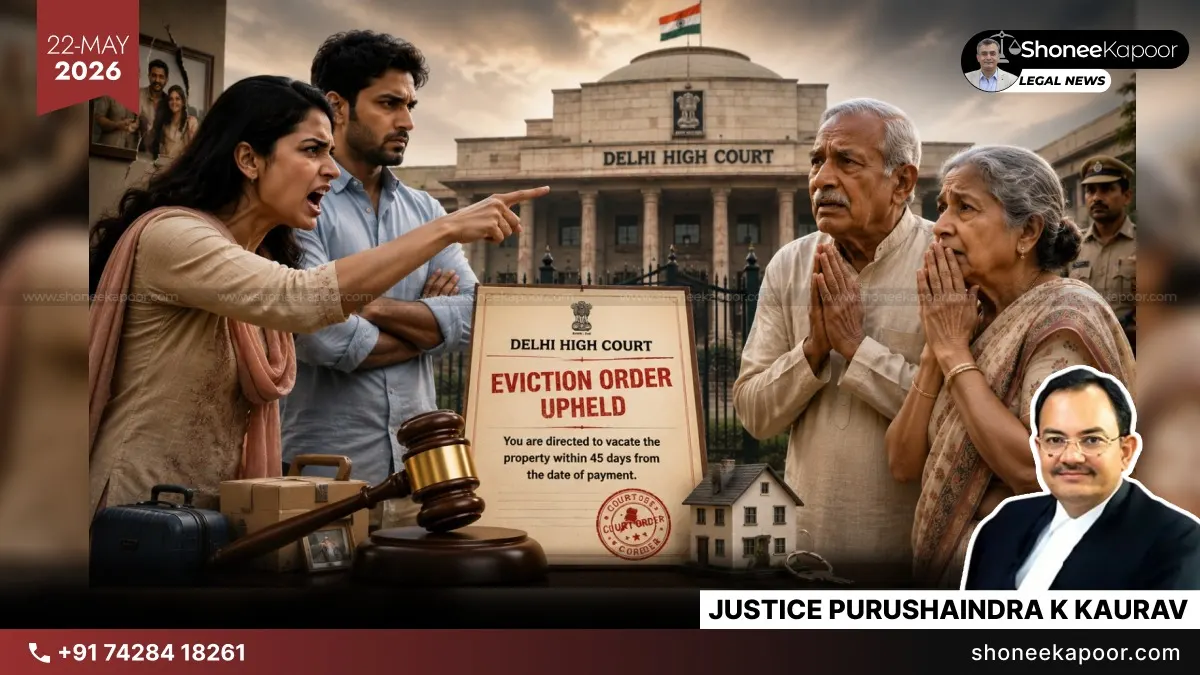
Can Elderly Parents Be Forced To Sacrifice Their Peaceful Life Because Of Matrimonial Disputes?
The Delhi High Court recognised that senior citizens cannot be compelled to suffer harassment or lose peaceful enjoyment of their self-acquired property because of disputes between their son and daughter-in-law.
NEW DELHI: The Delhi High Court, in a judgment by Justice Purushaindra Kumar Kaurav, held that a daughter-in-law cannot claim permanent accommodation in her in-laws’ self-acquired property under the Domestic Violence Act or the Senior Citizens Act.
The Court clarified that the law only protects the right to a “shared household” or reasonable alternate accommodation, and not a permanent right over the property.
The case involved a 76-year-old father-in-law and 73-year-old mother-in-law who alleged physical and mental harassment by their son and daughter-in-law. The elderly couple stated that they were unable to peacefully live in their own house and had no stable source of income except a government pension.
After examining the complaints, the District Magistrate passed an eviction order against the son and daughter-in-law and also directed police protection for the senior citizens.
The daughter-in-law later challenged the eviction order before the Divisional Commissioner. She argued that she had two children, including one special child, no independent source of income, and therefore could not be left without shelter.
The Divisional Commissioner, while balancing the rights of both sides, observed that senior citizens have a right to live peacefully with dignity, while the daughter-in-law also has a right to shelter.
Considering that one of the children was a special child, the Divisional Commissioner modified the eviction order and directed the in-laws to provide permanent alternate accommodation of similar size nearby.
Aggrieved by this direction of “permanent accommodation”, the elderly parents approached the Delhi High Court challenging the order passed by the Divisional Commissioner.
The High Court found that the relationship between the parties had become completely bitter and living together was no longer possible. The Court observed that while the daughter-in-law has protection under the Domestic Violence Act, senior citizens also have a legal right to peacefully enjoy their own property without harassment.
The Court said that both the Domestic Violence Act and the Senior Citizens Act are special laws meant to protect vulnerable groups, and therefore, rights under one law cannot completely destroy the rights available under the other.
It further observed that the right of residence under the Domestic Violence Act is only a protective right and does not create ownership or permanent residence rights in favour of the daughter-in-law over the in-laws’ property.
Justice Purushaindra Kumar Kaurav specifically held:
“There are no provisions under the DV Act or the Senior Citizens Act for the grant of permanent accommodation.”
The Court further clarified:
“What is recognised therein, is the right of shared-household.”
The High Court also observed that although the in-laws had earlier agreed before the appellate authority to provide alternate accommodation, such an undertaking could not be stretched into a permanent or lifelong obligation when the law itself does not recognise such a right.
Finally, the High Court directed the elderly couple to pay Rs.30,000 per month to the daughter-in-law towards alternate accommodation and maintenance, after which she and her children must vacate the property within 45 days.
Explanatory Table: Laws And Sections Involved
| Law / Section | Purpose | Relevance In This Case |
| Maintenance and Welfare of Parents and Senior Citizens Act, 2007 | Law protecting senior citizens from neglect and harassment by children/relatives | Senior citizen parents sought eviction under this Act |
| Section 3 – Senior Citizens Act | Gives overriding effect to the Act over inconsistent laws | Discussed while balancing rights under DV Act |
| Section 7 – Senior Citizens Act | Provides for constitution of Tribunal | Basis of proceedings before authorities |
| Section 8 – Senior Citizens Act | Allows summary procedure by Tribunal | Mentioned by Supreme Court precedent relied upon |
| Section 27 – Senior Citizens Act | Bars jurisdiction of civil courts in certain matters | Discussed in Supreme Court observations |
| Protection of Women from Domestic Violence Act, 2005 | Protects women from domestic violence and grants residence rights | Daughter-in-law claimed right of residence |
| Section 17 – DV Act | Gives woman right to reside in “shared household” | Central issue before High Court |
| Section 2(s) – DV Act | Defines “shared household” | Referred through Supreme Court judgment |
| Section 26 – DV Act | Allows reliefs under DV Act before other courts | Referred in Supreme Court precedent |
| Delhi Maintenance and Welfare of Parents and Senior Citizens Rules, 2016 | Delhi Rules governing protection of senior citizens | Used by District Magistrate while passing eviction order |
Case Details
- Case Title: Parmal & Anr. v. The State & Ors.
- Court: Delhi High Court
- Case Number: W.P.(C) 15440/2024
- Date Of Decision: 12 May 2026
- Bench: Hon’ble Mr. Justice Purushaindra Kumar Kaurav
- Neutral Citation: 2026:DHC:4450
- Petitioners: Parmal & Another
- Respondents: The State & Others
- Counsels:
- For Petitioner: Mr. Naginder Benipal, Mr. Ankit Siwach, Mr. Udit Vaghela, Mr. Jaskaran Singh, Mr. Saarthak Sethi, Mr. Arjun Baliyan, and Mr. Satyapal
- For Respondent: Ms. Avni Singh (Panel Counsel, GNCTD) with Mr. Vaibhav Sharma, Mr. Badar Mahmood (SPC for Union of India), Mr. Ammar Ahmad, Mr. Vina Rathi, DHCLSC, and Ms. Hetu
Key Takeaways
- Marriage does not give anyone automatic lifetime rights over parents’ self-acquired property.
- Elderly parents cannot be forced to sacrifice their peaceful life and dignity inside their own house because of matrimonial disputes of their children.
- The legal responsibility to maintain a wife and provide accommodation primarily lies on the husband, not on aged in-laws.
- Residence rights are meant for protection from destitution, not for permanent control or occupation of someone else’s property.
- Laws protecting women and laws protecting senior citizens must work together in balance, without destroying the rights of either side.
This Could Change Your Case-Get FREE Legal Advice-Click Here!
Disclaimer: The views and opinions expressed in this article are those of the Indian courts and do not necessarily reflect the official policy or position of “ShoneeKapoor.com” or its affiliates. This article is intended for informational and educational purposes only. The content provided is not legal advice, and viewers should not act upon this information without seeking professional counsel. Viewer discretion is advised.
