
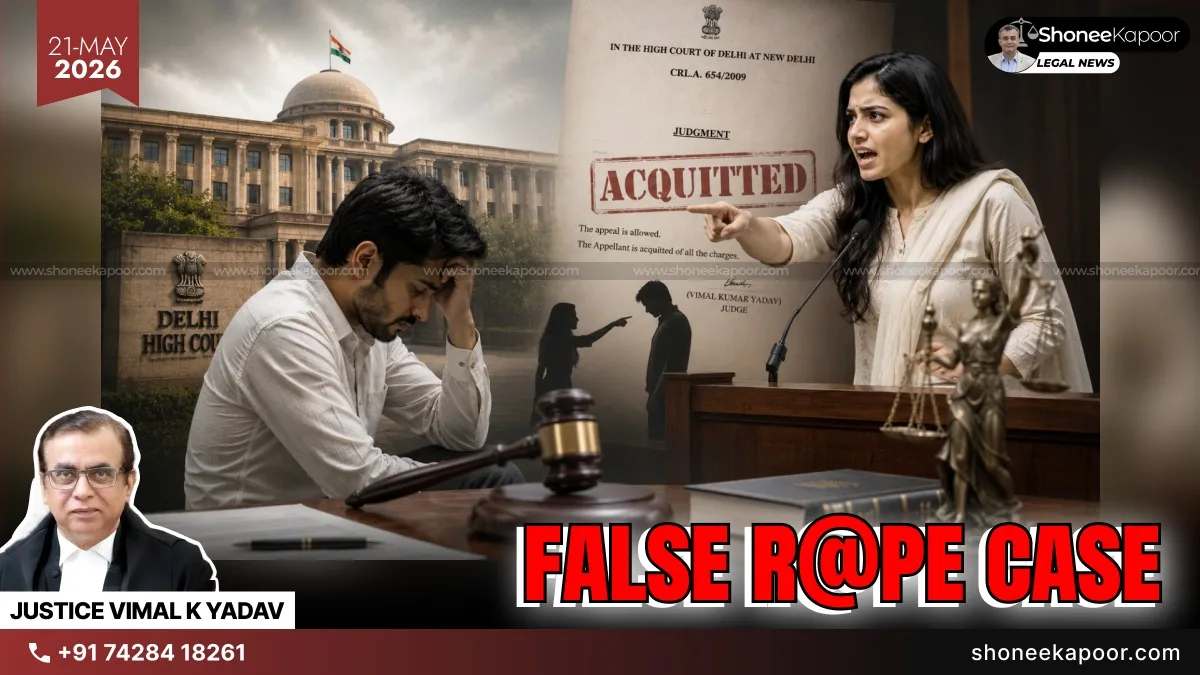
Delhi High Court acquitted a man who faced rape and kidnapping charges for years despite the prosecutrix voluntarily travelling with him, marrying him, and living with him for months.
How easily can a man’s life be destroyed when consent is ignored after a relationship becomes socially inconvenient?
NEW DELHI: The Delhi High Court, in a judgment dated May 11, 2026, acquitted a man accused of kidnapping and rape after finding that the prosecutrixhad voluntarily travelled with him, married him under the Special Marriage Act, and lived with him for nearly two months.
Justice Vimal Kumar Yadav observed that social and family pressure in interfaith relationships often changes the course of such cases.
The case started in 2004 when the father of the prosecutrix lodged a missing complaint at Farsh Bazar Police Station in Delhi and accused the man of taking away his daughter. An FIR under Sections 363, 366 and 376 IPC was registered. During investigation, police found that the woman had travelled with the accused from Delhi to West Bengal and had also married him during that period.
While hearing the appeal, the High Court noted that the prosecutrix had initially supported the accused in her statements under Sections 161 and 164 Cr.P.C. but later changed her version during the trial. The Court said she had-
“Turned tables and shifted the entire blame on the Appellant when she came to depose before the Court”.
Justice Vimal Kumar Yadav also made important observations on the social reality of interfaith relationships in India. The Court stated:
“Fragmented, stratified and deeply divided Indian society across all the classes left no room practically for the young lovers to choose their partners.”
The judgment further observed that “an inter-religious alliance was no less than a sin”.
The Court closely examined the age of the prosecutrix because it was the most important issue in the case. The prosecution relied on school records to claim she was a minor. However, the Court noted that there was no matriculation certificate or birth certificate from any municipal authority.
The ossification test estimated her age between 14 and 16 years, but with the accepted margin of error, the Court held that her age could legally extend up to 18 years.
The High Court also relied heavily on the conduct of the prosecutrix. The Court noted that she travelled more than 1500 kilometres in public transport, including buses and trains, but never raised any alarm or sought help from police or passengers. The Court observed:
“It is nearly impossible to believe that the prosecutrix did not have even a single opportunity to raise alarm and attract the attention of the public police or the Government officials”.
The judgment further recorded that the prosecutrix refused internal medical examination and had also written several letters to the accused, which according to the Court reflected a voluntary relationship. The Court stated:
“Her silence in such circumstances only indicates that she was an ally of the Appellant and accompanied him by her own choice, will and desire.”
The Court also took note of the fact that the marriage between the parties had been registered under the Special Marriage Act. Referring to the evidence on record, the Court observed:
“The prosecutrix had herself, of her own volition not only accompanied the Appellant but, got married under Special Marriage Act.”
Finally, the Delhi High Court concluded that the prosecution failed to prove the charges beyond reasonable doubt and acquitted the accused of all offences.
Important Laws And Sections Explained
| Law / Section | Purpose | How It Was Used in This Case |
| Section 363 IPC | Punishment for kidnapping a minor from lawful guardianship | FIR was registered because the father alleged his daughter was taken away by the accused |
| Section 366 IPC | Kidnapping or inducing a woman for marriage or illicit relationship | Police alleged the accused took the prosecutrix away to marry her |
| Section 376 IPC | Punishment for rape | Prosecution claimed the accused had physical relations without valid consent |
| Section 375 IPC Exception 2 | Old legal provision saying intercourse with wife above 15 years was not rape | Court referred to this because the parties had married under the Special Marriage Act |
| Section 161 Cr.P.C. | Statement recorded by police during investigation | Prosecutrix initially supported the accused in this statement |
| Section 164 Cr.P.C. | Statement recorded before a Magistrate | Prosecutrix again stated she had voluntarily accompanied the accused |
| Section 94 Juvenile Justice Act, 2015 | Procedure to determine age of child/minor | Court discussed this while examining prosecutrix’s age |
| Rule 12 of Juvenile Justice Rules, 2007 | Rules deciding which documents should be relied upon for age determination | Court referred to this for deciding validity of school records and ossification test |
| Special Marriage Act, 1954 | Law allowing interfaith and inter-caste marriages | Accused and prosecutrix had registered their marriage under this Act |
| Indian Evidence Act, 1872 | Law governing proof and admissibility of evidence | Court examined whether school records properly proved the prosecutrix’s age |
Case Details
- Case Title: Mohd. Quasim v. State (NCT of Delhi)
- Court: Delhi High Court
- Case Number: CRL.A. 654/2009
- Bench: Justice Vimal Kumar Yadav
- Neutral Citation: 2026:DHC:4097
- Date of Judgment: 11 May 2026
- Counsels:
- For Appellant: Mr. Samar Singh Kachwaha, Mr. Arsh Ranpal, Ms. Kavita Vinayak, and Mr. Yash Dadriwal
- For State: Mr. Nawal Kishore Jha, APP for State, and ASI Inder Singh, PS Farsh Bazar
- For Prosecutrix: Ms. Astha, Advocate, DHCLSC, and Ms. Megha Singh
Key Takeaways
- When an adult woman willingly travels, marries, and lives with a man for months, turning the relationship into a criminal case later destroys the very concept of consent and justice.
- False or pressured allegations in relationship disputes are ruining innocent men’s lives, careers, and families while the system blindly treats every man as guilty first.
- Courts are finally acknowledging that social and family pressure often forces women to change statements after consensual interfaith relationships become public.
- Age determination based on doubtful school records without reliable proof cannot be used to send a man to jail for decades.
- A man cannot be branded a kidnapper or rapist merely because a relationship later becomes socially unacceptable to the family or community.
This Could Change Your Case-Get FREE Legal Advice-Click Here!
Disclaimer: The views and opinions expressed in this article are those of the Indian courts and do not necessarily reflect the official policy or position of “ShoneeKapoor.com” or its affiliates. This article is intended for informational and educational purposes only. The content provided is not legal advice, and viewers should not act upon this information without seeking professional counsel. Viewer discretion is advised.
