
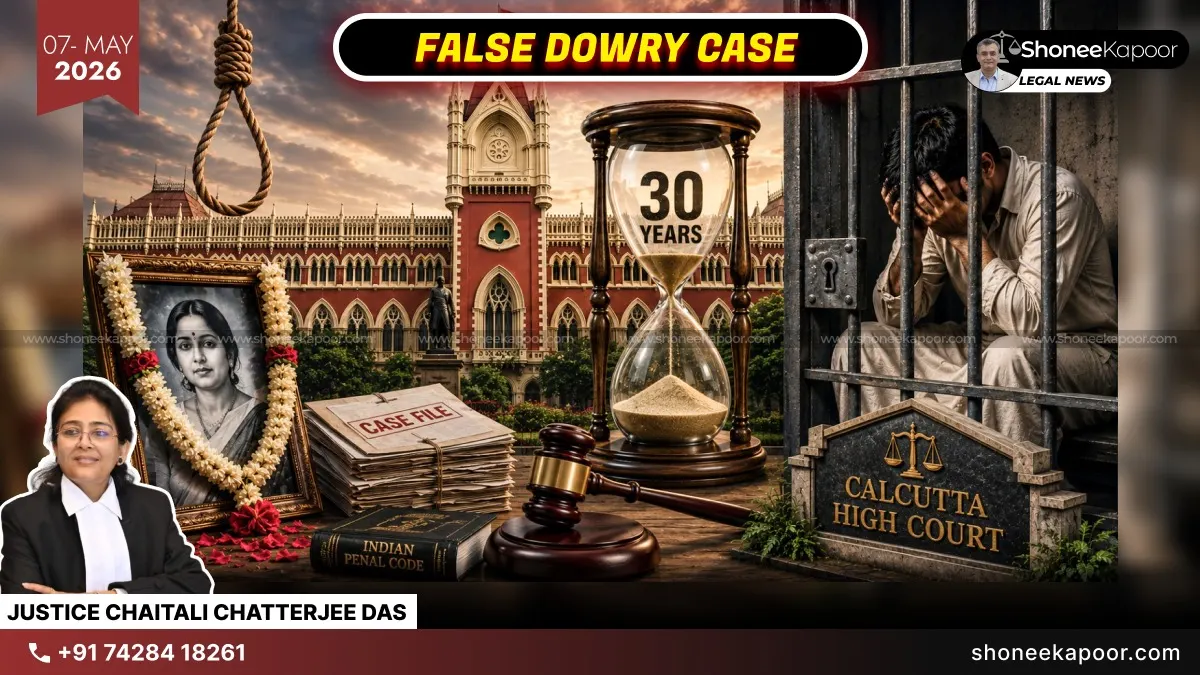
Can Hearsay Allegations Without Corroboration Send A Husband To Jail In A Dowry Death Case? Calcutta High Court Says No, Criminal Conviction Cannot Be Based On Suspicion Or Emotional Allegations Alone.
KOLKATA: The Calcutta High Court, through Justice Chaitali Chatterjee Das, set aside the conviction of a husband who had been held guilty under Sections 498A and 306 IPC in connection with the suicide of his wife in 1994.
The Court held that the prosecution failed to prove continuous cruelty, dowry demand, or any direct instigation that could legally amount to abetment of suicide.
The case began after the deceased woman’s brother filed a complaint alleging that his sister was being mentally and physically tortured by her husband and his sister. He further claimed that the harassment became unbearable and ultimately led to her death by hanging inside her matrimonial home in Murshidabad.
The trial court had convicted the husband and sentenced him to imprisonment. However, while hearing the appeal, the High Court found major contradictions in witness statements and observed that the entire prosecution story lacked strong and consistent evidence.
The Court noted that the marriage had taken place in 1982 and the incident occurred in 1994, but during all those years no complaint regarding dowry harassment or cruelty was ever filed before any authority. The Court also found that several witnesses only repeated what they had “heard” from others and had no direct knowledge of any assault or harassment.
Medical evidence also weakened the prosecution case. The post-mortem report confirmed that the death was suicidal in nature and there were no external injuries on the body except the ligature mark caused by hanging.
One of the most important developments in the case came from the testimony of the deceased woman’s daughter. She stated before the Court that relations between her parents were cordial. She also alleged that she had earlier been tutored by her maternal uncle and police officials while giving her statement as a child. According to her, her maternal uncle frequently demanded money from her mother and this issue had created mental pressure upon her.
The High Court observed that the prosecution failed to establish any direct act of instigation by the husband which is legally necessary for conviction in a suicide abetment case. While discussing the law, the Court quoted:
“Abetment involves a mental process of instigating a person or intentionally aiding a person in doing of a thing. Without a positive act on the part of the accused to instigate or aid in committing suicide, conviction cannot be sustained.”
The Court further observed that mere allegations or ordinary matrimonial disputes cannot automatically amount to abetment of suicide under Section 306 IPC. Referring to the Supreme Court judgment in Kashibai vs State of Karnataka, the High Court noted:
“Had there been any clinching evidence of incessant harassment on account of which the wife was left with no other option but to put an end to her life, it could have been said that the accused intended the consequences of his act, namely, suicide.”
The High Court also found it important that the alleged eyewitness had never informed police or any authority about the incident before appearing before the Court years later, making his testimony doubtful and unreliable.
While discussing hostile witnesses, the Court referred to the Supreme Court ruling in Neeraj Dutta vs State (Government of NCT of Delhi) and observed:
“Even the evidence of a ‘hostile witness’ if it finds corroboration from the facts of the case may be taken into account while judging the guilt of the accused.”
However, the Court held that in the present case there was no reliable corroboration to support the prosecution story. The evidence was found to be inconsistent, emotional, and influenced by family grudge rather than supported by legally sustainable proof.
The Court ultimately concluded that the prosecution failed to prove the essential ingredients required under Sections 498A and 306 IPC and held that criminal conviction cannot be based on suspicion, assumptions, or contradictory statements unsupported by clear evidence.
Accordingly, the Calcutta High Court acquitted the husband and set aside the conviction, bringing an end to criminal proceedings that had continued for nearly three decades.
Explanatory Table: Laws And Sections Involved
| Section / Law | Meaning In Simple Language | Role In This Case |
| Section 498A IPC | Punishes cruelty or harassment by husband or his relatives towards a married woman | Husband was accused of mentally and physically torturing his wife |
| Section 306 IPC | Punishment for abetment of suicide | Prosecution alleged that cruelty forced the wife to commit suicide |
| Section 107 IPC | Defines “abetment”, including instigation or intentional aid | High Court held prosecution failed to prove instigation or intentional act leading to suicide |
| Section 113A Evidence Act | Allows Court to presume abetment of suicide in certain matrimonial cases | Discussed during arguments regarding legal presumption |
| Section 313 CrPC | Statement of accused recorded by Court to explain allegations | Husband denied all allegations during examination |
| Section 360 CrPC | Provision relating to release on probation | Trial Court had granted benefit to co-accused sister |
| Probation of Offenders Act | Permits release on probation instead of imprisonment in suitable cases | Co-accused sister was released on probation |
Case Details
- Case Title: Bikash Chandra Paul vs The State of West Bengal
- Case Number: CRA 445 of 2009
- Court: Calcutta High Court
- Bench: Hon’ble Justice Chaitali Chatterjee Das
- Date Of Judgment: 05 May 2026
- Counsels:
- For Appellant: Mr. Soumyajit Das Mahapatra, Mr. Somnath Adhikary, Ms. Madhurai Sinha, Ms. Upasana Banerjee
- For State: Mr. P.K. Datta and Mr. Asraf Mandal
Key Takeaways
- Mere allegations by a wife’s family are not enough for conviction under Sections 498A or 306 IPC without strong and reliable evidence.
- Criminal conviction cannot be based on emotions, assumptions, or hearsay statements lacking proper corroboration.
- Abetment of suicide requires clear proof of instigation or intentional conduct, not ordinary matrimonial disputes or arguments.
- Delayed allegations without any prior complaints significantly weaken claims of continuous harassment or cruelty.
- Criminal law should not be misused as a tool for personal vendetta or family revenge after a tragic incident.
This Could Change Your Case-Get FREE Legal Advice-Click Here!
Disclaimer: The views and opinions expressed in this article are those of the Indian courts and do not necessarily reflect the official policy or position of “ShoneeKapoor.com” or its affiliates. This article is intended for informational and educational purposes only. The content provided is not legal advice, and viewers should not act upon this information without seeking professional counsel. Viewer discretion is advised.
