
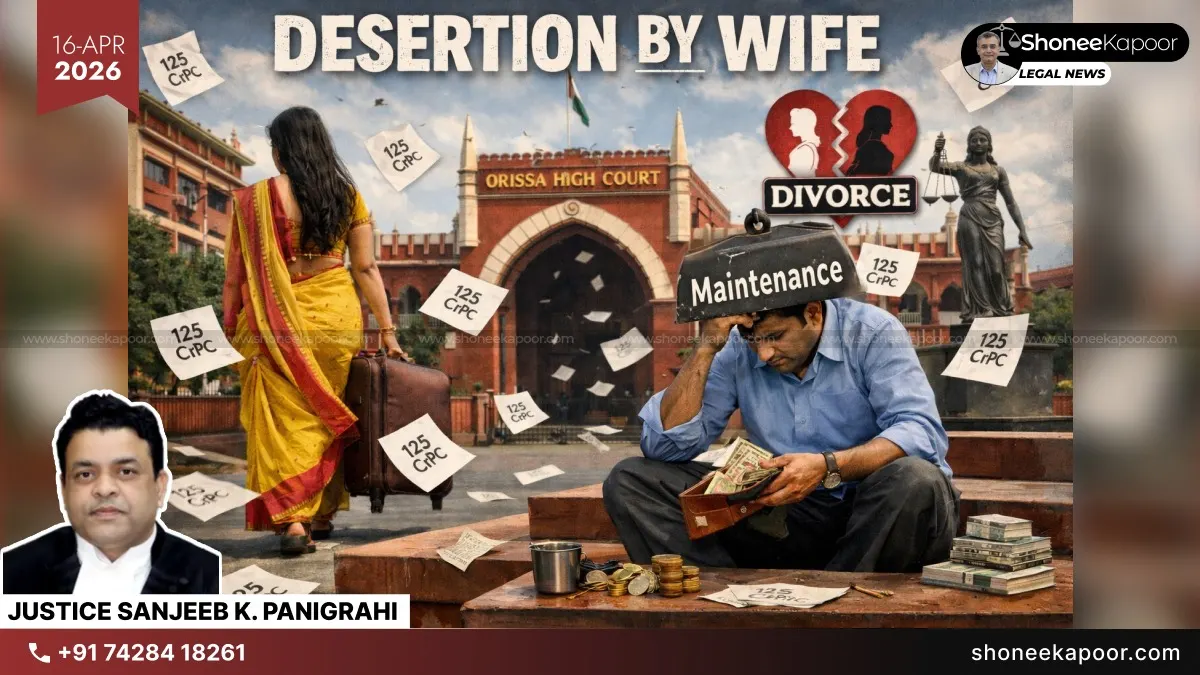
Wife leaves within weeks of marriage, husband gets divorce—still has to pay maintenance? Does law ignore fault and continue financial liability even after desertion is proved?
CUTTACK: The Orissa High Court said that even if a husband gets divorce on the ground of desertion by the wife, he cannot automatically stop paying maintenance to her.
The Court made it clear that divorce on the ground of desertion does not itself end the wife’s right to claim maintenance after divorce.
The Bench of Justice Sanjeeb Kumar Panigrahi observed:
“Under the BNSS, the maintenance provision stands renumbered as Section 144. The Explanation continues to include within the expression “wife” a divorced woman who has not remarried… In view of the above authorities, the legal position is clear that the decree of divorce on the ground of desertion does not, by itself, create a statutory bar to post-divorce maintenance. Therefore, the petitioner cannot succeed on the broad proposition that the present proceeding is inherently non-maintainable merely because the finding of desertion has attained finality.”
The case involved a marriage performed in 2003, where the wife allegedly left the matrimonial home within just over a month and never returned. Despite this, multiple legal proceedings continued for years.
During the divorce case, the wife was granted interim maintenance. Due to non-payment by the husband, his defence was struck off, and his divorce petition was initially dismissed. Later, in separate proceedings under Section 125 CrPC, the wife was granted ₹20,000 per month as maintenance.
Eventually, the High Court granted divorce to the husband in 2023 on the ground of desertion and noted that the amounts already paid would be treated as permanent alimony. Based on this, the husband stopped paying maintenance from November 2023.
However, the wife again approached the court seeking post-divorce maintenance under the newly renumbered Section 144 BNSS. The husband challenged this, arguing that once desertion is proved and divorce is granted, maintenance should not continue.
The Court examined whether desertion can bar maintenance under law and whether earlier observations about permanent alimony automatically cancel maintenance orders.
Relying on judgments such as Rohtash Singh v. Ramendri and Dr. Swapan Kumar Banerjee v. State of West Bengal, the Court reiterated that even a divorced woman falls within the definition of “wife” for maintenance purposes, and desertion alone is not enough to deny maintenance.
On the issue of whether earlier payments amount to permanent alimony and end future liability, the Court refused to decide it at this stage and stated:
“The petitioner has full liberty to raise all objections available in law before that forum, including objections founded on the divorce decree, the observation regarding permanent alimony, the payments already made, the plea of satisfaction or adjustment, and the statutory consequence flowing from Section 146 BNSS or any other applicable provision…Where the dispute is whether an earlier final maintenance order survives, stands satisfied, or requires variation in view of subsequent matrimonial adjudication, the proper course is to permit the competent court to examine the matter on its own statutory terms rather than foreclose the inquiry at threshold.”
The Court ultimately allowed the husband to approach the Family Court under Section 127 CrPC (now Section 146 BNSS) to seek cancellation or modification of the maintenance order, instead of stopping it unilaterally.
This judgment once again highlights how, under Indian law, financial liability of a husband may continue even after proving desertion by the wife, unless specifically modified or cancelled by a competent court.
Explanatory Table – Laws & Sections Involved
| Provision | Statute | Purpose | Court’s Interpretation in This Case |
| Section 125 CrPC | Code of Criminal Procedure, 1973 | Maintenance to wife, children, parents | Continues even after divorce; includes divorced wife |
| Section 125(4) CrPC | CrPC | Bars maintenance if wife refuses to live with husband without reason | Not applicable after divorce; cannot be used to deny post-divorce maintenance |
| Section 127 CrPC | CrPC | Alteration/cancellation of maintenance | Proper remedy for husband to seek modification |
| Section 144 BNSS | Bharatiya Nagarik Suraksha Sanhita, 2023 | Replacement of Section 125 CrPC | Same scope; includes divorced wife |
| Section 144(4) BNSS | BNSS | Equivalent of Section 125(4) CrPC | Cannot bar maintenance post-divorce |
| Section 146 BNSS | BNSS | Cancellation/variation after civil court decisions | Proper mechanism to adjust maintenance after divorce/alimony |
| Section 528 BNSS | BNSS | Inherent powers of High Court | Cannot be used to prematurely quash maintenance proceedings |
| Section 482 CrPC | CrPC | Inherent powers of High Court | Limited use; not for factual adjudication at initial stage |
| Section 24 HMA | Hindu Marriage Act | Interim maintenance during pendency | Wife was granted pendente lite maintenance |
| Section 25 HMA | Hindu Marriage Act | Permanent alimony | Court held no formal adjudication here; issue remains open |
| Section 9 HMA | Hindu Marriage Act | Restitution of conjugal rights | Wife earlier succeeded before Family Court |
Case Details
- Case Title: Dr. Deepak Padhi v. Gayatri Panda
- Court: High Court of Orissa at Cuttack
- Case Number: CRLMC No. 3213 of 2025
- Bench (Coram): Dr. Justice Sanjeeb K. Panigrahi
- Date of Hearing: 17.03.2026
- Date of Judgment: 31.03.2026
Counsels
- For Petitioner: Ms. Deepali Mohapatra, Advocate
- For Opposite Party: Mr. Bhawani Sankar Panigrahi, Advocate
Key Takeaways
- Even after proving desertion by wife, a man is still legally bound to pay maintenance—fault becomes irrelevant once money is involved.
- Law treats a divorced woman as “wife” for maintenance, effectively extending liability indefinitely unless remarriage or court modification occurs.
- Courts separate matrimonial fault from financial liability, creating a one-sided burden where men carry consequences despite winning the case.
- “Permanent alimony” observations do not automatically end maintenance—men must re-litigate again, increasing legal harassment and cost.
- The system forces men into continuous litigation cycles, where even a final divorce decree does not provide real closure or financial certainty.
This Could Change Your Case-Get FREE Legal Advice-Click Here!
Disclaimer: The views and opinions expressed in this article are those of the Indian courts and do not necessarily reflect the official policy or position of “ShoneeKapoor.com” or its affiliates. This article is intended for informational and educational purposes only. The content provided is not legal advice, and viewers should not act upon this information without seeking professional counsel. Viewer discretion is advised.
