
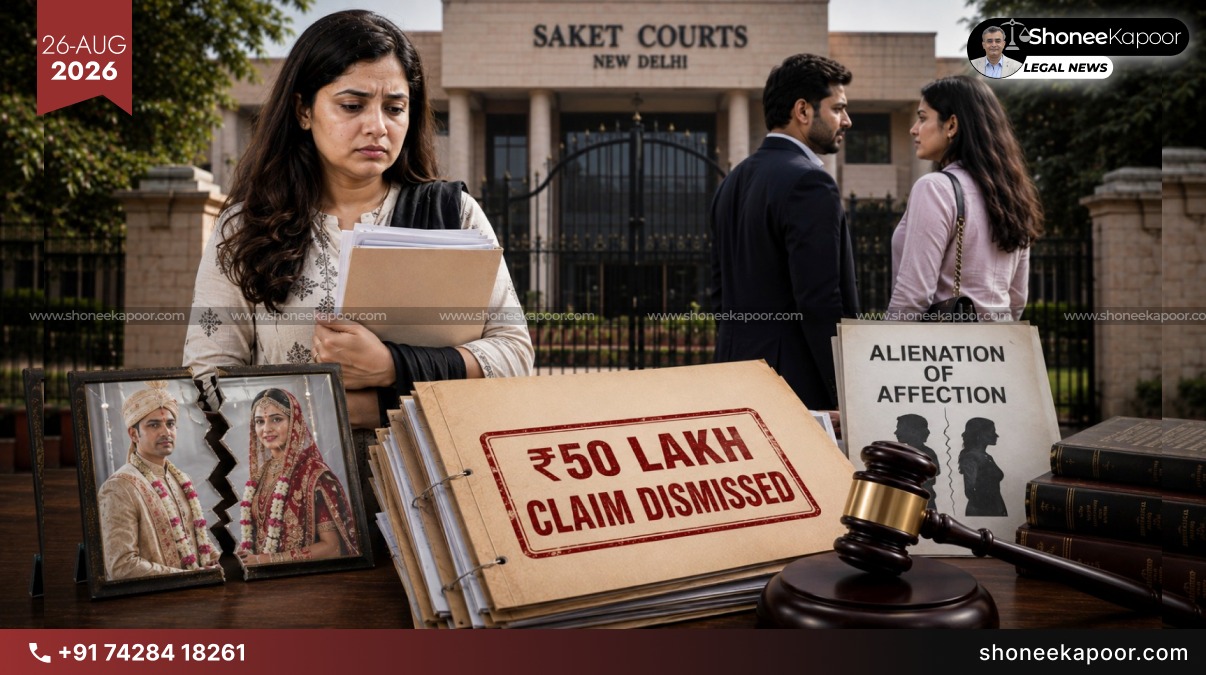
₹50 Lakh for ‘Stealing’ Her Husband’s Affection? Delhi Court Dismisses Wife’s Claim, Says Mere Allegations Were Not Enough

Curated by NEWS DESK
Editorial DeskThe Court examined whether an alleged extramarital relationship was enough to impose civil liability on a third party. What ultimately defeated the ₹50 lakh damages claim was the lack of proof of deliberate interference in the marriage.
NEW DELHI: A Delhi court has dismissed a woman's suit seeking ₹50 lakh damages from her husband's alleged extramarital partner, whom she accused of “stealing” her husband's affection and destroying their marriage.
District Judge Atul Ahlawat, District Judge-03, South-East District, Saket Courts, New Delhi, held on 20 August 2026 that the wife failed to establish that the other woman had actively induced, encouraged or intentionally caused the husband to withdraw from the marriage.
The Court said:
“Merely because two consenting adults had entered into a consensual sexual relationship outside the marriage and it led to the birth of a child, does not in itself establish the requirements with respect to the ingredients of the present tort of AoA,”
The case arose from the marriage of Pooja Sharma Bajaj and Kunal Bajaj, who married on 30 November 2001. According to the wife's case, her husband developed an extramarital relationship with Abheepsa Gupta after a trip to the United States in 2009 and finally left the matrimonial home in January 2013.
She further alleged that Kunal Bajaj and Abheepsa Gupta contracted a bigamous marriage in 2015 and had a daughter in September 2016. She claimed that Gupta knew Kunal was already married but nevertheless intentionally interfered in the marriage and caused her loss of companionship, mental trauma and financial difficulties.
The wife had originally claimed ₹1 crore as damages, along with interest. The amount was later reduced to ₹50 lakh. The court made her husband a pro forma defendant and did not seek damages from him.
The claim was based on the common law tort of Alienation of Affection (AoA), commonly described as a “heart-balm” action. Such a claim seeks compensation from a third person who intentionally interferes with a marriage and causes one spouse to lose the affection and companionship of the other.
The Court noted that Alienation of Affection has not been enacted as a statutory tort in India. However, the concept has received judicial recognition, particularly through the Supreme Court's observations in Pinakin Mahipatray Rawal v. State of Gujarat.
For such a claim, merely proving an affair is not sufficient. The claimant must establish that genuine love and affection existed between the spouses before the alleged interference, that this affection was destroyed, and that the third party's intentional or wrongful conduct directly caused its destruction.
The Court found a key problem with the wife's case: the evidence did not sufficiently establish that a loving and affectionate marital relationship existed immediately before the alleged third-party interference.
During cross-examination, the wife admitted that there had been instances of physical, emotional and mental abuse in the marriage. She also stated that her husband had denied her physical intimacy for most of the marriage after the initial two or three years.
The Court further found no cogent direct evidence showing that the alleged affair partner had actively induced the husband to leave the marriage. The wife's suspicion and information allegedly received from her driver could not substitute for legally acceptable proof, particularly as the driver had died before his evidence could be recorded.
The Court also drew a significant distinction between a spouse's legal duty and a third party's position. It observed that the obligation arising from the conjugal relationship rested upon the husband and could not automatically be imposed upon the other woman.
The Court said:
“There was no corresponding duty upon her to thwart away any advances made by the defendant no. 2, since the corresponding duty of conjugal relationship rested only on the defendant no. 2 and the defendant no. 1 cannot be saddled with such an obligation under the law,”
However, the Court did not accept the defendants' contention that the suit was barred by limitation. It treated alienation of affection as a continuing wrong for the purpose of Section 22 of the Limitation Act, 1963, meaning a fresh period of limitation continues to run during the continuance of the alleged wrong.
Ultimately, the wife failed to prove the essential ingredients necessary to establish the tort of Alienation of Affection. The court dismissed her ₹50 lakh damages claim.
EXPLANATORY TABLE OF LAWS AND SECTIONS
| Law / Provision | What It Means In This Case |
|---|---|
| Tort of Alienation of Affection (AoA) | A common-law claim alleging intentional third-party interference in a marriage. India has not expressly enacted it as a statutory tort. Active and intentional interference must be proved; an affair alone is insufficient. |
| Section 22, Limitation Act, 1963 | Deals with continuing breaches and continuing torts. The Court treated the alleged alienation of affection as a continuing wrong for limitation purposes. |
| Order VI Rule 17, CPC, 1908 | Allows amendment of pleadings. The plaintiff used this provision while amending her claim, which was ultimately reduced from ₹1 crore to ₹50 lakh. |
| Section 3, Indian Evidence Act, 1872 | Concerns the meaning of evidence and proof. The Court examined whether the plaintiff had produced legally sufficient material to establish the alleged interference. |
| Section 114(g), Indian Evidence Act, 1872 / Section 119(g), BSA, 2023 | Concerns adverse inference where relevant evidence is withheld. The plaintiff invoked this principle because the defendants did not enter the witness box. |
| Section 63(B), Bharatiya Sakshya Adhiniyam, 2023 | Relevant to the electronic evidence affidavit produced by the plaintiff with electronic records. |
| Section 494 IPC | Deals with marrying again during the lifetime of a spouse in circumstances where the second marriage is void. Bigamy allegations existed in connected proceedings, but the present Court was deciding the damages claim for Alienation of Affection. |
| Section 406 IPC | Deals with criminal breach of trust. A complaint under Sections 494 and 406 formed part of the documents relied upon in the litigation. |
| Section 354D IPC | Deals with stalking. The defendants alleged that private detectives had been engaged to follow the first defendant; this was part of their defence, not the issue finally decided in the damages suit. |
| Section 498A IPC | Deals with cruelty by a husband or his relatives. It arose while the Court discussed the Supreme Court's Pinakin Mahipatray Rawal judgment and the development of Alienation of Affection jurisprudence. |
| Section 306 IPC | Deals with abetment of suicide. It was also relevant through the Pinakin Mahipatray Rawal precedent discussed by the Court. |
| Section 497 IPC | The former adultery offence, struck down by the Supreme Court in Joseph Shine v. Union of India. The Court referred to this while explaining that an extramarital relationship itself is no longer criminalised under this provision. |
CASE DETAILS
| Particular | Details |
|---|---|
| Case Title | Pooja Sharma Bajaj v. Abheepsa Gupta & Anr. |
| Court | Court of District Judge-03, South-East District, Saket Courts, New Delhi |
| Bench | District Judge Atul Ahlawat, DHJS |
| Case Number | CS DJ No. 158/2024 |
| Date of Judgment | 20 August 2026 |
| Plaintiff | Pooja Sharma Bajaj |
| Defendants | Abheepsa Gupta and Kunal Bajaj |
| Counsel for Plaintiff | Ramakant Sharma and Prateek Avasthi |
| Counsel for Defendants | Bijaharini G, Reaa Mehta and Aditya Sarma |
KEY TAKEAWAYS
- An affair alone does not prove ₹50 lakh liability. Evidence of active interference is essential.
- Suspicion cannot replace proof, even in emotionally charged matrimonial disputes.
- The Court found that marital obligations rested on the husband, not automatically on the alleged third party.
- A broken marriage cannot become a licence to convert allegations into massive monetary claims.
- Matrimonial litigation must remain evidence-based; accusation, emotion and moral outrage are not legal proof.
Share Your Thoughts
Comments are moderated before publication.