
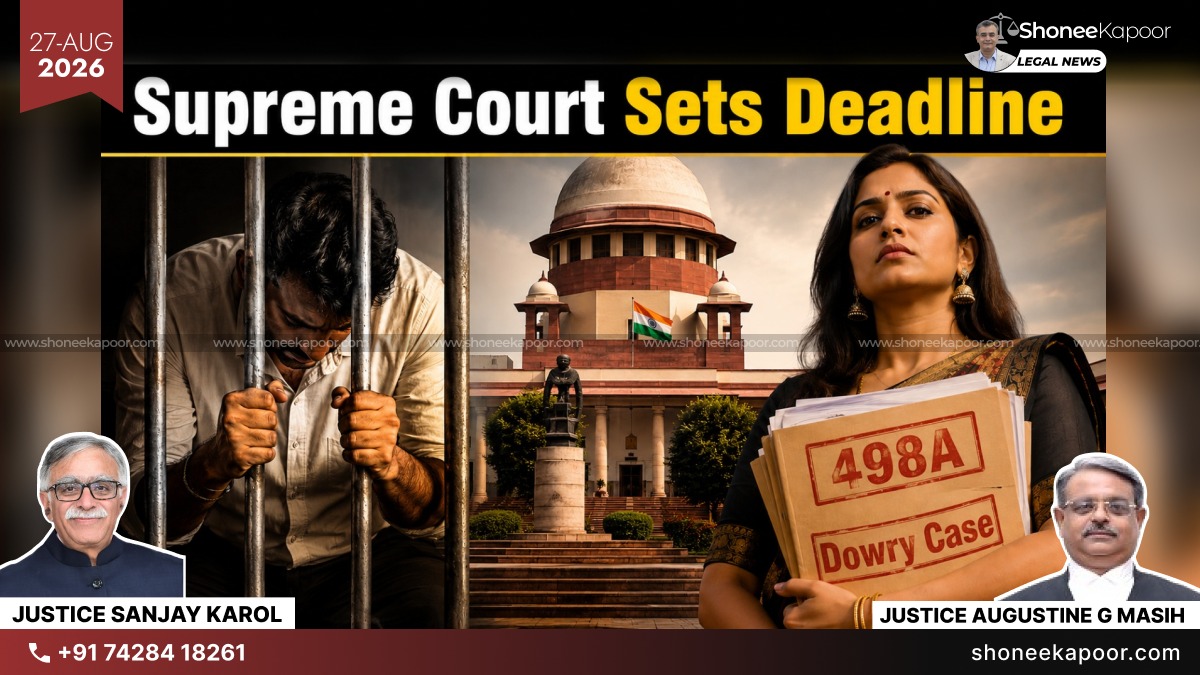
498A & Dowry Trials Put On Fast Track: Supreme Court Says Frame Charges Within 60–90 Days, Stop Needless Adjournments

Written and analysed by Vaibhav Ojha
Head Of Legal Communications
Can 498A and dowry cases continue for years without charges being framed or evidence moving forward? The Supreme Court has now issued detailed directions for faster trials, fewer adjournments and regular monitoring of old cases.
NEW DELHI: The Supreme Court has issued a set of directions to speed up trials involving dowry death and cruelty allegations and to strengthen the implementation of dowry-related laws across the country.
A Bench of Justice Sanjay Karol and Justice Augustine George Masih passed the directions on August 20, 2026, while considering compliance with its earlier judgment in State of Uttar Pradesh v. Ajmal Beg Etc. The Court dealt with delays in cases under Sections 304B and 498A of the Indian Penal Code, corresponding Sections 80 and 85 of the Bharatiya Nyaya Sanhita, 2023, and the Dowry Prohibition Act, 1961.
The Court directed that such cases should, as far as practicable, be treated on priority. District courts have been asked to identify cases pending for more than three years, especially those stuck at the stage of framing of charges or recording of evidence, and regularly monitor their progress.
One of the important directions concerns the time taken to frame charges. Trial courts should endeavour to frame charges within 60 to 90 days from the filing of the chargesheet. Once charges are framed, recording of evidence should start within a reasonable time and, as far as possible, continue without unnecessary breaks or on a day-to-day basis.
The Court also sought to control repeated adjournments, which can keep criminal proceedings pending for years. Trial courts have been asked to discourage unnecessary adjournments and record reasons whenever an adjournment is granted. If the accused's lawyer repeatedly remains absent without sufficient cause, the court may appoint a legal aid lawyer or an amicus to ensure that the trial does not remain stalled.
"At the same time, the Court's earlier directions had specifically recognised the need to train police and judicial officers so that they can properly understand the social and psychological aspects of such cases. The December 2025 judgment said such training would help ensure sensitivity towards "genuine cases versus those which are frivolous and abusive of the process of law."
Trial courts have also been asked to prepare calendars for examining important witnesses after charges are framed. Investigating agencies must ensure timely service of summons and production of witnesses so that evidence is not repeatedly delayed.
Technology will also be used to identify old cases. High Courts have been asked to use existing court-management systems, as far as possible, to monitor the stage-wise pendency of dowry-related cases and generate alerts for matters that have remained pending for a long time.
High Courts should also periodically review old criminal appeals, revisions, petitions under Section 482 CrPC or Section 528 BNSS and bail matters involving dowry-related offences. Particular attention has to be given to cases where trial proceedings have remained stayed for a long period. Stay orders may also be periodically reviewed in accordance with law.
The Supreme Court further directed States, Union Territories and High Courts to ensure regular training and sensitisation of judicial officers, police officials, prosecutors, protection officers, counsellors and other stakeholders dealing with such offences.
States may also consider appointing prosecutors who have experience in handling offences against women for prosecutions under Sections 304B and 498A IPC.
The directions also recognise that not every matrimonial dispute is of the same nature. In disputes mainly arising from matrimonial discord, where there are no allegations of death, grievous physical violence or other serious offences, courts may consider mediation or counselling wherever legally permissible and appropriate. Such a process must not compromise the rights of the parties or dilute the seriousness of cognizable offences.
States and Union Territories have also been asked to strengthen support systems, including one-stop centres, family counselling centres, women help desks, victim assistance mechanisms, helplines and online grievance systems. Awareness programmes concerning dowry, gender equality, constitutional values and women's rights are also to be conducted.
The Court has further directed High Courts and States and Union Territories to submit periodic status and compliance reports until there is a substantial reduction in the pendency of cases under Sections 304B and 498A IPC, corresponding Sections 80 and 85 BNS and the Dowry Prohibition Act.
These reports are required to contain details regarding pending and disposed cases, the stages at which cases remain pending, awareness initiatives, appointment or designation of Dowry Prohibition Officers, training programmes and other measures taken pursuant to the Court's directions. The reports are to be filed on January 15, May 15 and September 15.
The latest directions arise from the Supreme Court's December 15, 2025 judgment in State of Uttar Pradesh v. Ajmal Beg Etc., reported as 2025 INSC 1435. That case concerned the death of a 20-year-old woman who had been married for a little over a year. The prosecution case involved demands for a colour television, motorcycle and ₹15,000.
The trial court convicted her husband Ajmal Beg and his mother Jamila Beg under Sections 304B and 498A IPC and Sections 3 and 4 of the Dowry Prohibition Act. The Allahabad High Court subsequently set aside their convictions and acquitted them.
The Supreme Court later reversed the High Court's decision and restored the convictions, finding that the High Court had erred while assessing the evidence. The Supreme Court observed:
"So, the demand by Ajmal and/or his family members for a colour TV, a motorcycle and Rs.15,000/- in cash, unquestionably constitutes dowry."
While dealing with one of the reasons relied upon for acquittal, the Court further observed:
"Yet another reason given by the High Court for acquittal was that since Ajmal and his family members were poor, they could not have made such demand because even if they managed to procure the same, they had no means of maintaining the said goods. Suffice it to say that this reason does not appeal to reason."
The Supreme Court also said:
"We may also observe that, while reversing the findings of facts returned by the Trial Court, the High Court has not assigned any reasons explicitly holding such findings to be erroneous/perverse or illegal."
The original criminal case dated back to 2001 and ultimately took about 24 years to reach its conclusion before the Supreme Court. This long delay became an important reason for the Court to seek data on old dowry death and cruelty cases and push for their faster disposal.
In the December 2025 judgment, the Supreme Court had also asked governments to consider suitable changes in educational curricula to reinforce the constitutional principle that both parties to a marriage are equal. It further directed authorities to ensure that Dowry Prohibition Officers are properly appointed, equipped to perform their duties and made accessible to citizens.
On the wider need for public awareness, the Court had observed:
"We also recognize that many people today are/have been outside the education fold, and that it is equally, if not more so, important to reach them and make accessible and comprehensible, the relevant information regarding the act of giving or taking of dowry as also other acts sometimes associated therewith, other times independent thereof (mental and physical cruelty) is an offence in law."
The Court further requested District Administrations and District Legal Services Authorities to conduct regular awareness programmes with civil society organisations and social activists:
"This is to ensure change at the grassroot level."
Following the December 2025 judgment, several High Courts, States and Union Territories filed affidavits and data before the Supreme Court. The material was consolidated and examined before the latest directions were issued.
The directions therefore seek not only faster disposal but closer monitoring of criminal proceedings. For accused husbands and family members as well as complainants, prolonged proceedings can themselves carry serious consequences. A system that frames charges promptly, records evidence without avoidable delay and identifies frivolous or abusive proceedings at the appropriate stage can help ensure that criminal law reaches a conclusion based on evidence rather than leaving either side trapped in litigation for years.
The Supreme Court has listed the matter for October 15, 2026, for further consideration along with the compliance and periodic reports.
EXPLANATORY TABLE OF ALL IMPORTANT LAWS & SECTIONS
| LAW / SECTION | WHAT IT MEANS | HOW IT OPERATES IN THIS CASE |
|---|---|---|
| Section 304B IPC | Creates the offence of dowry death where the statutory ingredients are satisfied, including an unnatural death of a married woman within seven years of marriage coupled with qualifying dowry-related cruelty/harassment soon before death. | One of the principal offences involved in the original prosecution. The Supreme Court's directions now require courts to prioritise and monitor such cases. |
| Section 498A IPC | Punishes cruelty by the husband or his relatives against a married woman. “Cruelty” has a specific statutory meaning and is not established merely by every matrimonial disagreement. | The original accused were convicted under this provision. The August 2026 directions specifically target delays in 498A prosecutions. |
| Section 80 BNS, 2023 | The BNS provision corresponding broadly to the former Section 304B IPC, dealing with dowry death. | The Court expressly pairs Section 304B IPC with Section 80 BNS while framing directions applicable to current cases. |
| Section 85 BNS, 2023 | Penal provision concerning cruelty by a husband or relative of husband against a woman, corresponding to the former Section 498A IPC framework. | Included alongside Section 498A in the priority, monitoring and compliance directions. |
| Dowry Prohibition Act, 1961 | Central legislation prohibiting giving, taking and demanding dowry and creating the statutory enforcement framework against dowry. | The Court found continuing implementation problems and directed stronger institutional enforcement, including effective functioning of Dowry Prohibition Officers. |
| Section 309 CrPC | Governs adjournment/postponement of criminal proceedings and supports expeditious continuation of evidence once examination has begun, subject to law. | The Supreme Court relied on it while directing that evidence should, as far as practicable, proceed continuously or day-to-day. |
| Section 346 BNSS, 2023 | BNSS provision corresponding to the criminal-procedure framework for adjournment/postponement and continuous conduct of proceedings. | The Court expressly invoked Section 346 BNSS alongside Section 309 CrPC for continuous/day-to-day recording of evidence. |
| Section 482 CrPC | Preserves the High Court's inherent powers to prevent abuse of process and secure the ends of justice. It was frequently invoked for quashing criminal proceedings. | High Courts have been directed to periodically review old pending Section 482 matters involving dowry-related offences, particularly where trials have been stayed. |
| Section 528 BNSS, 2023 | Preserves the High Court's inherent powers under the new criminal-procedure regime, broadly corresponding to Section 482 CrPC. | Old pending Section 528 petitions involving these offences are also to be periodically reviewed for expeditious disposal. |
CASE DETAILS
| PARTICULAR | DETAILS |
|---|---|
| Case Title | The State of Uttar Pradesh v. Ajmal Beg Etc. |
| Court | Supreme Court of India |
| Jurisdiction | Criminal Appellate Jurisdiction |
| Proceeding | Miscellaneous Application Nos. 2689-2690 of 2025 |
| In | Criminal Appeal Nos. 132-133 of 2017 |
| Applicant/Appellant | State of Uttar Pradesh |
| Respondents | Ajmal Beg Etc. |
| Order Date | 20 August 2026 |
| Bench | Justice Sanjay Karol and Justice Augustine George Masih |
| Next Listing | 15 October 2026, with compliance-cum-periodic reports |
KEY TAKEAWAYS
- 498A and dowry cases will get priority, increasing pressure on accused husbands and families to prepare their defence early.
- Charges should preferably be considered within 60–90 days, so men cannot assume the case will remain stuck for years before trial begins.
- Unnecessary adjournments are to be discouraged, meaning criminal proceedings can move rapidly once charges are framed.
- Old 498A and dowry cases pending beyond three years will face greater monitoring, including cases stalled at charge or evidence stage.
- Most importantly, the Supreme Court itself recognised the need to distinguish genuine cases from those that are “frivolous and abusive of the process of law.” Speedy justice cannot mean speedy punishment of innocent men.
Share Your Thoughts
Comments are moderated before publication.