
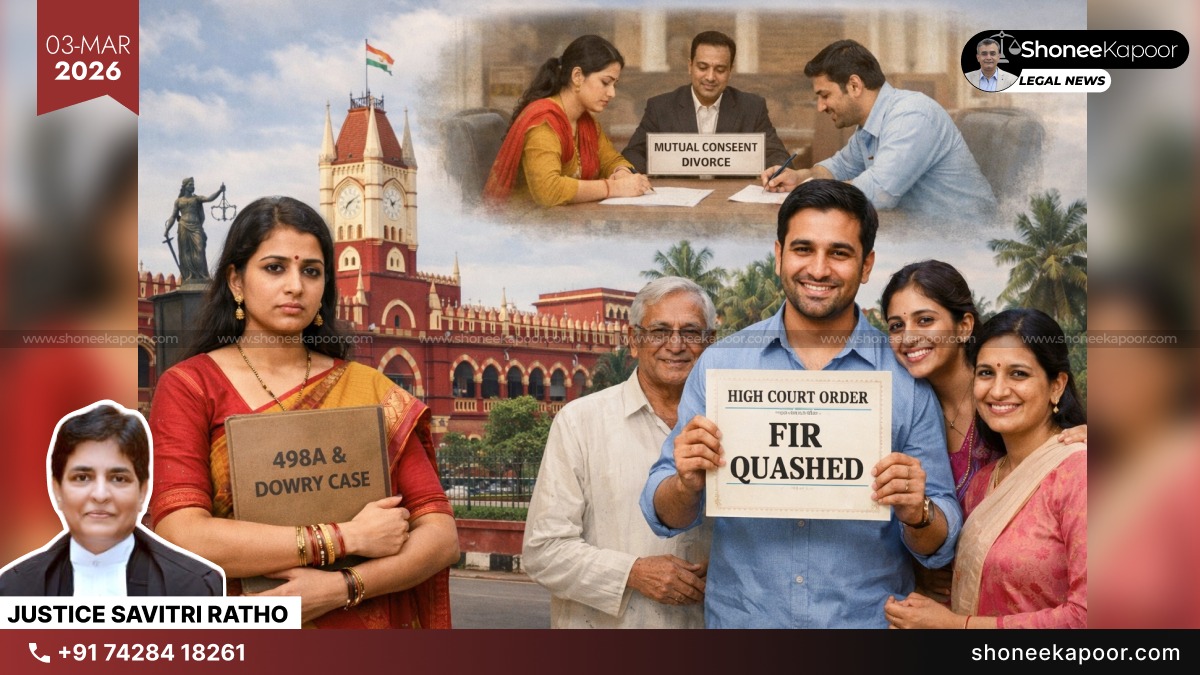
Can a criminal trial continue even after both spouses legally part ways? The Orissa High Court answers this sharply: once a marriage ends by mutual consent, keeping a decade-old 498A case alive serves no purpose.
CUTTACK: Justice Savitri Ratho of the Orissa High Court at Cuttack quashed a criminal case filed under Sections 498A/34 IPC and Section 4 of the Dowry Prohibition Act after noting that the husband and wife had already dissolved their marriage by mutual consent.
The case was pending for several years before the SDJM, Puri, and arose from allegations of dowry demand and threats made by the wife.
As per the complaint, the husband and his family members were accused of demanding Rs 5 lakhs as dowry and threatening the wife when the full amount was not arranged. Based on these allegations, a police case was registered in 2012. The husband and his relatives approached the High Court seeking quashing of the proceedings, stating that the dispute was matrimonial in nature and had already been settled.
During the hearing, it was placed before the Court that both parties had filed a joint petition for divorce by mutual consent and that the Family Court had already granted a decree dissolving their marriage. The High Court reproduced the operative portion of the Family Court’s order as:
“ORDER
The joint petition filed by the petitioner (wife) and respondent (husband) for dissolution of their marriage by a decree of divorce by mutual consent is hereby allowed. Their marriage solemnized on 16.2.2005 is hereby dissolved by a decree of divorce with effect from the date of the decree. Both the parties are free in all respect from that date.”
After examining the background of the case, Justice Savitri Ratho observed that the parties had settled their differences and that the marriage stood dissolved. The Court noted:
“From this, it is apparent that the Petitioner No.1 and Opposite Party No.2 had settled their differences and agreed for dissolving their marriage by mutual consent. Almost ten years have elapsed in the meanwhile.”
The Court further held:
“On a careful examination of the background facts, keeping in mind the decisions of the Supreme Court and as the marriage between the Petitioner No.1 and Opposite Party No.2 has been dissolved by a decree of divorce on mutual consent under Section 13B of the Hindu Marriage Act, I am of the opinion that no useful purpose would be served to keep G.R. Case No. 626 of 2012 in the Court of the learned S.D.J.M., Puri pending any further.”
With these findings, the Orissa High Court allowed the petition and formally quashed the criminal proceedings, bringing an end to the long-pending matrimonial litigation.
Explanatory Table: Laws And Sections Involved
| Law / Section | Purpose | How Applied in This Case |
| IPC Section 498A | Deals with cruelty by husband or his relatives | FIR was registered alleging dowry harassment and cruelty against the husband and his family |
| IPC Section 34 | Fixes joint liability when act is done with common intention | Used to implicate multiple family members together |
| Dowry Prohibition Act, Section 4 | Punishes demand for dowry | Allegation of demand of Rs 5,00,000 for business purposes |
| CrPC Section 482 | Gives High Court inherent power to prevent abuse of process and secure justice | High Court used this power to quash the criminal proceedings |
| Hindu Marriage Act, Section 13B | Provides for divorce by mutual consent | Parties had already dissolved their marriage through mutual consent before quashing |
| CrPC Section 397 | Provides revisional jurisdiction of High Court | Mentioned in judicial context regarding scope of interference |
| Article 142, Constitution of India | Empowers Supreme Court to pass orders for complete justice | Referred in discussion on quashing matrimonial disputes |
Case Details
- Case Title: Husband & Others v. State of Odisha & Another
- Case Number: CRLMC No. 4110 of 2015
- Court: High Court of Orissa at Cuttack
- Bench: Hon’ble Miss Justice Savitri Ratho
- Date of Judgment: 03 February 2026
- Counsels:
- For Petitioners: Mr. D.K. Swain, Advocate
- For Opposite Party No.1 (State): Mr. Raj Bhusan Dash, A.S.C
Key Takeaways
- If husband and wife have already taken mutual divorce and settled disputes, criminal cases arising purely from matrimonial conflict can be quashed by the High Court.
- Section 498A and dowry cases cannot be allowed to continue endlessly once the marriage itself has legally ended and parties have moved on.
- High Courts have strong powers under Section 482 CrPC to stop misuse of criminal law and prevent unnecessary harassment.
- Long-pending matrimonial prosecutions, especially after settlement, serve no real purpose except prolonging mental, financial and professional damage.
- This judgment reinforces that criminal law should not be used as a pressure tactic in failed marriages once disputes are resolved and divorce is granted.
This Could Change Your Case-Get FREE Legal Advice-Click Here!
Disclaimer: The views and opinions expressed in this article are those of the Indian courts and do not necessarily reflect the official policy or position of “ShoneeKapoor.com” or its affiliates. This article is intended for informational and educational purposes only. The content provided is not legal advice, and viewers should not act upon this information without seeking professional counsel. Viewer discretion is advised.
