
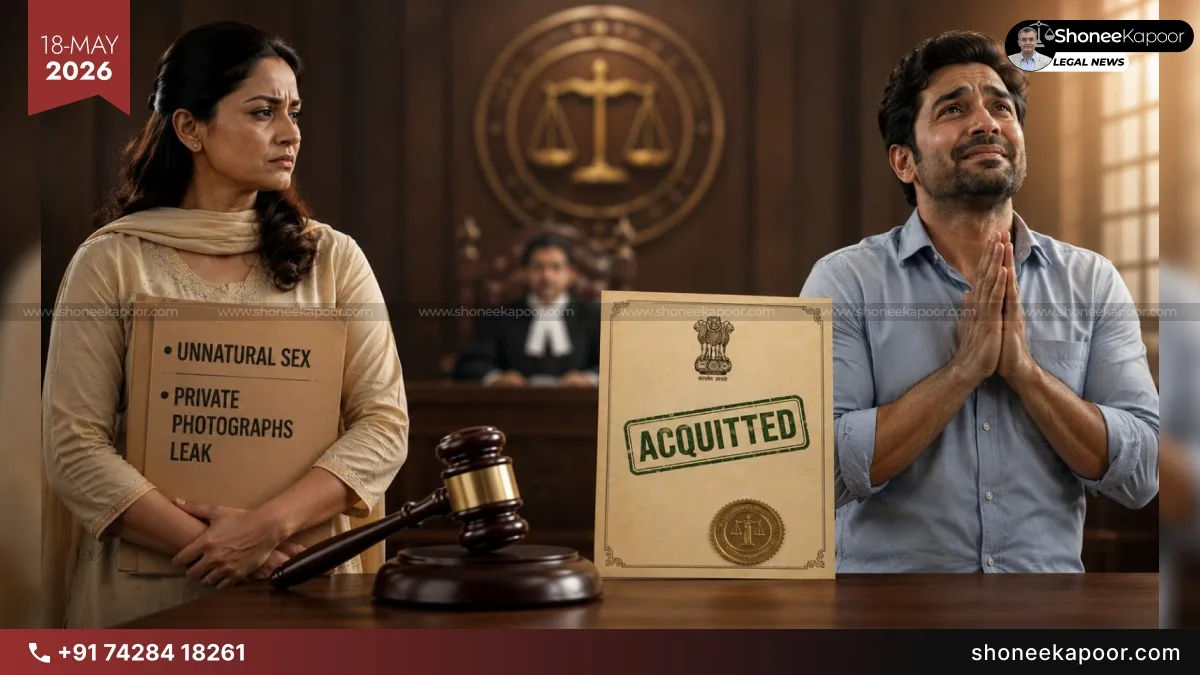
Were serious criminal charges built only on inconsistent statements and weak electronic evidence? The Bengaluru Court said conviction cannot happen without clear proof, medical support and authentic digital evidence.
BENGALURU: The Additional Chief Judicial Magistrate Court, Bengaluru, presided over by Judge Girish Chatni, acquitted a man accused under Sections 498A, 377 and 201 IPC along with Sections 66E and 67 of the Information Technology Act in a matrimonial dispute filed by his wife.
The complainant alleged that after their marriage in 2015, the accused forced her into unnatural sex, mentally harassed her and later circulated her private photographs through Facebook and WhatsApp without consent. The prosecution claimed the couple had met while studying at IIT Mumbai and later married in Bengaluru through Arya Samaj and Christian ceremonies.
During trial, however, the Court found major inconsistencies in the complainant’s statements given at different stages of the case. The judgment noted that several important allegations were either changed, expanded or introduced later. The Court also observed contradictions regarding consent, frequency of alleged acts, timelines and surrounding events.
While discussing the law after the Supreme Court’s judgment in Navtej Singh Johar v. Union of India, the Court clarified that consensual sexual acts between adults are not criminal offences and that absence of consent must be clearly proved.
The Court relied on the Supreme Court judgment in Rai Sandeep @ Deepu v. State (NCT of Delhi) and reproduced the following observation:
“In our considered opinion, the ‘sterling witness’ should be of a very high quality and calibre whose version should, therefore, be unassailable.”
The Court further quoted:
“What would be more relevant would be the consistency of the statement right from the starting point till the end…”
It also reproduced:
“Only if the version of such a witness qualifies the above test… it can be held that such a witness can be called as a ‘sterling witness’ whose version can be accepted by the Court without any corroboration…”
After analysing the evidence, the Court held that the complainant’s testimony did not meet this standard because of material contradictions and improvements made over time.
The Court also noted that despite allegations of repeated painful anal intercourse, the complainant never sought immediate medical treatment, even though hospitals were available in Bengaluru and IIT Bombay. The medical examination conducted later reportedly found no injuries. The doctor recorded:
“No injury seen in all over body. No injury seen in private parts. No injury seen in anus. No bleeding. No discharge.”
The medical opinion further stated:
“No definite opinion can be given about anal sex.”
The Court held that the prosecution failed to provide reliable medical, electronic or independent corroboration for the allegations. Finding that the charges were not proved beyond reasonable doubt, the Court acquitted the accused of all offences.
Explanatory Table: Laws And Sections Involved
| Law / Section | Purpose | How Applied In This Case |
| Section 498A IPC | Punishes cruelty or harassment by husband or relatives | Wife alleged mental and physical cruelty; Court found insufficient proof. |
| Section 377 IPC | Punishes non-consensual unnatural sexual acts | Wife alleged forced anal sex; Court found contradictions and lack of evidence. |
| Section 201 IPC | Punishes destruction of evidence | Husband was accused of deleting accounts; allegation not proved. |
| Section 66E Information Technology Act | Protects privacy of private electronic images | Alleged sharing of private photos without consent; evidence found unreliable. |
| Section 67 Information Technology Act | Punishes electronic transmission of obscene material | Alleged circulation of nude photos; prosecution failed to prove offence. |
| Section 164 Cr.P.C. | Recording of statement before Magistrate | Court noted inconsistencies in statements. |
| Section 313 Cr.P.C. | Allows accused to explain evidence against him | Accused denied all allegations. |
| Special Marriage Act | Governs registered civil marriages | Marriage between parties was registered under this law. |
Case Details
- Case Title: State v. Husband
- Case Number: C.C. No. 57405/2019
- Court: Court Additional Chief Judicial Magistrate, Mayohall Unit, Bengaluru
- Judge: Sri Girish Chatni, XXIX Addl. Chief Judicial Magistrate
- Neutral Citation: KABC0C0260852019
- Date of Decision: 15 May 2026
- Counsels:
- For Prosecution: Learned Assistant Public Prosecutor
- For Accused: Sri S.S., Advocate
Key Takeaways
- A changing story and repeated contradictions can destroy even the most serious criminal allegation and raise doubts about the truthfulness of the case.
- Marriage does not take away a man’s right to fair investigation, proper evidence and proof beyond reasonable doubt before calling him guilty.
- Emotional allegations without medical records, reliable electronic evidence or independent corroboration cannot automatically become proof against a husband.
- Criminal law should protect genuine victims, not become a pressure tactic or weapon during failed marriages and matrimonial disputes.
- Consistency in testimony, credibility of witnesses and strong evidence will always matter more than sensational allegations and emotional narratives.
This Could Change Your Case-Get FREE Legal Advice-Click Here!
Disclaimer: The views and opinions expressed in this article are those of the Indian courts and do not necessarily reflect the official policy or position of “ShoneeKapoor.com” or its affiliates. This article is intended for informational and educational purposes only. The content provided is not legal advice, and viewers should not act upon this information without seeking professional counsel. Viewer discretion is advised.
