




For over 30 years, hard evidence has shown gender symmetry in partner violence. Still, governments fund shelters only for women, media frames every abuser as male, and policies silence male victims. Dr. Murray Straus’s research didn’t just challenge ideology; it exposed how “equality” ends when men need protection.
Introduction: Equal Blows, Unequal Blame
The story of domestic violence has been straightforward for decades: women suffer and men make them suffer. It became a social truth that was reiterated in courtrooms, classrooms, and campaigns until it was considered taboo to question it. Beneath that reassuring simplicity, however, is a truth so disturbing that even academics attempted to conceal it. Few people want to face the fact that men and women commit partner violence at nearly equal rates, according to more than 200 independent studies and thirty years of worldwide research led by sociologist Dr. Murray A. Straus. The difference lies not in who hits, but in who gets believed.
However, domestic violence is still treated as a “male-only crime” in every policy, news article, and court ruling. Male victims are not visible. The excuse for female offenders is reframed as “reacting in self-defence.” Researchers like Straus himself who dared to disagree were ridiculed, silenced, and even threatened.
This is about a system based on selective empathy, not just numbers. The silence is deafening when men are victims. The narrative vanishes when women are the ones who commit the crimes. Over time, what started out as a movement for justice has turned into a one-sided crusade that rejects the truth, defends ideology, and punishes men. Therefore, the question remains: If equality entails treating everyone fairly, why does it disappear the instant men bleed?
The Evidence They Tried to Bury: Men and Women Hit Equally
It is a myth that only men commit acts of aggression. The data contradicts this. The story was upended in 1975 by the U.S. National Family Violence Survey, one of the biggest and most reputable studies ever carried out. It was discovered that 11.6% of women and 12% of men had abused their partners. Almost the same. Even more shocking? Severe assaults, such as kicking, punching, choking, or hitting with objects, were reported by 4.6% of women and 3.8% of men. There was no statistically significant difference. Simply put, the likelihood of women using severe physical violence was equal to that of men.
However, rather than being discussed, this ground-breaking evidence which was published by reputable researchers Gelles, Straus, and Steinmetz was denied. The academic and activist worlds buried the narrative rather than changing it. While the matching numbers for “husband-beating” subtly vanished, the emphasis remained on “wife-beating.” Decades later, more than 200 studies conducted on different continents have confirmed the same pattern: Domestic violence is a mutual, human, and tragically common phenomenon that is not gendered. However, the question remains more pressing than ever: why are only men held accountable when women strike just as frequently?
Behind Closed Doors: The Truth They Couldn’t Face
The seminal study Behind Closed Doors: Violence in the American Family, written by Dr. Murray Straus and his associates in 1975, subtly altered the course of history. Within its pages lay a revelation that no one wanted to confront: the rates of partner violence are almost equal for men and women. The twist is that Straus himself initially failed to see the full ramifications. Like the majority of academics at the time, he viewed domestic violence through a feminist lens, viewing it as the result of female victimisation and male dominance.
His previous work, Sexual Inequality, Cultural Norms, and Wife-Beating” (1976), did not address partner violence, but rather “wife-beating.” Even the scientist who discovered gender symmetry was unable to recognise it at this time because the presumption was so ingrained.
Dr. Suzanne Steinmetz, Straus’s colleague, faced ridicule, harassment, and professional isolation when she dared to publish her 1977 paper, The Battered Husband Syndrome.
She was accused of fraud by her coworkers. At her daughter’s wedding, there were demonstrations, hate mail, and even a bomb threat. The message was unmistakable: some facts were too risky to be made public. However, the numbers continued to rise. The same pattern had already been confirmed by 23 separate studies by the mid-1980s, including two national surveys: Women hit their partners just as frequently as men do. And yet, public policy, academia, and media all continued to act as if the problem was one-directional.
The Turning Point
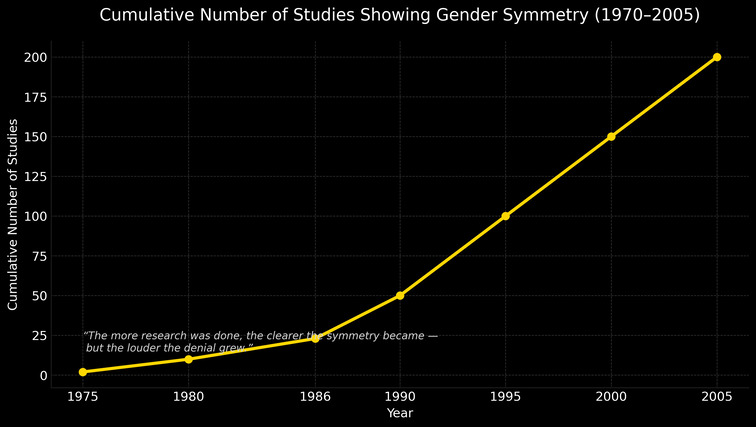
Straus went deeper rather than back away. In his subsequent writings, he pinpointed the psychological and social causes of partner violence, which are traits that both men and women share: jealousy, anger, control, power struggles, and learnt aggression. He realised what few were willing to acknowledge: Partner violence has many causes, and male dominance is just one of them. More than 200 studies demonstrating gender symmetry across nations, cultures, and age groups were later documented by meta-analyses conducted by Archer (2000) and Fiebert (2004). Still, most academics chose silence over confrontation, afraid that even acknowledging the data would make them targets.
Straus’s initial hesitancy demonstrates the strength of ideology, even when it triumphs over science. Decades, hundreds of studies, and individual bravery were required to publicly state what the data had been indicating since the 1970s: Violence in relationships is a human problem, not a problem specific to men or women.
Cumulative Number of Studies Showing Gender Symmetry (1970–2005)
Ten Major Studies Demonstrating Gender Symmetry in Partner Violence
| Study / Source | Men Perpetrators (%) | Women Perpetrators (%) | Key Finding |
|---|---|---|---|
| Brinkerhoff & Lupri (1988) – Canadian National Survey | 17.8 / 10.1 | 23.3 / 12.9 | Women slightly higher across all categories |
| Mihorean (2005) – Canadian General Social Survey | 7.0 | 8.0 | Gender parity |
| Mirrlees-Black (1999) – British Crime Survey | 4.2 | 4.1 | Near-perfect symmetry |
| Kessler et al. (2001) National Co-morbidity Study | 17.4 | 17.7 | Virtually equal perpetration |
| Straus (1995) – National Alcohol and Family Violence Survey | 6.5 / 9.1 / 6.2 | 9.5 / — / 9.5 | Women again higher in minor violence |
| Moffitt & Caspi (1999) – Dunedin Health Study (NZ) | 1.9 / 27.0 | 4.5 / 34.0 | Both sexes show high reciprocity |
| Tjaden & Thoennes (2000) – U.S. National Violence Against Women `Survey | 1.3 | 0.9 | Small gender gap; violence is mutual |
| Eaton et al. (2007) – Youth Risk Behavior Survey | 8.8 | 8.9 | Symmetry begins in adolescence |
| Woffordt et al. (1994) – National Youth Survey | 20.2 / 5.7 | 34.1 / 3.8 | Equal but reciprocal patterns |
| Ernst et al. (1997) – Emergency Room Visits | 19.0 | 20.0 | One-third of injured patients are men |
The Part of Domestic Violence No One Talks About: One-third of victims are men, none of the sympathy is
The results aren’t always the same, even when men and women strike at the same rates. The consequences aren’t symmetrical, even though the violence is. While both sexes engage in comparable levels of physical aggression, research indicates that women are more likely to sustain injuries, experience fear, and die as a result. There is no denying that men tend to cause more physical harm than women because they are generally stronger. Custodial duties and economic vulnerability also affect women, which can keep them in abusive relationships for longer. However, nobody discusses this part: Men continue to account for almost one-third of all partner violence fatalities and injuries. Despite the fact that men make up one in three victims of severe domestic abuse, there are hardly any campaigns, shelters, or compassion for them.
Even more concerning, research indicates that having both violent partners increases the risk of harm and escalation. Aggression is reciprocal in at least half of violent couples, creating a vicious cycle that harms both partners. Yes, women frequently experience more obvious harm. However, harm and blame are not the same thing.
Politicians and activists overlook the agonising reality that men also suffer, albeit more subtly, when they concentrate solely on the suffering of women. Perhaps the true asymmetry lies not in the violence per se, but rather in how the world responds to it. The system reacts when a woman sobs. The system laughs when a man cries.
The Myth of Self-Defence: What Really Drives Women to Violence
“She only hit him in self-defence” is a claim that has protected women from accountability in domestic violence cases for decades. Although it seems honourable, even natural, the science reveals otherwise. Women’s violence “is more likely to be in self-defence,” according to a statement made by the World Health Organisation itself. However, the truth was turned upside down when researchers looked back at the exact studies that the WHO had cited.
In Saunders (1986), 70% of minor and 60% of severe assaults by women were not in self-defence. DeKeseredy et al. (1997) found that 37% of minor and 43% of severe attacks were initiated by women. Across all major studies, only around 7% of women’s assaults could truly be called self-defence.
The catch is that, in the one study with high rates of self-defence, men were actually more likely to be defending themselves than women (56% vs. 42%) (Harned, 2001).
What, then, motivates women to use violence? The same feelings that motivate men: control, frustration, jealousy, and rage. 90% of women who hit their partners acknowledged that they did so out of anger or punishment rather than fear in Pearson’s (1997) study. The same pattern is seen in homicide research as well: 60% of female killers had a prior criminal record, 60% had initiated force, and Only 1 in 10 acted in true self-defence (Felson & Messner, 1998).
Violence is not solely a “male impulse,” as the evidence makes abundantly evident. This is a human response. However, women’s aggression is accepted while men’s aggression is denounced. The term “self-defence” has evolved into a social shield that conceals responsibility behind compassion. The reasons why women hit are the same as those of men, but only one gender is given an excuse.
Power Has No Gender: The Truth About Dominance and Violence
Feminist theory has been repeating the same idea for decades: Men use violence to control women. Indeed, that is often the case. However, this theory denies that dominance is genderless in and of itself. Women can and frequently do use violence to exert control, discipline, or authority over their partners.
According to a seminal study by Medeiros & Straus (2006), which involved 854 students from two American universities, any kind of dominance, whether it be female or male, raised the risk of partner violence. Aggression ensues when someone, whoever that person is, tries to dominate the relationship. This outcome wasn’t unique.
The same universal truth was confirmed when the International Dating Violence Study (Straus, 2008) replicated the findings across more than 14,000 students in 32 countries: Violence increases when equality is replaced by control, not when men replace women.
At least five other significant studies came to the same conclusion: violence is not bred by masculinity (Coleman & Straus, 1986; Kim & Emery, 2003; Straus et al., 2006; Sugihara & Warner, 2002; Tang, 1999).
Regardless of who is in charge, there is an imbalance of power. Given that the data indicates that it is human dominance, why do we still refer to it as “male dominance”? Because facing a mirror is more difficult than facing an adversary. The desire for control is the root cause of violence, not being a man or a woman.
How Academia Buried the Truth About Domestic Violence?
The world ought to have stopped and paid attention when the statistics started to reveal that women commit domestic violence at the same rate as men. Rather, it silenced the messengers, closed its journals, and closed its eyes. Not only did Dr. Murray Straus reveal gender symmetry, but he also revealed a system that was actively trying to conceal it. This is how it took place:
- Concealing the proof: When studies revealed equal violence by both sexes, researchers simply deleted the female data before publishing. In a Kentucky Commission on Women survey (1979), both men and women reported equal assault rates but the final report showed only men’s violence. A Canadian study (Kennedy & Dutton, 1989) originally displayed male-to-female and female-to-male violence. In the published version? The female data vanished. Even the World Health Organization’s school survey once included a question about boys being slapped by girlfriends; that question was quietly removed in later reports. Hundreds of researchers later admitted they never submitted such findings because they feared rejection, outrage, or career suicide.
- Avoided Collecting the Evidence: You just stop asking the question when you don’t want to confront the truth. A reputable questionnaire intended to gauge violence between partners was used in the Canadian National Violence Against Women Survey (1995), but all questions regarding women’s perpetration were removed. Until a last-minute compromise compelled them to include male victims, the U.S. National Violence Against Women Survey was set to follow suit. Suddenly, 39% of violent acts were committed by women. Because of how “uncomfortable” those findings were, the report wasn’t released for two years, and even then, the majority of follow-up studies just ignored the male data.
- Selective Citation: Global organisations such as the U.S. Justice Department and the World Health Organisation merely cited studies that made men appear to be the only perpetrators, even when equal-violence data was available. The few reports that favoured male-only guilt were exaggerated as universal truth, while those that demonstrated symmetry were subtly left out of bibliographies.
- Distorted the Conclusions: Further, some researchers twisted their own findings. Even if studies revealed that men and women were equally motivated, they would still conclude that women were “defending themselves.” Some blatantly contradicted their own statistics and tables.
- Straus pointed out that after these articles were published in “respected journals,” the erroneous conclusions were taken as fact, converting fiction into “evidence.”
- Prevented the Publication: Even courageous academics were subject to fear-based academic censorship. Fearing that it would ruin their careers, many withdrew their work before it was published. Straus described a colleague who co-wrote a paper demonstrating gender symmetry but withdrew it before it was submitted out of concern for public humiliation and tenure rejection. Silence has emerged as the most secure research stance in academia.
- Starve the Research: Research on male victims was specifically denied funding by the National Institute of Justice. One reviewer objected to the premise, which led to the rejection of Straus’s own grant to investigate violence as a “human relationship issue” rather than just a gender issue. Money determines what truths are investigated in research and what remains hidden.
- Harassment and Intimidation of the Truth-Tellers: Lastly, intimidation is the most unsettling technique. Campaigns were launched to discredit Dr. Straus and other researchers: professor Susan Steinmetz was accused of fraud for publishing on female violence and even received a bomb threat at her daughter’s wedding. At the University of Manitoba, a lecturer’s contract wasn’t renewed because her findings showed equal rates of male and female partner violence. Straus himself was shouted down, boycotted, and publicly smeared as a misogynist. Even when his talks weren’t about gender at all, protesters ensured he couldn’t speak.
The Cost of Denial:
Truth-seekers have been punished for presenting data that deviates from ideology for more than 30 years. What ought to have been a scientific debate turned into a moral witch hunt in which keeping quiet was rewarded and facts were risky. According to Straus, “The evidence was dismissed because it was unacceptable, not because it was incorrect.” Thus, the world continued to tell only half the story while men and women continued to suffer in silence.
How the Media Distorts Reality: When Only One Side of Violence Makes Headlines
You’re not alone if you think that men mostly harm women in domestic violence; in fact, that’s precisely how the media wants it to be perceived. Data supports the fact that women are responsible for almost half of all domestic assaults and approximately one-third of all partner homicides. But watching the news wouldn’t tell you that.
The Statistics the Headlines Don’t Show: In brutal clarity, a study of 785 Cleveland homicide cases (Lundman, 2000) exposed the bias: 79% of cases where a man killed a woman were reported. Only 50% of cases where a woman killed a man made it to print. And even when reported, male-on-female cases got double the coverage that is 3.6 articles vs. 1.7.
In summary, it makes headlines when a man kills. It’s a footnote when a woman kills. The prejudice doesn’t stop there. Despite a 33% decrease in the actual homicide rate, television coverage of homicides in the United States increased by 473% between 1990 and 1998. For what reason? due to the fact that violence sells. And the best-selling stories are those about weak women and vicious men. Even the research was misguided.
Women-on-men domestic violence among the elderly is negligible, a major magazine boldly declared. However, according to the very study it cited (Pillemer & Finkelhor, 1986), there was a definite gender symmetry, with wives attacking husbands in 43% of elder abuse cases.
The story was written clearly, but the facts were there. The Double Standard of Celebrities The world was outraged, and rightfully so, when pop star Rihanna was attacked. However, two female celebrities were arrested a few weeks later: Kelly Bensimon, who left her boyfriend bleeding, and Geno Hayes’ girlfriend, who stabbed him. for assault in the home.
What do you think? No global outrage. No “end violence” hashtags. In fact, most outlets didn’t even call those incidents domestic violence at all. As men’s-rights lawyer Marc Angelucci (2009) put it: “Female abusers and male victims are not only politically incorrect—they also don’t sell well.”
Why it matters? The media did not intentionally lie, according to Straus. According to him, perception, profit, and ideology are the sources of bias. What keeps viewers interested is what reporters anticipate seeing. However, the dangerous illusion that violence in relationships is a one-way street is created by this selective storytelling. The outcome: When men are beaten, they remain silent, Violence-prone women remain unseen And society continues to be ignorant.
“Half of the truth perishes with the silence when only one type of victim is permitted to exist.”
Why Society Can’t See Women’s Violence? Even When It’s Right in Front of Them
Why the World Refuses to See the Truth About Gender Symmetry? Why do people still assume that men are primarily responsible for partner violence if the rates of violence against women and men are almost equal?
Perception, culture, and bias are layers of distortion accumulated over centuries, it is the the answer, not the evidence. Dr. Murray Straus found a number of strong forces that prevent society from seeing the whole picture of domestic abuse.
Because Men Commit Most Other Crimes
Men make up the majority of violent crime statistics in practically every category, from homicide to robbery. The gender ratio can reach 10 to 1 in certain situations (Dawson, Straus & Fauchier, 2007). Naturally, the public believes that domestic violence must fall under this category as well. But it doesn’t. Partner violence is one of the few crimes where gender symmetry consistently appears. Yet our cultural expectations don’t allow us to see it.
Because Police and Hospitals Only See Half the Picture
80–99% of reported cases have male perpetrators, according to police and hospital records. However, these figures show who calls and who gets hurt, not who hits. Attacks by men are more likely to result in obvious injuries, which prompts the police to get involved. Due to embarrassment, incredulity, or fear of ridicule, the majority of male victims never disclose abuse. Actually, less than 5% of all domestic violence cases result in a police call (Kaufman, Kantor & Straus, 1990).
In public, only the most severe, obvious end of the spectrum is included in the official data, and this is typically when the man is stronger. The outcome? A public record that portrays men as 99% of abusers, despite the fact that, in private, mutual violence is much more prevalent.
Because Women Are Injured More, So Sympathy Flows One Way
Women are more likely to experience physical harm or fear of it, and pain inevitably elicits empathy. This emotional bias erases male victims while drawing attention to female victims. Additionally, because attacks by women result in fewer obvious injuries, they are socially minimised and dismissed as “emotional outbursts” rather than crimes. However, the statistics are still startling: Approximately one-third of all partner violence-related injuries and fatalities are men (Catalano, 2006; Straus, 2005). Emotion becomes selective when society disregards that, and equality perishes along with it.
Because History Taught Us to Excuse One Side
Under the notorious theory of “reasonable chastisement,” men were legally permitted to “discipline” their wives for centuries. Feminism rightfully opposed and overturned those laws by the end of the 19th century. However, society became so oblivious to female violence as a result of the moral emphasis on male violence.
The movement (and academia) had already constructed its identity around a one-sided narrative, even as data started to reveal that women were also perpetrators. As Straus acknowledged: “It was more difficult to witness women’s violence because of the necessary efforts to stop the acceptance of men’s violence.”
Because Power and Gender Stereotypes Don’t Match
Women are viewed as gentle and men as powerful by society. Therefore, data that depicts women as violent conflicts with our perception of “the caring female.” According to Straus, women continue to perpetrate high rates of partner violence even in societies where men predominate. This is a cognitive contradiction that most people choose to overlook. The narrative we’ve been told for generations doesn’t support the notion that “the gentle sex” could be just as violent.
Because the Media Doesn’t Show You the Whole Truth
As discussed earlier, journalists chase ratings not accuracy. Stories of brutal men and helpless women sell; stories of violent women and abused men don’t. So the public never sees the other half. The silence isn’t accidental, it’s profitable.
Because False Beliefs Are Hard to Erase
Myths endure despite the presentation of hard data. According to psychological research, people may remember a falsehood more vividly if they deny it (Schwarz et al., 2007). Therefore, the old myth that “only men abuse” continues to reverberate more loudly than the reality, even when official organisations like the CDC acknowledge gender symmetry.
The Result: Half the Story, Half the Justice
Cultural, emotional, historical, and institutional distortions all combine to form one obstinate story: that domestic abuse is a woman’s suffering and a man’s crime. However, the truth is much more equal and complex. People they love can be harmed, manipulated, and destroyed by both men and women. We cannot establish justice that safeguards everyone, not just those who fit the mould, until we confront that reality.
Conclusion : When We Protect Only One Side, Everyone Loses
The global movement to “end violence against women” has been going on for decades. Although that mission is admirable, it is only partially accurate. Over the course of his career, Dr. Murray Straus proved something very unsettling: We cannot stop violence against women unless we also stop violence by women. Regardless of gender, every scream, shove, or slap perpetuates the cycle. According to Straus’s research, women who attack first have a statistically higher chance of becoming victims later. It was validated by a meta-analysis conducted by Stith et al. (2004): “The best indicator of a woman becoming a victim of violence is her own act of violence.” To put it another way, women’s alleged “harmless” violence is harmful because it supports the very system that it purports to oppose.
All forms of partner violence must be stopped to prevent partner violence. This entails letting go of the notion that one gender is infallible. It entails admitting that men can also be victims and that ignoring them makes no one safer just less safe. Cracks are slowly showing up in the wall of denial:
- The U.S. Department of Justice now admits that teen dating violence is gender equal.
- The California Court of Appeal (2008) struck down a law that funded shelters only for women, calling it unconstitutional.
Even the Violence Against Women Act has been updated to include male victims, though the system still treats them like ghosts. Each change, small as it seems, is part of a quiet revolution a shift from ideology to reality.
Straus believed progress would come not just through law, but through discipline-shift from sociologists obsessed with patriarchy to psychologists focused on healing individuals and couples. He was right. As research becomes more psychological than political, the truth becomes harder to ignore violence in relationships is not about men vs. women but about power, emotion, and control – shared by both sexes.
A new generation of thinkers is shattering the taboo in courtrooms and universities. Gender symmetry is real, and books, journals, and court decisions are finally daring to say it. Denying it only serves to keep victims hidden and families broken. To eradicate family violence, both male and female perpetrators must be held accountable. Because it is hypocritical to have equality without honesty. Furthermore, as Straus cautioned, we will never be able to fully protect one gender until we cease acting as though only one is capable of harm.
“The first step to ending violence against women is ending violence by women.” – Dr Murray A. Straus
Author’s Reflection:
Dr. Murray A. Straus spent his life studying family violence not to defend men or condemn women, but to demand honesty from science. His work revealed what society refused to see: that violence is a human problem, not a gendered one. He faced ridicule, censorship, and hatred but he never retracted the truth. The ultimate irony is that a man who fought to end violence for all became a victim of intellectual violence himself.

Leave A Comment